

Graviton Infrared Claims and Relational Observables
An infrared graviton mode is partly a statement about coordinates: sufficiently soft tensor perturbations can act as large residual diffeomorphisms over a finite laboratory. A physical claim must therefore be expressed through a finite-region relational, curvature, detector, or asymptotic observable and shown to survive the allowed gauge transformation and dressing choices.
Required background. de Sitter infrared regimes fixes the claim tuple; interacting secular regimes fixes power counting; primordial tensor modes fixes the constrained field; the constraint/observable dictionary fixes residual gauge transformations; and relational gravitational observables fixes dressing. Helpful background. Review the massless zero-mode obstruction.
Soft tensors and finite-region observables
Section titled “Soft tensors and finite-region observables”Write the spatial metric as
The equal-coordinate tensor variance contains a soft integral of the schematic form
Its depends on an infrared boundary and on comparing metric components at coordinate-labelled points. Over a region much smaller than , a constant is removed at linear order by the active pullback
Equivalently, the passive coordinates in which the spatial metric is locally unperturbed are ; stating the active or passive convention fixes the sign.
This observation does not prove that every soft-graviton effect vanishes. Derivatives of the long mode contribute to curvature, boundaries can make a large transformation physically distinct, and the relational prescription used to identify endpoints fluctuates. It does prove that the bare coordinate variance is not by itself an operational observable.
A finite-region construction supplies locations dynamically. For example, scalar clock and ruler fields can define two events and , after which one evaluates a curvature tensor smeared around those events. Alternatively, a geodesic-deviation measurement compares a congruence with fixed local preparation. The dressing, smearing scale , initial hypersurface, and boundary conditions become part of the observable.
First application: coordinate tensor versus curvature response
Section titled “First application: coordinate tensor versus curvature response”Take a nearly constant soft tensor and compare:
- the coordinate two-point function at fixed ; and
- a smeared two-point function of the linearized Weyl tensor between clock-defined regions of fixed physical size .
Under the residual anisotropic transformation, the first changes because its coordinate separation changes. The Weyl observable contains derivatives of and the constant mode drops out; its remaining infrared dependence begins with gradients or with the dressing/boundary response. Holding the operational regions fixed is essential—moving them with the gauge transformation tests a different experiment.
Higuchi, Marolf, and Morrison exhibit a gauge transformation that removes the standard planar-patch free graviton two-point infrared divergence Higuchi, Marolf, and Morrison 2011, §§2–4, pp. 3–15. Other analyses emphasize that geodesic or relational constructions can retain long-mode sensitivity through the definition of distance and finite regions Giddings and Sloth 2011, §§3–5, Eqs. (3.1)–(5.8). These results answer different observable questions and do not justify either universal secular screening or universal pure-gauge cancellation.
The structure map keeps tensor gauge constraints and relational dressing outside the scalar stochastic branch. Inspect the finite-region observable before following any secular arrow.

Constant soft tensors can be coordinate artifacts in a finite patch, while gradients, boundaries, and relational endpoint fluctuations can contribute to a specified observable. Schematic; not to scale.
Domain and failure conditions
Section titled “Domain and failure conditions”The chapter’s canonical domain table records the evidence boundary. This page treats perturbative gravitons on a fixed or semiclassical de Sitter background. It does not construct a nonperturbative quantum-gravity Hilbert space or a unique global relational observable.
Adversarial test. Change the gauge and relational dressing while keeping the physical smearing region, clock preparation, and boundary data fixed. Compute the coordinate tensor correlator and the same relational curvature observable in both descriptions. Downgrade any secular effect that survives only in , changes with the dressing beyond its expected matching ambiguity, or is dominated by modes larger than the operational region without a boundary interpretation.
As of 10 August 2026, the status is observable-specific and disputed beyond controlled free or perturbative constructions. The validity map therefore hands surviving scalar effects to scalar resummation, but hands graviton effects only to an explicitly relational calculation with contrary results recorded.
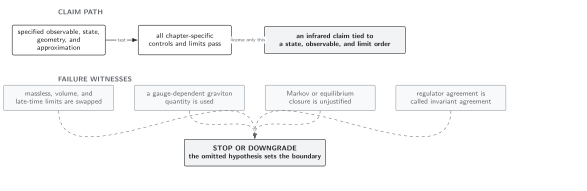
Coordinate secular growth is evidence for a physical graviton effect only after gauge, dressing, finite-region, and boundary tests agree for the same operational quantity. Schematic; not to scale.
References
Section titled “References”- Giddings, S. B., and M. S. Sloth, “Semiclassical Relations and IR Effects in de Sitter and Slow-Roll Space-Times,” Journal of Cosmology and Astroparticle Physics 2011(01), 023 (2011), doi:10.1088/1475-7516/2011/01/023.
- Higuchi, A., D. Marolf, and I. A. Morrison, “de Sitter Invariance of the dS Graviton Vacuum,” Classical and Quantum Gravity 28, 245012 (2011), doi:10.1088/0264-9381/28/24/245012.
Original QFT.org content:CC BY 4.0, unless an item supplies different terms. Third-party material retains its own terms.