

Mass Thresholds, Decoupling, and Curvature Expansions
A heavy field decouples from a low-energy observable through powers of external momentum and curvature divided by its mass, after local threshold corrections have been matched. A mass-independent beta function can keep displaying the heavy species below threshold; that bookkeeping does not by itself contradict physical decoupling.
Required background. Renormalization of Gravitational Couplings by Matter Loops supplies the local residue, Decoupling Theorems and Threshold Corrections supplies the matching logic, and Modes, Virtualities, and EFT Scale Separation supplies the momentum regions.
Helpful background. Heat Kernels and the Schwinger–DeWitt Expansion gives the inverse-mass series, while EFT Truncation Errors and Breakdown Diagnostics supplies error reporting.
Threshold functions versus local running
Section titled “Threshold functions versus local running”At second order in a weak curvature, a massive matter determinant contains terms of the form
where denotes a curvature or bundle field strength. The exact tensor coefficients depend on spin and , but a representative scalar-loop form factor is
For Euclidean , this expression is real. At low momentum,
whereas for ,
The logarithm reproduces ultraviolet running; the power series shows infrared suppression after the constant local matching term has been separated. Covariant perturbation theory constructs the corresponding curvature form factors without expanding their derivatives Barvinsky and Vilkovisky 1985, §§ 5–6.
First application: scalar matching below threshold
Section titled “First application: scalar matching below threshold”Match at a scale . The constant and ultraviolet-local pieces renormalize the coefficients of , , , and lower-dimensional terms. Below threshold, the first new response from the representative kernel is
with fixed by the relevant tensor projection and the moment above. Integration by parts can rewrite this as derivative curvature operators, but the external-momentum suppression remains.
For , the logarithm series is alternating and uniformly bounded because . Truncating after gives the explicit bound
where is the beta function. Curvature perturbation adds independent conditions,
The reported truncation error is the larger of the derivative-series estimate and the omitted curvature-order estimate. This makes “heavy” a quantitative property of the background and observable.
The classic decoupling theorem applies after renormalized low-energy parameters are matched Appelquist and Carazzone 1975, pp. 2856–2861. In curved space, explicit mass-dependent calculations show quadratic infrared decoupling in higher-derivative gravitational form factors, while the cosmological and Newton sectors are not obtained from the same flat-background projection Gorbar and Shapiro 2003, §§ 4–6. It would be too strong to infer a universal low-energy beta function for or from the curvature-squared result.
Drive the curvature through the hierarchy
Section titled “Drive the curvature through the hierarchy”Increase a characteristic curvature scale from to order unity while holding the local truncation fixed. At the first value, successive terms should decrease according to the stated estimate. Near unity, all curvature orders can compete; near timelike invariant momentum , the form factor reaches its two-particle branch point and no Taylor series about can cross it.
The correct downgrade is not “the heavy field fails to decouple everywhere.” It is: the inverse-mass local expansion no longer controls this background or kinematic channel, so retain the full form factor or restore the heavy field as an explicit degree of freedom.
The structure map places threshold matching between local coefficients and nonlocal form factors. Inspect the handoff at .

Local matching retains threshold corrections while derivative effects decouple for ; the full kernel is required near and above threshold. Schematic; not to scale.
Domain and failure conditions
Section titled “Domain and failure conditions”The expansion requires both weak curvature and subthreshold external invariants. Minimal-subtraction beta functions are not physical threshold functions; mass generation by symmetry breaking can also leave nondecoupling effects. See Domain and failure conditions.
The failure map’s hierarchy branch stops the local series when curvature, derivatives, or timelike invariant mass reaches . Changing the subtraction scale cannot restore a lost expansion parameter.
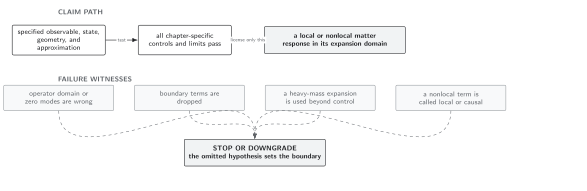
Physical decoupling is an observable and hierarchy statement; it is not read directly from a mass-independent ultraviolet residue. Schematic; not to scale.
Handoffs
Section titled “Handoffs”Matter-Induced Nonlocal Form Factors retains the kernel beyond the local series. General matching remains with Decoupling Theorems and Threshold Corrections.
References
Section titled “References”- Appelquist, Thomas, and James Carazzone. “Infrared Singularities and Massive Fields.” Physical Review D 11 (1975): 2856–2861. DOI.
- Barvinsky, Andrei O., and Grigori A. Vilkovisky. “The Generalized Schwinger–DeWitt Technique in Gauge Theories and Quantum Gravity.” Physics Reports 119 (1985): 1–74. DOI.
- Gorbar, Eduard V., and Ilya L. Shapiro. “Renormalization Group and Decoupling in Curved Space.” Journal of High Energy Physics 2003, 021 (2003). DOI.
Original QFT.org content:CC BY 4.0, unless an item supplies different terms. Third-party material retains its own terms.