

Constraints, Conservation, and the Bianchi Identity
The semiclassical constraints propagate only when the entire renormalized equation is covariantly conserved. The geometric Bianchi identity, matter diffeomorphism Ward identity, nonlocal response contact terms, and boundary fluxes form one compatibility condition. If a regulator leaves a nonconserved source, correcting the geometry after each step hides rather than solves the error.
Required background. The semiclassical Einstein equation defines the residual tensor; conservation and local covariance supplies the renormalized source identity; and stress-tensor Ward identities supplies its symmetry origin.
Helpful background. Interacting stress Ward identities explain contact terms, and variation–response consistency relates the one-point identity to the response kernel.
The compatibility identity
Section titled “The compatibility identity”Define the full equation residual
Each local curvature tensor is the variation of a diffeomorphism-invariant action, so
identically. On the matter equations, invariance of the same renormalized functional gives
Therefore . This is not an additional evolution equation; it is the identity that makes four components of constraints rather than independent accelerations.
Choose a foliation with normal and spatial projector. The Hamiltonian and momentum residuals are
Projecting gives a homogeneous first-order system for once the spatial evolution equations hold. Hence vanishing constraints on one Cauchy surface remain zero in the continuum problem. Boundary fluxes add explicit source terms and must be included rather than silently set to zero.
For an inverse-metric perturbation , write the nonlocal response as
where the separated-point part of is in the site’s plus-source convention. The Ward identity differentiates both the commutator kernel and local contact terms. Transversality of the separated-point commutator alone is insufficient. Christensen’s point-splitting analysis exhibits how covariant subtraction and local geometric terms restore a conserved renormalized stress (Christensen 1976, §§ II–IV).
The structure map’s lower checkpoint points to this chain: causal response and constraint propagation must pass together before stability or self-consistency is interpreted.

Constraint-preserving semiclassical evolution. The diagram is schematic and not to scale; local curvature variations, nonlocal contact terms, initial-state terms, and boundary fluxes all enter the conservation check.
The failure map identifies constraint drift as a physical invalidation, not merely a poor gauge choice. A small spatial evolution residual with growing does not solve the full tensor equation.
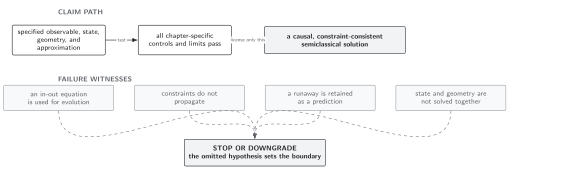
Failure witness for nonconserved sources. This schematic, not-to-scale map requires the divergence residual and gravitational constraints to converge independently before a mean solution is licensed.
Application: homogeneous constraint propagation
Section titled “Application: homogeneous constraint propagation”Suppress higher-curvature notation temporarily and define
The spatial equation may be written
while the matter Ward identity is
Then
Finite curvature tensors add terms to both equations, but their identically vanishing divergence makes the same cancellation hold. A causal memory contribution is admissible when its energy and pressure components obey the corresponding nonlocal continuity identity, including lower-limit terms at .
This gives a practical verification protocol: evaluate the residual, spatial residual, continuity residual, and the differentiated relation among them on the same grid. Do not infer conservation from the fact that the same numerical routine supplied and .
Adversarial test: a nonconserved subtraction remainder
Section titled “Adversarial test: a nonconserved subtraction remainder”Let the computed stress obey
because a cutoff or subtraction was applied differently to energy and pressure. If the spatial equation is still imposed, the constraint evolves as
Even a small systematic accumulates. Resetting after every step so that changes the evolution equation and can disguise the error. The correct response is to restore a covariant regulator or add the missing local counterterm/contact contribution, then show that and converge to zero together.
The strongest surviving result before that repair is a solution of selected projected equations with a quantified constraint violation. It is not a solution of the semiclassical Einstein equation.
Domain and failure conditions
Section titled “Domain and failure conditions”See the chapter domain and failure-conditions table. Constraint propagation assumes the complete renormalized source is conserved, the evolution equations hold, and boundary fluxes are included. An anomaly in the trace is compatible with conservation; a diffeomorphism anomaly or regulator artifact is not unless the theory and inflow terms are enlarged accordingly.
Exercise
Section titled “Exercise”If and , find the late-time constraint drift.
Solution
Integrating gives
and therefore . A transient conservation error leaves a permanent constraint offset.
Handoff
Section titled “Handoff”Large-N, loop, and ℏ hierarchies state which conserved mean and connected terms belong at a given approximation order.
References
Section titled “References”- Christensen, Stephen M. “Vacuum Expectation Value of the Stress Tensor in an Arbitrary Curved Background: The Covariant Point-Separation Method.” Physical Review D 14 (1976): 2490–2501. doi:10.1103/PhysRevD.14.2490.
- Wald, Robert M. General Relativity. Chicago: University of Chicago Press, 1984. Publisher record.
Original QFT.org content:CC BY 4.0, unless an item supplies different terms. Third-party material retains its own terms.