

Local Field Algebras, Causality, and the Time-Slice Property
A local quantum field theory assigns observables to spacetime regions, preserving inclusion, causal independence, and dynamical propagation. The assignment need not factor the Hilbert space into one tensor factor per region. For a free scalar, support properties of test functions make locality explicit, while the field equation implies the time-slice property: observables in any neighborhood of a Cauchy surface generate the algebra of its full causal development.
Required background. Covariant Algebraic Quantization and Fock Realizations supplies the field algebra; Microcausality and Relativistic Compatibility supplies the causality principle.
Helpful background. Operator Algebras and Positive Functionals supplies algebraic structure; Why Continuum Regions Do Not Usually Factorize explains the continuum tensor-product obstruction.
Region-indexed algebras
Section titled “Region-indexed algebras”For each suitable open, causally convex region , let be the algebra generated by fields smeared with test functions supported in . The basic relations are:
- isotony: implies ;
- Einstein causality: causally disjoint and have commuting bosonic algebras;
- equations of motion: ;
- time slice: if contains a Cauchy surface for a globally hyperbolic region , then under the canonical inclusion.
For the scalar field,
If the supports of and are causally disjoint, the support property of gives , proving Einstein causality. This argument uses causal disjointness in the background geometry; coordinate separation is not enough.
The time-slice property follows from hyperbolic propagation. Choose cutoff functions across two Cauchy surfaces inside . For every compactly supported in , one can construct such that
has support in . The equation-of-motion relation then gives . Bär, Ginoux, and Pfäffle give the exact causal sequence underlying this construction Bär, Ginoux, and Pfäffle 2007, Theorem 3.4.7.
What locality does not assert
Section titled “What locality does not assert”Isotony is an inclusion statement, not an assertion that
for every spatial region. In relativistic continuum QFT, sharply localized von Neumann algebras in physically standard representations are typically type III, and the vacuum is entangled across every boundary scale. Additional hypotheses such as a split inclusion can provide an intermediate type-I factor for separated regions, but this is not the same as exact factorization at a common boundary.
Nor does microcausality say that timelike-separated observables commute. The causal propagator is generally nonzero inside the light cone. Finally, a noncausally convex region can allow causal curves to leave and re-enter; assigning it an algebra by naive restriction can lose the propagation information required by the category of backgrounds.
First application: diamonds and a time slice
Section titled “First application: diamonds and a time slice”Let be causally convex diamonds in a globally hyperbolic spacetime. Smearing with supports in the diamonds gives
Let be an arbitrarily thin open neighborhood of a Cauchy surface for . Hyperbolic propagation and the equation of motion give
Thus shrinking in time does not necessarily shrink the algebra if the smaller region still contains complete Cauchy data. Shrinking spatially does.
Two adversarial modifications expose the boundaries. If is replaced by a region that is not causally convex, a causal curve can sample data outside the declared region before returning, so the simple inclusion no longer represents a closed local problem. If one additionally assumes a hidden tensor product for and its causal complement, ultraviolet entanglement and type-III structure invalidate entropy manipulations based on a trace-class reduced density matrix.
Construction and failure maps
Section titled “Construction and failure maps”The first map should be read from the local-algebra box outward: the algebra is reached only after causal propagation and reduction, and a state evaluates it only afterward.

Region algebras inherit causal support and the equation of motion before any state is evaluated; the construction map is schematic and not to scale.
In the failure map, inspect global hyperbolicity and changed observable assignment. Those are the two checks that distinguish a valid time-slice inclusion from an unsupported restriction to a region.
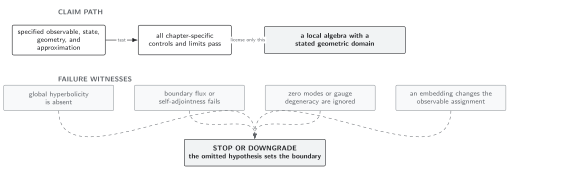
Time-slice and causality claims are licensed only for the stated causally convex, globally hyperbolic domain; exact tensor factorization is not among their conclusions. Schematic and not to scale.
The comparative table in Domain and failure conditions gives the chapter-wide scope. On this page the decisive checks are causal convexity, vanishing spacelike commutators, and whether a region contains a Cauchy surface; failure downgrades the claimed inclusion or time-slice isomorphism rather than merely changing a state.
Check your understanding
Section titled “Check your understanding”Why can a thin neighborhood of a Cauchy surface have the same algebra as a much larger domain ?
Solution
Every compactly supported source in is equivalent modulo the equation of motion to one supported in . The field relation identifies their generators. This uses well-posed hyperbolic propagation and fails if does not contain complete Cauchy data for the domain.
Local Covariance, Isometries, and Background Embeddings promotes the regional assignment to a comparison among spacetimes. Type classification, split inclusions, and theorem-level nets remain in Volume XVI.
References
Section titled “References”- Christian Bär, Nicolas Ginoux, and Frank Pfäffle, Wave Equations on Lorentzian Manifolds and Quantization, European Mathematical Society (2007), DOI, Open PDF, §§3.4 and 4.3.
- Romeo Brunetti, Klaus Fredenhagen, and Rainer Verch, “The Generally Covariant Locality Principle—A New Paradigm for Local Quantum Field Theory,” Communications in Mathematical Physics 237 (2003), 31–68, DOI, arXiv:math-ph/0112041.
- Christopher J. Fewster and Kasia Rejzner, “Algebraic Quantum Field Theory—An Introduction,” in Progress and Visions in Quantum Theory in View of Gravity, Birkhäuser (2020), 1–61, DOI, arXiv:1904.04051.
Original QFT.org content:CC BY 4.0, unless an item supplies different terms. Third-party material retains its own terms.