

Anomaly-Induced and Nonlocal Actions
The trace anomaly fixes the Weyl variation of an effective action, not the entire action. Integrating that variation produces a particular nonlocal or Wess–Zumino functional; boundary conditions, zero modes, local scheme terms, and arbitrary Weyl-invariant functionals remain to be supplied before a stress tensor is determined.
Required background. Trace Anomalies and Convention Translation fixes the anomaly coefficients, Matter-Induced Nonlocal Form Factors supplies nonlocal kernels, and The 1PI Effective Action and Mean-Field Equations supplies metric variation.
Helpful background. Wess–Zumino Consistency and Descent explains integrability, while Conservation, Local Covariance, and the Backreaction Source supplies stress-tensor Ward identities.
Weyl variation and the Paneitz operator
Section titled “Weyl variation and the Paneitz operator”Write the four-dimensional anomaly in a declared Euclidean convention as
The sign relating this Euclidean equation to the site’s Lorentzian stress definition must be performed with the full metric continuation. The coefficients and multiply nontrivial anomaly classes. The coefficient is shifted by a finite local counterterm.
It is useful to combine
with the fourth-order conformal operator
For ,
These identities integrate the nontrivial part of the anomaly.
First application: a conformally related background
Section titled “First application: a conformally related background”Integrating along yields the Wess–Zumino difference
where is a chosen local representative for the scheme-dependent total derivative. Differentiating with respect to returns the anomaly, providing a direct check of every factor.
A covariant nonlocal representative for the nontrivial part is
Its Weyl variation is . This is the Riegert construction Riegert 1984, pp. 56–60. The inverse requires a domain, treatment of its kernel, and boundary or Green-function data. A Lorentzian in–out inverse is not automatically retarded.
On a compact manifold, define the inverse only after projecting out every zero mode or imposing a normalization condition; otherwise is undefined. On a conformally flat background , the anomaly still fixes only the conformal-factor dependence relative to : it does not determine . These two checks separate a genuine anomaly coefficient from information hidden in the reference functional or Green function. For backreaction, the in–in kernel must also make the metric response real, conserved, and retarded.
Homogeneous ambiguity test
Section titled “Homogeneous ambiguity test”Let be any Weyl-invariant functional, local or nonlocal:
Then
has the same trace anomaly. Nevertheless,
is generally a nonzero conserved traceless stress contribution, and its second variation changes response. Different homogeneous solutions of similarly encode boundary or state information. Mazur and Mottola formulate this cohomological nonuniqueness explicitly Mazur and Mottola 2001, §§ II–IV.
Therefore the anomaly licenses the trace and a particular integrated representative. It does not select a quantum state, determine all traceless stress components, or prove a cosmological backreaction solution.
The structure map shows anomaly integration branching from, but not exhausting, the nonlocal effective action. Inspect the explicit homogeneous-functional branch.

Anomaly coefficients fix a Weyl variation; local scheme terms, kernel boundary data, and traceless Weyl-invariant response require additional input. Schematic; not to scale.
Domain and failure conditions
Section titled “Domain and failure conditions”The displayed formula assumes a smooth four-dimensional geometry and a defined inverse of . Boundaries add anomaly and Wess–Zumino terms; zero modes obstruct a naive inverse; causal use requires an in–in Green function. See Domain and failure conditions.
The failure map stops the inference from a correct trace to a unique stress tensor. Adding is the decisive counterexample: the trace is unchanged while response changes.
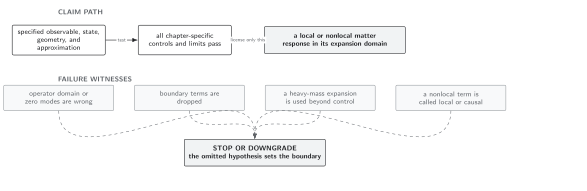
Anomaly integration is nonunique up to local scheme terms and Weyl-invariant functionals; choosing a particular representative does not remove that freedom. Schematic; not to scale.
Handoffs
Section titled “Handoffs”Anomaly coefficients and sign translation remain with Trace Anomalies and Convention Translation. Metric variation continues in Effective-Action Variation, Stress Tensors, and Consistency Checks.
References
Section titled “References”Original QFT.org content:CC BY 4.0, unless an item supplies different terms. Third-party material retains its own terms.