

Effective Field Theory of Inflation and the Goldstone Mode
The effective field theory of inflation organizes fluctuations by the symmetry-breaking pattern of a preferred clock rather than by a chosen microscopic potential. Its Wilson coefficients determine the sound speed, dispersion, interactions, mixing with gravity, and strong-coupling scale; none may be varied independently of the hierarchy that keeps freeze-out below the cutoff.
Required background. Background symmetry breaking and decoupling supplies unitary gauge and ; constraint solving and the observable dictionary supplies the reduction; effective field theory as a controlled expansion supplies truncation logic; and cosets and nonlinear realizations supplies the symmetry construction.
Helpful background. Gravitational EFT power counting supplies curvature-scale checks, while local field redefinitions clarifies redundant operators.
Unitary-gauge operators and the Goldstone action
Section titled “Unitary-gauge operators and the Goldstone action”At the first few orders, the unitary-gauge action contains
The first line is fixed by the background. The second line illustrates two independent fluctuation operators: changes the scalar time kinetic term, while changes mixing and derivative interactions. Restoring and taking the decoupling limit gives
with
Because , positive gives . Positivity requires . At linear order . Cheung and collaborators derive this operator basis and restoration in Cheung et al. 2008, §§2–4, Eqs. (5)–(38).
Power counting and the strong-coupling test
Section titled “Power counting and the strong-coupling test”The same coefficient that lowers enhances interactions such as
After canonical normalization, their amplitudes grow with energy. The strong-coupling scale is defined by the failure of the dimensionless interaction expansion, not by a coefficient in the unnormalized Lagrangian. A prediction requires
together with if the Goldstone-only action is used. Order-one factors and the detailed expression for depend on which operators dominate and on whether new dispersion enters before strong coupling.
For the first application, retain and . Derive the quadratic kinetic and gradient matrices before removing redundant terms. The first fixes as above; the second changes the constraint solution and can generate scale-dependent dispersion after mixing is integrated out. Computing both in unitary gauge and in the restored theory checks the symmetry realization.
Power counting must include radiative stability. A large coefficient can generate symmetry-allowed operators under loops, so a truncation that retains one enhanced cubic vertex while setting its radiative companions to zero requires an additional symmetry or tuning. Technical naturalness is tested by estimating loop-induced coefficients at the matching scale and evolving them to freeze-out. It is distinct from observational smallness: an operator may be tightly constrained yet radiatively natural, or phenomenologically useful yet require repeated tuning.
Time dependence adds another expansion. Restoring generates interactions involving , , and so on. Their suppression follows from a slow-variation hierarchy only if the coefficients evolve slowly compared with the mode frequency. A sharp feature requires retaining this tower or matching across a resolved profile.
The structure map locates Wilson-coefficient power counting between symmetry breaking and correlator evaluation.

The EFT maps symmetry-allowed unitary-gauge coefficients to Goldstone propagation and interactions; mixing, freeze-out, strong coupling, and the UV cutoff must form a controlled hierarchy. Schematic; not to scale.
Adversarial coefficient deformation
Section titled “Adversarial coefficient deformation”Increase one interaction coefficient while keeping the background fixed. Recompute the canonical normalization, scattering or wavefunction expansion parameter at , and the leading neglected operator. If the inferred approaches freeze-out, a large bispectrum estimate from the same operator is not a controlled prediction. A symmetry-related tower may have to be resummed, or new degrees of freedom must enter.
Field redefinitions can move strength among redundant operators but cannot repair a missing hierarchy or remove a physical nonanalytic correlator. See the chapter’s domain and failure conditions. The validity map marks ghosts, gradient instability, strong coupling, and premature decoupling separately.
Finally, a subluminal is neither by itself a proof of a conventional Lorentz-invariant UV completion nor a pathology. The sign and magnitude must be evaluated together with positivity, causality, background dependence, and the actual cutoff of the inflationary medium.
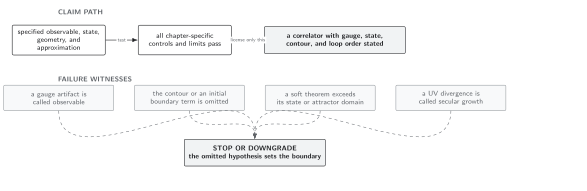
Large EFT coefficients are predictive only while the mode is stable and the mixing, freeze-out, strong-coupling, and UV scales remain parametrically ordered. Schematic; not to scale.
References
Section titled “References”- Cheung, C., P. Creminelli, A. L. Fitzpatrick, J. Kaplan, and L. Senatore, “The Effective Field Theory of Inflation,” Journal of High Energy Physics 03, 014 (2008), doi:10.1088/1126-6708/2008/03/014.
Original QFT.org content:CC BY 4.0, unless an item supplies different terms. Third-party material retains its own terms.