

Negative Modes, Determinants, and Decay Prefactors
A Euclidean action difference becomes decay evidence only after fluctuations are reduced to physical variables and a contour supplies the required imaginary contribution. In gravity, the conformal-factor instability, diffeomorphism constraints, collective coordinates, and renormalized determinant are inseparable parts of that statement. Counting negative entries of an unreduced Hessian is not a gauge-invariant test.
Required background. Euclidean gravitational saddles fixes the differentiable action and contour problem. Coleman–De Luccia bounces supplies the saddle, while flat-space decay rates and prefactors supplies the one-negative-mode logic before constraints are added.
Helpful background. Gauge and scale dependence of decay rates explains why a truncated effective potential is not itself an observable, and proper-time and zeta determinants supplies determinant regularization.
From the Hessian to a decay contour
Section titled “From the Hessian to a decay contour”Expand the Euclidean fields about a stationary saddle :
For an ordinary positive quadratic form, Gaussian integration produces . A single physical direction with eigenvalue instead requires deformation onto a steepest-descent contour. With the false-vacuum boundary prescription, this deformation yields the imaginary contribution whose sign and factor of one half enter the decay rate. Coleman makes explicit why the relevant saddle needs one tunneling negative direction rather than an arbitrary number (Coleman 1988, §§ 2–3).
Gravity adds an immediate qualification: the Euclidean Einstein action is unbounded along a naive real conformal rescaling. The infinitely many “negative conformal modes” of the unreduced real-metric integral are not the one physical tunneling mode. One must state a conformal contour, fix diffeomorphisms, include the Faddeev–Popov or equivalent Jacobian, solve the lapse and shift constraints, and only then analyze the physical scalar and tensor sectors.
A gauge-reduced spectral problem
Section titled “A gauge-reduced spectral problem”For an -symmetric scalar–gravity saddle, harmonic decomposition on separates scalar, vector, and tensor sectors. In the scalar sector, lapse and scalar shift perturbations are nondynamical. Eliminating them gives a reduced quadratic form schematically of Sturm–Liouville type,
with a physical inner product
When the reduction is regular and , the eigenvalue problem
has the usual nodal interpretation. If the chosen variable makes or vanish, a divergent effective potential or an apparent tower of negative modes may be a singular-coordinate warning rather than a physical spectrum. The cure is not to discard inconvenient eigenvalues; it is to compare a second regular reduction or a constrained Hamiltonian formulation. Gratton and Turok exhibit how constraint reduction changes the gravitational negative-mode problem (Gratton and Turok 2001, §§ II–IV), while Lee and Weinberg analyze the remaining subtleties for CDL bounces (Lee and Weinberg 2014, §§ II–V).
The practical classification is:
- gauge directions: removed with their Jacobian, not counted;
- constraint directions: solved or integrated with the declared contour, not treated as independent oscillators;
- collective zero modes: converted into moduli integrals with their normalization;
- the tunneling negative mode: a physical reduced direction associated with escape from the saddle;
- additional physical negative modes: evidence that the saddle is not the elementary decay saddle, unless a more complete contour analysis demonstrates otherwise.
For a flat-space localized bounce, four translations give familiar collective coordinates and the prefactor per four-volume takes the schematic form
The prime removes collective zero modes and the determinant includes counterterms in the same renormalization prescription as . This formula is a normalization check, not a template to paste onto a compact gravitational saddle: compactness, isometries, boundary ensemble, and the absence of a global four-volume change the collective-coordinate factor.
Gauge and field-redefinition adversarial test
Section titled “Gauge and field-redefinition adversarial test”Compute the physical scalar spectrum twice:
- fix a regular gauge and solve the linearized constraints before diagonalization;
- use a distinct gauge-invariant canonical variable, including its functional Jacobian.
Map the boundary conditions and inner products between the two descriptions. The number of physical negative modes, the normalized zero-mode measure, and the renormalized determinant ratio must agree. Repeat after a nonsingular field redefinition ; the Hessian and measure change separately, while the complete prefactor does not.
If the counts disagree, the result remains an unresolved contour or reduction problem. Reporting whichever gauge produces one negative eigenvalue is not evidence. Likewise, an imaginary part generated solely by choosing a contour for the universal conformal factor does not identify false-vacuum decay.
Domain, renormalization, and handoff
Section titled “Domain, renormalization, and handoff”The determinant has ultraviolet divergences. Heat-kernel or zeta methods isolate local counterterms, but the finite answer also depends on the renormalized couplings and boundary terms. A scale variation of must cancel the running of the action through the working loop order. Failure of that cancellation is a truncation or bookkeeping error, not a physical scale dependence of the exact rate.
The structure map shows where the prefactor sits. Inspect the narrow link between a stationary saddle and a state-dependent decay observable: the gauge-reduced spectrum and contour occupy that link.

The fluctuation calculation between a gravitational saddle and a decay claim. The diagram is schematic and not to scale; every determinant is defined together with its measure, boundary data, gauge reduction, contour, and counterterms.
The failure map emphasizes that several superficially similar signs of instability have different meanings. Inspect the separate stops for an unreduced conformal mode, an extra physical negative mode, and a gauge-dependent count.
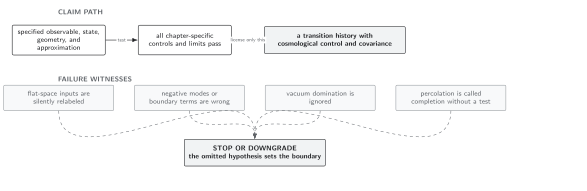
Failure conditions for negative modes and prefactors. The diagram is schematic and not to scale; “one negative mode” refers only to the regular gauge-reduced physical problem on the justified integration contour.
These restrictions specialize the chapter’s domain and failure conditions. If the Euclidean contour remains unresolved, real-time vacuum decay provides an independent initial-value formulation, but it does not retroactively validate an ambiguous determinant.
Exercise
Section titled “Exercise”Consider a quadratic form
with the linear constraint . Show why the signs of and separately do not count physical negative modes.
Solution
On the constraint surface,
There is one physical negative direction precisely when
A nonsingular change of coordinates in the two-dimensional unreduced space can change the diagonal entries and , while the restricted quadratic form and its inertia are unchanged. The gravitational calculation is functional and gauge constrained, but the same principle forbids counting unreduced diagonal signs.
References
Section titled “References”- Coleman, S. “Quantum Tunneling and Negative Eigenvalues.” Nuclear Physics B 298 (1988): 178–186. DOI.
- Gratton, S., and N. Turok. “Homogeneous Modes of Cosmological Instantons.” Physical Review D 63 (2001): 123514. DOI. Open PDF.
- Lee, H., and E. J. Weinberg. “Negative Modes of Coleman–De Luccia Bounces.” Physical Review D 90 (2014): 124002. DOI. Open PDF.
Original QFT.org content:CC BY 4.0, unless an item supplies different terms. Third-party material retains its own terms.