

Curvature Operator Bases and Field Redefinitions
A curvature basis is a basis of low-energy observables only after integrations by parts, dimension-dependent identities, leading equations of motion, boundary conditions, and local field redefinitions have been specified. A redefinition removes an equation-of-motion-redundant operator from one action basis; it does not erase its contribution to all amplitudes or background observables, because other coefficients and source couplings move with it.
Required background. Applying EFT Power Counting to Gravity fixes the retained derivative order; Local Field Redefinitions and the Equivalence Theorem fixes observable equivalence; and Levi–Civita Connections, Geodesics, and Riemann Curvature fixes curvature identities.
Helpful background. Integration by Parts and Equation-of-Motion Redundancy supplies the reduction algorithm, while Basis Translation, Scheme Dependence, and Reproducibility supplies coefficient maps.
Four-derivative gravity in four dimensions
Section titled “Four-derivative gravity in four dimensions”At curvature-squared order, take
The four-dimensional Euler density is
Therefore
On a compact oriented four-manifold without boundary, is topological and has no local bulk variation. With a boundary it requires the corresponding Chern–Gauss–Bonnet boundary term; discarding the bulk density alone changes the variational problem Myers 1987, §§II–III. In , the same quadratic combination is not topological in this sense.
The structure map places basis reduction before gauge fixing and loop matching. Inspect the handoff: coefficients are not physical until the observable map is carried through.

An independent bulk basis depends on dimension and boundary data; matching and observable translation follow only after every induced operator has been retained. The map is schematic and not to scale.
First application: move the Ricci operators
Section titled “First application: move the Ricci operators”Use the site Einstein–Hilbert action with for clarity and redefine the covariant metric locally:
where are treated perturbatively at four-derivative order. Since ,
up to a boundary term and six-derivative corrections. Thus the two Ricci coefficients can be moved into other operators in pure vacuum gravity at this order. In the reduced basis above, setting
cancels their displayed bulk coefficients to first order.
This is not deletion. The matter action changes by
so curvature–matter operators appear. With , lower-derivative gravitational coefficients also shift. External sources, composite operators, Jacobians beyond the working order, and boundary terms must be transformed. The equivalence theorem guarantees equality of on-shell observables under an invertible local perturbative redefinition when all these changes are included Kamefuchi, O’Raifeartaigh, and Salam 1961, pp. 529–535.
For pure Einstein gravity with and no boundary, the leading vacuum equations give . The Ricci-squared operators are then EOM redundant for on-shell graviton amplitudes at this order, and is topological. That special statement must not be exported to off-shell effective actions, matter-coupled observables, nonzero cosmological constant, or manifolds with boundary.
Boundary and dimension tests
Section titled “Boundary and dimension tests”Repeat the calculation on a region with boundary. Integrations by parts produce normal derivatives of , and the Euler term contributes through its boundary completion. A basis that retains only bulk coefficients is incomplete for boundary charges or wavefunctionals.
Repeat it in . becomes a dynamical Lovelock density rather than a topological number, so eliminating by the four-dimensional identity gives wrong equations and amplitudes. Finally, a field redefinition that becomes singular on a background or moves a pole into the low-energy domain is not an admissible perturbative basis change there.
Domain and failure conditions
Section titled “Domain and failure conditions”The chapter comparison table licenses a reduced basis only with dimension, topology, boundary action, leading equations, matter content, and observable stated. Wilson coefficients still require matching. Redundancy is order dependent: using corrected equations of motion inside operators at the same order can inadvertently discard physical terms.
The failure map’s redundant-operator branch includes the opposite error as well—discarding a term where the reduction hypotheses fail.
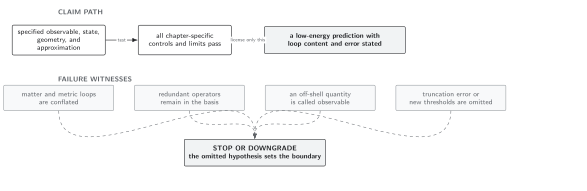
Field redefinitions preserve matched observables only when induced operators, sources, surface terms, and the perturbative inverse are retained. The map is schematic and not to scale.
References
Section titled “References”- Kamefuchi, S., L. O’Raifeartaigh, and A. Salam. “Change of Variables and Equivalence Theorems in Quantum Field Theories.” Nuclear Physics 28, 529–549 (1961). doi:10.1016/0029-5582(61)90056-6
- Myers, R. C. “Higher-Derivative Gravity, Surface Terms, and String Theory.” Physical Review D 36, 392–396 (1987). doi:10.1103/PhysRevD.36.392
Original QFT.org content:CC BY 4.0, unless an item supplies different terms. Third-party material retains its own terms.