

Validity, Breakdown, and Quantum-Gravity Handoffs
The boundary of curved-spacetime QFT is not a single energy marked “Planckian.” Validity depends on what is being predicted, at what resolution and duration, in which state, with which curvature and coupling hierarchy, and to what tolerance. This final chapter supplies a disciplined way to stop, downgrade, or transfer a claim while preserving every low-energy result that remains controlled.
Helpful background. Fixed-background, semiclassical, gravitational-EFT, and quantum-gravity regimes supplies the regime distinctions; gravitational-EFT validity and breakdown supplies cutoff logic; stochastic-gravity validity limits supplies fluctuation diagnostics; and quasi-de Sitter validity supplies finite-duration and evidence boundaries.
A validity verdict is attached to an observable
Section titled “A validity verdict is attached to an observable”For a specified observable , collect the calculation into an error contract
Here is the state, represents smearing or detector resolution, is the causal domain and duration, the are dimensionless expansion or fluctuation measures, and is the required accuracy. The prediction is controlled only if omitted terms are bounded below and the mathematical construction exists on .
Different observables on the same geometry can receive different verdicts. A renormalized mean stress may be reliable while its unsmeared pointwise variance is undefined; a detector response may remain finite while a global particle number is ambiguous; a low-frequency Hawking flux may be robust while the endpoint geometry is outside the derivative expansion. Stochastic gravity makes this distinction concrete by treating the noise kernel as a distribution whose operational consequences require smearing and a response problem Hu and Verdaguer 2020, §§3–5, Eqs. (3.1)–(5.28).
Likewise, gravitational EFT remains predictive below its cutoff even though it is not a microscopic completion. Nonanalytic long-distance quantum corrections can be universal while analytic local terms remain Wilson coefficients to be matched Donoghue 1994, §§II–IV, Eqs. (2.1)–(4.13).
The structure map separates three outcomes: continue within the approximation, downgrade to a narrower observable or shorter domain, or transfer a precisely posed remainder.

Validity belongs to an observable-specific error contract. A failed control parameter narrows or transfers only the affected claim while preserving independent low-energy results. Schematic; not to scale.
Routes through the chapter
Section titled “Routes through the chapter”- Observable-specific validity contracts assigns separate scales and tolerances to each predicted quantity.
- Semiclassical breakdown diagnostics combines mean equations, linear response, noise, state, and EFT tests.
- Cross-expansion hierarchies determines whether curvature, derivatives, loops, occupation, or duration fails first.
- Large-N, species, and cutoff hierarchies distinguishes fixed bare from fixed renormalized limits.
- Trans-Planckian sensitivity compares robustness claims across horizons and cosmology.
- Cauchy and chronology horizons identifies failures of global construction and state propagation.
- Singularities and initial conditions separates observable breakdown from universal endpoint claims.
- Evaporation endpoints and information marks controlled semiclassical intervals and unresolved completion questions.
- Low-energy constraints on UV completion states qualified causality, analyticity, and positivity bounds.
- Analogue and phenomenological evidence follows measurements only as far as their model map licenses.
- The quantum-gravity handoff packages an unresolved observable without selecting a favored framework.
Domain and failure conditions
Section titled “Domain and failure conditions”This is the canonical comparison table for the chapter. Mutable evidence claims are bounded by information available through 10 August 2026.
| Problem | Observable and domain | Control data | Strongest licensed output | Failure or destination |
|---|---|---|---|---|
| Validity contract | Declared smeared or relational object | State, resolution, duration, tolerance | Object-specific error bound | Narrow the object or improve the calculation |
| Semiclassical background | Mean geometry plus selected probes | Equation residual, response spectrum, noise kernel | Stable mean-field prediction with fluctuation estimate | Stochastic treatment, higher EFT order, or transfer |
| Cross-expansion ordering | One finite-duration process | Curvature, energy, coupling, loop, occupation, secular parameters | First omitted-order estimate | Resum, include operators, or shorten the domain |
| Large-N and species | Renormalized gravitational theory with fields | Limit held fixed, thresholds, running couplings | Parametric mean and fluctuation hierarchy | Match thresholds or lower the gravitational cutoff |
| Trans-Planckian robustness | Hawking flux or inflationary correlator | State, dispersion, preferred frame, adiabaticity | Conditional low-energy insensitivity | Unknown UV initial or propagation data |
| Cauchy or chronology horizon | Algebra, state, and smeared observable in a stated region | Extension, wavefront set, stress response | Region-limited theorem or divergence statement | Non-globally-hyperbolic boundary data or rigorous treatment |
| Singular limit | Detector, stress, or correlator approaching a boundary | Curvature, state, smearing, extension | Prediction up to a stated stopping surface | Initial-condition or quantum-gravity remainder |
| Evaporation endpoint | Flux, geometry, entropy, or information proxy | Adiabaticity, curvature, fluctuations, entropy prescription | Controlled interval of evaporation | Endpoint and microscopic unitarity question |
| UV consistency bound | On-shell low-energy amplitude or invariant coefficient | Analyticity, causality, subtractions, massless exchanges | Qualified Wilson-coefficient constraint | UV model comparison after IR completion |
| Analogue or astrophysical evidence | Directly measured spectrum or propagation observable | Calibration, nuisance model, map fidelity | Kinematic or EFT parameter statement | Gravitational dynamics or microscopic completion remains open |
| Final transfer | Exact unresolved observable and surviving constraints | Failed approximation, error budget, alternatives, evidence grade | Framework-neutral problem statement | Quantum-gravity or rigorous destination |
The validity map emphasizes that high curvature is only one path to failure. Long duration, large occupation, state singularity, global causal failure, uncontrolled fluctuations, or an inference step beyond measured data can intervene first.
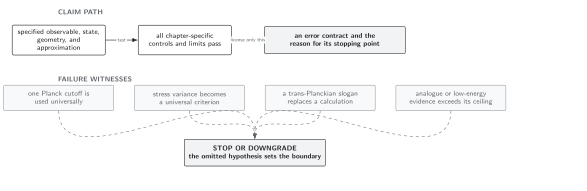
There is no universal breakdown number: each failure channel is compared with the resolution and tolerance of one observable, and the surviving claims remain valid within their own domains. Schematic; not to scale.
References
Section titled “References”- Donoghue, J. F., “General Relativity as an Effective Field Theory: The Leading Quantum Corrections,” Physical Review D 50, 3874–3888 (1994), doi:10.1103/PhysRevD.50.3874.
- Hu, B. L., and E. Verdaguer, “Stochastic Gravity: Theory and Applications,” Living Reviews in Relativity 23, 3 (2020), doi:10.1007/s41114-020-00026-7.
Original QFT.org content:CC BY 4.0, unless an item supplies different terms. Third-party material retains its own terms.