

Conical Entropy and Effective-Action Variations
Conical entropy is the response of a renormalized effective action to an angular defect. It is useful because ultraviolet divergences become local bulk and surface heat-kernel coefficients, but the calculation is defined only after fixing the cone smoothing, operator domain, boundary conditions, zero modes, gauge contact terms, and order of limits.
Required background. Replica constructions fixes the derivative; heat kernels with boundaries and cones supplies the local expansion; and effective-action variation fixes which functional is varied. Helpful background. Review species, edges, and contact terms and entropy counterterms.
Heat kernels on a regulated cone
Section titled “Heat kernels on a regulated cone”Let be smooth for nonzero core radius and approach a cone around as . For a Euclidean Laplace-type matter operator with declared domain,
where the prime and encode the chosen zero-mode treatment. Near ,
The proper-time determinant and local coefficient expansion, including boundary and zero-mode qualifications, are developed in Vassilevich 2003, §2, pp. 287–302.
has a short-time expansion in local invariants on . It produces area, intrinsic-curvature, ambient-curvature, extrinsic-curvature, and—depending on spin and coupling—contact terms. The entropy is
A flat-cone check fixes normalization: terms exactly proportional to disappear under , while the coefficient linear in the deficit survives. A second check compares differentiation before and after the proper-time integral at finite and ; disagreement signals a nonuniform limit or an unaccounted zero mode. Determinant phases are irrelevant for a positive Euclidean scalar operator but must be declared for nonpositive or complex operators.
The Lorentzian site operator is not inserted directly into this Euclidean determinant. One first performs the declared Wick and curvature-sign translation to the Euclidean Laplace-type ; in four dimensions the site conformal value remains recorded as .
First application: one-loop scalar entropy
Section titled “First application: one-loop scalar entropy”For a scalar and a smooth stationary cut, compute at fixed smoothing radius, integrate only after identifying the surface coefficients, and renormalize them with the same gravitational action used off the cone. The result has the form
The area term renormalizes ; curvature terms renormalize higher-derivative entropy couplings. For a nonminimally coupled scalar, the defect curvature can generate a localized term not captured by counting independent oscillator pairs. For Maxwell theory, gauge fixing, ghosts, and electric-flux edge sectors must be treated together. Fursaev and Solodukhin derive the distributional curvature terms and their use in one-loop divergences Fursaev and Solodukhin 1995, §§2–4, pp. 2135–2143.
The result is an in-out/Euclidean effective-action entropy. It does not by itself provide a causal real-time backreaction law. A time-dependent response requires an in-in construction with retarded kernels; the equality of local ultraviolet counterterms does not identify their nonlocal finite parts.
The structure map asks the reader to follow the effective action through bulk, defect, and edge contributions before summing them.

Conical differentiation localizes part of the effective action on the replica defect; operator-domain and edge data determine which surface terms occur. Schematic; not to scale.
Domain and failure conditions
Section titled “Domain and failure conditions”Use the chapter’s canonical domain table to distinguish a one-loop matter calculation from a gravitational replica saddle. Here the controlled hierarchy is during coefficient extraction, followed by renormalization and then removal of the auxiliary smoothing.
Adversarial test. Take before the short-time expansion in one calculation and remove the UV cutoff first in another. Localized curvature can mix with divergent heat-kernel coefficients, and the two limits need not commute. Agreement must be demonstrated by a common smoothing prescription or by matching the full renormalized bulk-plus-surface action; a bare contact term alone is not invariant.
The failure map isolates noncommuting limits from analytic-continuation and gauge-algebra failures.
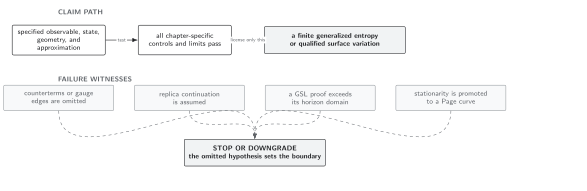
Cone entropy is controlled by an explicit limiting procedure; disagreement between bare surface terms is not physical until counterterms and edge sectors are matched. Schematic; not to scale.
References
Section titled “References”- Fursaev, D. V., and S. N. Solodukhin, “On the Description of the Riemannian Geometry in the Presence of Conical Defects,” Physical Review D 52, 2133–2143 (1995), doi:10.1103/PhysRevD.52.2133.
- Vassilevich, D. V., “Heat Kernel Expansion: User’s Manual,” Physics Reports 388, 279–360 (2003), doi:10.1016/j.physrep.2003.09.002.
Original QFT.org content:CC BY 4.0, unless an item supplies different terms. Third-party material retains its own terms.