

Bubble Sources and Cosmological Gravitational-Wave Propagation
A gravitational-wave forecast has two independent calculations: generation from a transverse-traceless unequal-time stress correlator, and propagation through the later cosmological background. Bubble counts or latent heat do not determine the source correlator, while redshifting a fitted source spectrum does not validate the fit. The final precision cannot exceed the weaker of the source model and the cosmological transfer.
Required background. Expansion history, percolation, and completion supplies an accepted transition history. Bubble growth and wall friction supplies wall and fluid inputs, and thermal percolation and reheating supplies the source-era background.
Helpful background. Mode matching across cosmological eras supplies later transfer, while the baryon-yield handoff illustrates the independent use of the same transition history.
Tensor response to an unequal-time source
Section titled “Tensor response to an unequal-time source”Use conformal time and
Each Fourier mode obeys
For a stochastic source, the essential input is the unequal-time correlator (UETC),
The retarded solution is
Consequently, the gravitational-wave spectrum contains a double time integral of . An equal-time stress spectrum alone cannot determine it. Coherent, delta-correlated, and finite-coherence sources with the same equal-time power generally produce different amplitudes and shapes. Caprini and Durrer formulate this UETC dependence for stochastic relativistic sources (Caprini and Durrer 2006, Eqs. (8)–(18)).
For subhorizon freely propagating modes, a useful averaged energy density is
The averaging scale must be shorter than the background-evolution scale and longer than the wave period. Near the horizon, evolve the tensor equation instead of assigning a local wave energy density prematurely.
Acoustic-source application
Section titled “Acoustic-source application”Suppose a completed radiation-era transition supplies a fluid UETC, its covariance, a source start time, and a duration . Compute the retarded double integral on the actual , then verify:
- the TT projector and polarization normalization;
- causal infrared behavior of the supplied correlator;
- convergence in temporal and spatial resolution;
- the stress-energy budget relative to the available kinetic energy;
- stability under the supplied source-lifetime model.
Expansion matters when is not small. Roper Pol, Procacci, and Caprini include expansion in a sound-shell calculation and find duration-dependent spectral behavior rather than a universal linear rescaling (Roper Pol, Procacci, and Caprini 2024, abstract and §§ 3–5). This is a controlled semi-analytic model for acoustic sources, not a theorem that all transitions share its spectral template.
The lifetime is itself model dependent. Ellis, Lewicki, and No show in a broad model survey that acoustic activity can last only a fraction of a Hubble time in many transitions, while some strongly supercooled models allow longer activity (Ellis, Lewicki, and No 2020, revised 2026, §§ 3–5). As of the August 2026 evidence cutoff, this supports carrying lifetime uncertainty; it does not license choosing the longest lifetime to maximize a signal.
Propagation to the present
Section titled “Propagation to the present”After the source switches off and anisotropic stress becomes negligible, evolve the homogeneous tensor equation across every change in equation of state and relativistic degrees of freedom. Wavenumber is comoving, so
If production ends in radiation domination and subsequent expansion is adiabatic, then
up to the separately computed tensor transfer from free-streaming species and later horizon evolution. This formula follows from and .
If reheating continues after sourcing, entropy is injected, or an early matter- or kination-dominated era intervenes, the compact formula is invalid. For a freely propagating subhorizon mode during a constant- era,
Thus matter domination suppresses the fraction as , radiation leaves it constant apart from changing degrees of freedom, and kination enhances it as . The full background and neutrino or dark-radiation anisotropic stress should be integrated as a transfer function.
Coherence and transfer adversarial test
Section titled “Coherence and transfer adversarial test”Hold the equal-time source power fixed and construct three admissible temporal models:
Normalize them to the same integrated stress budget, propagate each through the same cosmology, and compare the spectra. Then hold one source model fixed while varying the allowed reheating and histories. The envelope of both tests is the minimum credible forecast uncertainty. A narrow instrumental-looking band smaller than that envelope is rejected.
The structure map makes the source–transfer split explicit. Inspect the handoff from a UETC and source lifetime to a primordial spectrum, followed by a separate cosmological Green function.

Gravitational-wave generation and propagation as two calculations. The diagram is schematic and not to scale; source coherence and lifetime are distinct from the later cosmological transfer function.
The failure map blocks precision that is not supported by both halves. Inspect the stops for an equal-time-only source, assumed Hubble lifetime, incomplete transition, and unmodeled entropy or equation-of-state era.
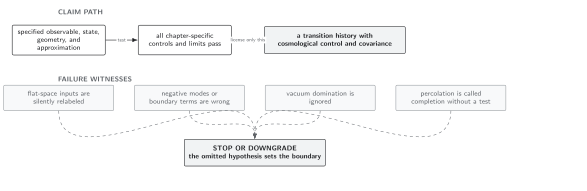
Failure conditions for a transition-generated gravitational-wave spectrum. The diagram is schematic and not to scale; forecast precision is bounded by both source-model and propagation uncertainties.
These limits refine the chapter’s domain and failure conditions.
Exercise
Section titled “Exercise”Derive the adiabatic radiation-era redshift factor multiplying .
Solution
Free subhorizon waves obey . With and entropy conservation,
Divide by and use with . The result is
References
Section titled “References”- Caprini, C., and R. Durrer. “Gravitational Waves from Stochastic Relativistic Sources: Primordial Turbulence and Magnetic Fields.” Physical Review D 74 (2006): 063521. DOI. Open PDF.
- Ellis, J., M. Lewicki, and J. M. No. “Gravitational Waves from First-Order Cosmological Phase Transitions: Lifetime of the Sound Wave Source.” Journal of Cosmology and Astroparticle Physics 2020, no. 07 (2020): 050; arXiv revision v4 (2026), results unchanged. DOI. Open PDF.
- Roper Pol, A., S. Procacci, and C. Caprini. “Characterization of the Gravitational Wave Spectrum from Sound Waves within the Sound Shell Model.” Physical Review D 109 (2024): 063531. DOI. Open PDF.
Original QFT.org content:CC BY 4.0, unless an item supplies different terms. Third-party material retains its own terms.