

Cosmological Cutting Identities and Unitarity Constraints
Cosmological cutting identities are consequences of unitary time evolution for a specified state and analytic object. They relate discontinuities of wavefunction diagrams to products of lower-order data, but they are not ordinary Cutkosky rules with the external S-matrix states removed. Branch conjugation, the initial density matrix, and the late boundary condition are part of the identity.
Required background. Total-energy and factorization singularities defines the relevant sheets, and the object dictionary fixes ket and bra coefficients. Cutkosky rules and the optical theorem supply the flat-space comparison.
Helpful background. Unitarity normalization and largest-time identities supplies the closed-time-path cancellation, while S-matrix unitarity fixes the distinct asymptotic statement.
Unitarity before discontinuities
Section titled “Unitarity before discontinuities”For an initial density matrix and identical sources on the two time branches,
Perturbatively, this identity implies cancellations among diagrams whose latest vertex lies on the ket or bra branch. A cutting rule reorganizes those cancellations by replacing selected internal propagators with on-shell or branch-discontinuity kernels. It therefore inherits:
For Bunch–Davies modes, conjugation is tied to a definite analytic continuation of the energy variables. Define to mean the difference of boundary values across the declared internal- cut after that continuation. This definition is safer than writing “imaginary part,” because complex couplings, parity-odd tensors, and different branch conventions can move factors of .
Tree exchange identity
Section titled “Tree exchange identity”Consider the -channel exchange coefficient
where and contain the external bulk-to-boundary modes and vertices. The wavefunction propagator has a cut factorization
where is the cut mode combination fixed by the ket–bra conjugation and is fixed by the internal two-point normalization or Wronskian. Substitution separates the double integral:
The bracketed factors are the corresponding discontinuities of lower-point wavefunction coefficients. This is the tree-level single-cut relation in a convention-neutral form. A concrete check computes once with the ket propagator and once with its bra-conjugate continuation, takes their difference, and compares it with the product of the two three-point branch differences including .
Goodhew, Jazayeri, and Pajer derive the cosmological optical theorem for local interactions, arbitrary masses, and the Bunch–Davies state (Goodhew, Jazayeri, and Pajer 2021, Eqs. (2.15)–(2.24) and § 3). Melville and Pajer extend the construction to systematic cuts and loop order (Melville and Pajer 2021, revised 2026, §§ 3–5). The 2026 revision corrects an even number of minus signs without changing the results, a useful reminder to translate signs from the exact published convention.
What the cut fixes
Section titled “What the cut fixes”A cut determines a discontinuity, not an entire analytic function. If
then has the same cut whenever is analytic across it. Local contact terms, subtraction polynomials, and some boundary terms therefore remain. At loop order, renormalized local counterterms join this ambiguity.
Nor does a cut by itself imply positivity. The cut kernel may be positive for a selected parity-even forward object and positive-norm state, but cosmological coefficients are complex branch-dependent quantities. Converting a cut into a sign requires a real observable, a positive measure, kinematic restrictions, and control of subtractions.
Finite-time density-matrix adversarial test
Section titled “Finite-time density-matrix adversarial test”Replace the Bunch–Davies pure state by a Gaussian density matrix at finite ,
fixes same-branch boundary kernels and couples the two branches. Perturbation theory now contains initial-surface vertices, occupation factors, and interference terms. The identity still holds for a normalized density matrix and unitary evolution, but the Bunch–Davies cut mode and weight no longer give the complete result.
Compute the exchange diagram with the full density-matrix propagator. If an unmodified standard-state cutting rule misses the -dependent terms, reject it; derive a state-specific rule instead. The strongest surviving claim is perturbative unitarity of the full closed-time-path object, not universality of one compact cut formula.
The structure map places state and branch data upstream of every cut. Inspect how an internal discontinuity factorizes only after its propagator and two-point normalization are fixed.

Cosmological cutting as a state- and branch-specific consequence of unitarity. The diagram is schematic and not to scale; a cut fixes nonanalytic data while analytic contact and subtraction terms remain.
The failure map highlights initial-state dependence. Inspect the stops for replacing branch discontinuity by a naive imaginary part or applying a Bunch–Davies cut to a finite-time density matrix.
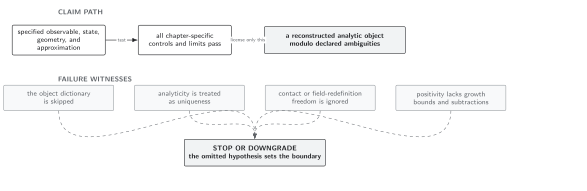
Failure conditions for cosmological cutting identities. The diagram is schematic and not to scale; unitary evolution survives state changes, while the explicit cut kernel and interference terms generally change.
These restrictions refine the chapter’s domain and failure conditions. The analytic terms left by cuts are classified in locality and field-redefinition equivalence.
Exercise
Section titled “Exercise”Suppose . Prove that a two-vertex exchange integral factorizes across the cut.
Solution
For
linearity gives
The result is a product because the cut propagator has rank one in its two time arguments for this single species and polarization. A sum over species or helicities gives a corresponding sum of products.
References
Section titled “References”- Goodhew, H., S. Jazayeri, and E. Pajer. “The Cosmological Optical Theorem.” Journal of Cosmology and Astroparticle Physics 2021, no. 04 (2021): 021. DOI. Open PDF.
- Melville, S., and E. Pajer. “Cosmological Cutting Rules.” Journal of High Energy Physics 2021, no. 05 (2021): 249; arXiv revision v2 (2026), sign corrections with results unchanged. DOI. Open PDF.
Original QFT.org content:CC BY 4.0, unless an item supplies different terms. Third-party material retains its own terms.