

Stationary Horizons, Surface Gravity, and Redshift
For a nonextremal stationary horizon, surface gravity is the conversion rate between Killing time and a regular affine parameter on the horizon. The same rate controls the near-horizon redshift and the dimensionless thermal ratio . Its numerical value is meaningful only after the horizon generator has been normalized.
Required background. Horizon taxonomy identifies when a Killing horizon exists, and Tolman redshift and local temperature supplies the stationary redshift law.
Helpful background. Accelerated detectors gives the Rindler comparison, and WKB and turning-point methods supports later mode propagation.
Surface gravity and regular null coordinates
Section titled “Surface gravity and regular null coordinates”For a static spherical metric
assume a simple zero , , and normalize in the stated exterior. Then
for the future outer horizon orientation. Define the tortoise coordinate and null coordinates by
Near the horizon,
The outgoing Killing coordinate is singular at the future horizon. A regular Kruskal coordinate is
up to a positive affine rescaling and shift. Along the horizon is affine, whereas translation rescales exponentially. Equivalently,
This exponential is the local kinematic input to both the collapse Bogoliubov transform and horizon KMS analyticity. It requires a simple, nonextremal zero; an extremal double zero gives a different, typically power-law relation.
The relation between a bifurcate Killing horizon, its normalized generator, and the corresponding thermal state is conditional on global state existence, not a consequence of the coordinate change alone (Kay and Wald 1991, §§ 5–7).
A static observer has four-velocity and measures
The divergent local temperature near the horizon describes the acceleration of static worldlines; a freely falling detector in a horizon-regular state need not measure the same response.
The structure map places in the first box because its normalization propagates into state frequencies, the KMS or mode relation, and the scattering flux.

Surface gravity as the scale connecting geometry to near-horizon QFT. The diagram is schematic and not to scale; scattering and asymptotic flux remain separate later steps.
The failure map tests a pure convention error: rescaling the generator while leaving , frequency, or temperature unchanged produces a spurious physical difference.
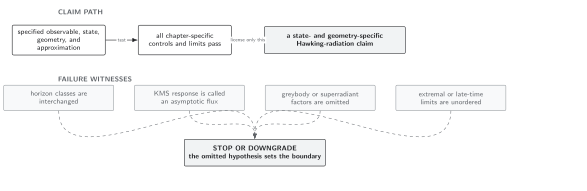
Normalization failure for stationary horizons. This schematic, not-to-scale map licenses only ratios and observables formed with one consistently normalized time flow.
Application: the exponential affine relation
Section titled “Application: the exponential affine relation”For Schwarzschild, , , and asymptotic normalization gives . On a fixed- slice near the horizon,
where the second proportionality holds because is fixed, while the regular affine label itself obeys . A positive-frequency horizon mode therefore becomes a non-monochromatic function of . Conversely, a late-time Killing mode behaves near the horizon as
whose analytic continuation across produces the relative factor underlying the Planck ratio.
Now rescale with . Then
so and are invariant. In an asymptotically flat spacetime, imposing fixes . In de Sitter or a finite static region there may be no such infinity, so the normalization convention must be reported with any temperature.
Domain and failure conditions
Section titled “Domain and failure conditions”See the chapter domain and failure-conditions table. The result assumes a nondegenerate Killing horizon, one time orientation, and a stated normalization of . It licenses the exponential affine relation and the scale with respect to that flow. The decisive checks are a simple zero of the lapse and invariance of under generator rescaling. A dynamical horizon or an extremal double zero requires a different map; inconsistent rescaling downgrades any numerical temperature to a convention artifact.
Exercise
Section titled “Exercise”Derive from a simple zero of .
Solution
Expand . Then
Exponentiating gives the regular coordinate .
Handoff
Section titled “Handoff”Gravitational collapse supplies a physical state preparation and a ray-tracing map whose late-time form contains this exponential relation.
References
Section titled “References”- Hawking, Stephen W. “Particle Creation by Black Holes.” Communications in Mathematical Physics 43 (1975): 199–220. doi:10.1007/BF02345020.
- Kay, Bernard S., and Robert M. Wald. “Theorems on the Uniqueness and Thermal Properties of Stationary, Nonsingular, Quasifree States on Spacetimes with a Bifurcate Killing Horizon.” Physics Reports 207 (1991): 49–136. doi:10.1016/0370-1573(91)90015-E.
- Wald, Robert M. Quantum Field Theory in Curved Spacetime and Black Hole Thermodynamics. Chicago: University of Chicago Press, 1994. Publisher record.
Original QFT.org content:CC BY 4.0, unless an item supplies different terms. Third-party material retains its own terms.