

Spin, Gauge, and Gravitational-Anomaly Responses
Chiral matter can obstruct a gauge or diffeomorphism Ward identity even after every ultraviolet divergence has been removed. The observable statement is the anomaly polynomial together with the chosen current, stress tensor, local counterterms, and boundary inflow—not an isolated divergence formula copied from another convention.
Required background. Trace Anomalies and Convention Translation separates Weyl from diffeomorphism breaking; Gauge Fields, Gauge Fixing, and Ghosts on Curved Backgrounds supplies bundle and spin data; Consistent and Covariant Anomalies supplies the two current normalizations.
Helpful background. Gravitational, Mixed, Discrete, and Orientation Anomalies treats global and dimension-dependent classification; Wess–Zumino Consistency and Descent derives the descent sequence.
Consistent and covariant response
Section titled “Consistent and covariant response”Define the consistent current and stress by
This fixes the page-local metric-variation sign. Under ,
Because it is an effective-action derivative, satisfies the Wess–Zumino consistency condition. It is generally not gauge covariant. A local Bardeen–Zumino polynomial defines
The covariant current transforms covariantly, but it is not in general the functional derivative of one local effective action. The two anomalies can differ in normalization; they are not two independent quantum effects. Bardeen and Zumino construct this relation and its gravitational analogue Bardeen and Zumino 1984, §§2–5, pp. 424–443.
For a four-dimensional chiral current, it is safest to expose the normalization as
Here is the contravariant Levi–Civita tensor; in a positively oriented chart . Generators are Hermitian, , and the representation trace, coupling placement, chirality, and consistent/covariant choice determine . Those coefficients must be recomputed from the anomaly polynomial when any convention changes. The path-integral Jacobian provides a regulator-independent derivation once the current normalization is fixed Fujikawa 1979, pp. 1195–1198.
The mixed axial–gravitational term in four dimensions is not a four-dimensional diffeomorphism anomaly. Pure local gravitational anomalies of chiral matter occur in dimensions ; Alvarez-Gaumé and Witten give the dimensional and field-content conditions Alvarez-Gaumé and Witten 1984, §§2–4, pp. 276–301.
First application: verify a chiral charge change
Section titled “First application: verify a chiral charge change”Let bound a region , with any timelike boundary contribution written explicitly. Integrating the displayed divergence gives
This is a reproducible charge-balance calculation: compute the two characteristic-density integrals, include side flux, and use coefficients from one declared anomaly polynomial. Repeat with the covariant current. The local divergence and boundary flux change by the Bardeen–Zumino contribution, while the fully matched charge balance does not.
Under a diffeomorphism, an anomalous consistent current also enters the stress identity. With the current convention above,
up to boundary-supported terms. A Bardeen counterterm can redistribute local terms between the gauge and diffeomorphism identities. It cannot remove a nontrivial anomaly class.
Adversarial counterterm and inflow test
Section titled “Adversarial counterterm and inflow test”Add a local functional . Its variations shift
If a calculation then announces “current conservation” without checking the shifted stress identity, it has mistaken a convention for invariant content. The adversarial check is to evaluate both Ward identities before and after the shift. The surviving statement is the descent class, the total inflow-balanced variation, and any genuinely conserved combination.
On a manifold with boundary, a bulk Chern–Simons or invertible response can vary by the negative of the boundary consistent anomaly:
This requires the boundary orientation, representation, coefficient, and allowed boundary condition to match. Omitting the inflow current produces a false boundary nonconservation; adding inflow with the wrong sign doubles it. This page makes no classification claim about global anomalies or -invariants, which remain with the anomaly-theory treatment.
Response and failure maps
Section titled “Response and failure maps”The structure map should be read as a chain from regulated fermion response to a declared current and stress convention, followed by the complete set of Ward identities.

Consistent and covariant currents are two related representatives of one anomaly class, and boundary inflow is part of the conserved total system; the map is schematic and not to scale.
The failure map asks whether an apparent violation is a true anomaly, a Bardeen redistribution, a missing boundary contribution, or a convention mismatch.
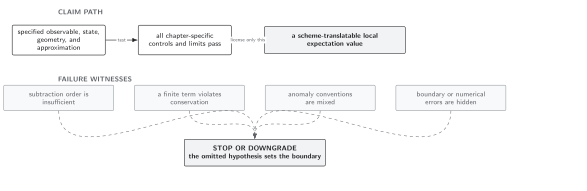
Only the matched polynomial, Ward identities, and inflow system support a convention-independent response claim; the map is schematic and not to scale.
Use Domain and failure conditions. State dimension, spin structure, chirality, representation and trace, consistent or covariant current, curvature and epsilon conventions, boundary orientation, counterterms, and inflow sector.
Renormalized Currents and Charge Density constructs anomaly-free local currents by point splitting. Volume III owns anomaly polynomials, descent, and global classification; this page exports only the convention-complete curved-background response. The foundational local classification cited here was checked through 10 August 2026; no claim is made about unsettled global-anomaly classifications.
References
Section titled “References”- Luis Alvarez-Gaumé and Edward Witten, “Gravitational Anomalies,” Nuclear Physics B 234 (1984), 269–330, DOI.
- William A. Bardeen and Bruno Zumino, “Consistent and Covariant Anomalies in Gauge and Gravitational Theories,” Nuclear Physics B 244 (1984), 421–453, DOI.
- Kazuo Fujikawa, “Path-Integral Measure for Gauge-Invariant Fermion Theories,” Physical Review Letters 42 (1979), 1195–1198, DOI.
Original QFT.org content:CC BY 4.0, unless an item supplies different terms. Third-party material retains its own terms.