

Hawking Radiation from Gravitational Collapse
In a collapse spacetime, Hawking radiation arises because regular early-time positive-frequency data are related nonlinearly to late-time retarded time. The decisive late-time relation is exponential, but the physical claim also needs a Hadamard in-state, causal propagation through the collapsing geometry, normalized asymptotic modes, and a fixed-background interval. The Planck factor obtained at the horizon is not yet the spectrum transmitted to infinity.
Required background. Particle creation in time-dependent backgrounds supplies Bogoliubov mixing; horizon taxonomy fixes the collapse geometry; surface gravity and redshift fixes the exponential scale; and causal propagators supplies field evolution.
Helpful background. The Hadamard parametrix states the required short-distance regularity, and adiabaticity and Stokes phenomena helps separate late production from transients.
Collapse kinematics and the in-state
Section titled “Collapse kinematics and the in-state”Consider spherical collapse that is asymptotically flat in the past and approaches a Schwarzschild exterior of mass in the future. Let be an affine advanced null coordinate on and retarded time on . Outgoing rays that escape increasingly late skim the forming horizon, giving
with in the stationary late exterior. The constants and depend on collapse details; the exponent controls the universal late ratio.
Choose an in-state that is positive frequency with respect to affine and Hadamard across the collapsing matter. A normalized outgoing mode on behaves as
Propagated backward through the geometric-optics region, it has the precursor
This is not purely positive frequency in . Its Fourier decomposition into and yields coefficients satisfying
After forming finite-frequency wavepackets and using Bogoliubov normalization,
for a bosonic mode at the near-horizon production stage. Hawking’s original collapse calculation derives this late-time spectrum and then includes propagation to infinity (Hawking 1975, §§ 2–3).
The construction map locates collapse in the second box: it supplies both the state preparation and the geometry. The near-horizon Planck ratio occupies the next box, while greybody transmission and renormalized flux remain downstream.

Logical position of the collapse derivation. This schematic, not-to-scale map separates the Bogoliubov occupation from the independently transmitted and renormalized asymptotic observable.
The failure map tests whether the state and spacetime were silently replaced. An eternal exterior metric does not specify a collapse in-state, and a singular early state can imprint arbitrary outgoing excitations.
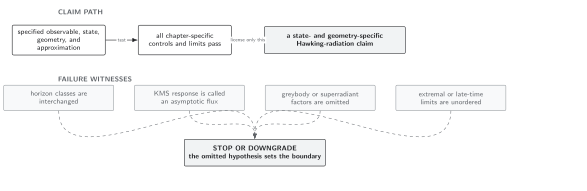
Failure boundary for collapse radiation. The map is schematic and not to scale; the surviving result is limited to the chosen eternal state or excited initial data unless regular collapse preparation is restored.
Application: a collapsing null shell
Section titled “Application: a collapsing null shell”Take an ingoing null shell with flat interior and Schwarzschild exterior. Match the regular interior null coordinate across the shell to exterior . Rays escaping just before the horizon forms cross the shell at radius , with . The matching then gives
so and
For a packet centered at frequency and late retarded time , the expected horizon occupation is Planckian up to collapse transients suppressed by the subleading terms in . At future infinity a scalar partial wave instead has
where is the greybody transmission. The derivation here fixes the denominator, not .
The approximation requires wavepacket wavelengths short relative to the scale on which the exterior settles but low enough for the field theory to be trusted. It also requires observation times short compared with appreciable mass loss. These are separate geometric-optics, ultraviolet, and backreaction controls.
Adversarial comparison
Section titled “Adversarial comparison”On the maximally extended eternal Schwarzschild metric, the Boulware, Hartle–Hawking, and Unruh states are distinct choices. The metric alone selects none of them. The Unruh state reproduces the future-exterior features expected from collapse; the Hartle–Hawking state adds an incoming thermal bath; the Boulware state is vacuum at infinity but singular on the horizons. Thus replacing collapse by an eternal metric leaves a state-selection problem rather than a dynamical derivation.
If the early state contains non-Hadamard short-distance excitations or a tuned incoming flux, the Fourier transform can change. The strongest robust statement is conditional: regular Hadamard short-distance behavior and no specially prepared high-frequency incoming excitations give the late Hawking ratio. Trans-Planckian robustness requires the further tests developed later in the chapter.
Domain and failure conditions
Section titled “Domain and failure conditions”Use the chapter domain and failure-conditions table. This page assumes regular asymptotic in modes, a Hadamard in-state, a collapse ray map with nonzero late , geometric-optics propagation, and negligible backreaction over the packet. It licenses a late near-horizon Planck ratio and, after separate scattering, an outgoing spectrum. Failure of collapse preparation downgrades the result to a chosen eternal state; failure of Hadamard or adiabatic control makes the outgoing occupation state dependent; omission of greybody factors blocks a luminosity claim.
Exercise
Section titled “Exercise”Show that the ratio gives the Bose occupation above.
Solution
Bogoliubov normalization for one diagonalized packet gives . Writing and yields
Handoff
Section titled “Handoff”The next page evaluates the Fourier transform explicitly, introduces finite-resolution wavepackets, and separates asymptotic thermality from transient corrections in the ray map.
References
Section titled “References”- Fredenhagen, Klaus, and Rudolf Haag. “On the Derivation of Hawking Radiation Associated with the Formation of a Black Hole.” Communications in Mathematical Physics 127 (1990): 273–284. doi:10.1007/BF02096757.
- Hawking, Stephen W. “Particle Creation by Black Holes.” Communications in Mathematical Physics 43 (1975): 199–220. doi:10.1007/BF02345020.
- Unruh, William G. “Notes on Black-Hole Evaporation.” Physical Review D 14 (1976): 870–892. doi:10.1103/PhysRevD.14.870.
Original QFT.org content:CC BY 4.0, unless an item supplies different terms. Third-party material retains its own terms.