

Curved-Space OPE and Local Short-Distance Expansions
The curved-space operator-product expansion separates universal local short-distance data from the state in which a product is measured. Its coefficients are locally and covariantly built from the metric, couplings, and relative point configuration; expectation values of the local operators carry the state dependence. Curvature enters both the coefficient scaling expansion and the operator-mixing basis.
Required background. Curved-space time-ordered products supplies renormalized products, the Hadamard microlocal criterion controls admissible states, and renormalized contact products supplies coincidence conventions.
Helpful background. Local composite operators gives the field basis, while renormalized insertions explains its finite redefinitions.
A local asymptotic relation
Section titled “A local asymptotic relation”Choose a point in a convex normal neighborhood containing and . For renormalized local fields and , the OPE is
The symbol is not equality at finite separation. After truncating the sum by dimension or scaling order, the remainder must decrease with a stated power when and approach as . In perturbative curved-spacetime QFT the statement is made order by order in the couplings and in expectation values of Hadamard states.
The coefficients satisfy four structural tests:
- local covariance: an admissible embedding transports using only the metric and couplings near the coalescing points;
- microlocal regularity: their wavefront sets allow the required smearing and state insertion;
- scaling expansion: each coefficient is a sum of tangent-space Lorentz-invariant distributions multiplied by curvature polynomials and covariant derivatives at ;
- associativity: when three or more points coalesce hierarchically, expanding a subcluster first agrees asymptotically with expanding the whole cluster.
Hollands proves these properties and a remainder that vanishes in arbitrary Hadamard-state expectation values for perturbative interacting theories on general Lorentzian curved spacetimes (Hollands 2007, §§ 3–5).
Scalar expansion through dimension two
Section titled “Scalar expansion through dimension two”For a real scalar, choose the symmetric coalescence and . Through local fields of engineering dimension two and to the first displayed geometric order, write
At zeroth order in , contains the Hadamard singularity, for this symmetric choice, and the curvature correction appears in the local expansion of the parametrix. The split between and is basis and scheme dependent because is a curvature multiple of the identity; displaying it separately makes dimension counting and mixing transparent. Physical products are unchanged when coefficients and operators are transformed together.
At first order in , time-ordered insertions modify all three coefficients. The coefficient of the identity contains singular and logarithmic terms; acquires logarithmic scale dependence; and curvature permits contributions proportional to , , and covariant derivatives consistent with dimension. A declared truncation might mean:
- perturbative order ;
- operators of dimension at most two;
- geometric expansion through in the coefficient of the identity;
- remainder tested after smearing over fixed noncoincident directions and over a specified class of Hadamard states.
Without all four declarations, “leading OPE” is ambiguous.
The construction map places the OPE downstream of local time-ordered products and their finite curvature normalization. Inspect the full chain: the coefficients inherit the ultraviolet extension, causal locality, operator mixing, and Ward identities of the interacting fields they expand.

The OPE as short-distance data of the controlled interacting theory. This schematic, not-to-scale map shows why a coefficient cannot be defined independently of the renormalized local field basis.
For OPE claims, the failure map tests state independence and remainder control in addition to the shared chapter hypotheses. Absorbing one state’s smooth expectation value into a coefficient fails before the expansion can be transported to another Hadamard state.
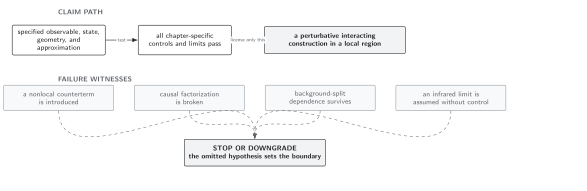
Claim boundary for the curved-space OPE. The diagram is schematic and not to scale; local covariance, multi-state separation, scaling remainder, and associativity must all pass before a Wilson coefficient is licensed.
Taking a state gives
The coefficients are state independent; the one-point function is not. This separation is the curved-space replacement for extracting Wilson coefficients from a preferred vacuum matrix element.
Application: a reproducible short-distance fit
Section titled “Application: a reproducible short-distance fit”Choose several Hadamard states on the same local geometry. Compute or measure their two-point functions for a family of small , subtract the same locally covariant Hadamard singularity, and independently determine in the same renormalization scheme. Then fit the common coefficients in
A state-independent OPE predicts that the same and fit every , while the residuals obey the declared short-distance order. Changing the composite basis by must be accompanied by
and the corresponding shift of the identity coefficient. This is a direct scheme-translation check.
Associativity supplies an independent test: for three scalar fields with , first expand the pair and then expand the resulting operators with . The result must match the three-point OPE in the nested scaling domain through the common truncation.
Adversarial test: fitting one raw state
Section titled “Adversarial test: fitting one raw state”Fit in one state and call the entire fitted smooth term a Wilson coefficient. For any second Hadamard state,
is smooth but generally nonzero at . The fit has absorbed into the putative identity coefficient, so reusing it predicts the wrong constant term in . No ultraviolet singularity exposes the error because the contamination is smooth.
The strongest surviving claim is a state-specific short-distance parametrization. It becomes a state-independent OPE only after the local operator expectation values are separated and the coefficients pass multi-state, covariance, scaling, and associativity tests.
Domain and failure conditions
Section titled “Domain and failure conditions”Use the chapter domain and failure-conditions table together with the OPE-specific data: a convex normal neighborhood, fusion path, perturbative order, local operator basis, scaling truncation, and class of Hadamard states. These inputs license state-independent local covariant coefficients only when the remainder has the declared scaling behavior and nested fusions pass associativity. A one-state raw fit is downgraded to a state-specific parametrization; a failed remainder or null-direction microlocal check restricts the fusion domain and cannot be handed to an infrared or macroscopic claim.
Checks and limitations
Section titled “Checks and limitations”- State the fusion path and scaling variable; Lorentzian null coalescence can have additional singular structure.
- Transform coefficients contragrediently under every finite operator-basis change.
- A finite truncation is asymptotic and local. It need not converge at macroscopic separation.
- Hadamard-state control does not automatically cover non-Hadamard states or sharp boundaries.
- Conformal-block data belong to a special symmetry setting; generic curved-space coefficients depend on local geometry rather than global conformal invariance.
Exercise
Section titled “Exercise”If , derive the coefficient transformation that leaves the displayed OPE unchanged.
Solution
Substitute :
Thus and . A coefficient alone is scheme dependent; the summed product is not.
Handoff
Section titled “Handoff”The OPE controls ultraviolet coalescence inside a fixed local region. Removing the compact interaction switching probes the opposite end of the scale range and requires independent infrared hypotheses.
References
Section titled “References”- Hollands, Stefan. “The Operator Product Expansion for Perturbative Quantum Field Theory in Curved Spacetime.” Communications in Mathematical Physics 273 (2007): 1–36. doi:10.1007/s00220-007-0230-6.
- Hollands, Stefan, and Robert M. Wald. “Axiomatic Quantum Field Theory in Curved Spacetime.” Communications in Mathematical Physics 293 (2010): 85–125. doi:10.1007/s00220-009-0880-7.
Original QFT.org content:CC BY 4.0, unless an item supplies different terms. Third-party material retains its own terms.