

Fields and Local Algebras on Curved Backgrounds
A curved-spacetime field theory has a definite physical domain only after its background, causal and boundary data, field bundle, differential operator, classical phase space, observable algebra, and quantum state have been distinguished. Geometry fixes propagation, but it does not choose a state. A gauge-fixed equation can expose a useful propagator, but it does not by itself identify the physical observables. A locally valid equation also need not give a globally predictive theory when global hyperbolicity, suitable boundary conditions, or control of zero modes is missing.
This chapter constructs that background-and-field layer. It begins by separating fixed-background QFT from semiclassical and quantum-gravitational approximations, then develops scalar, spinor, gauge, and differential-form systems through causal propagation, covariant phase space, algebraic quantization, local covariance, topology, and timelike boundaries. State selection and ultraviolet admissibility begin in the next chapter.
Helpful background. Hyperbolic Equations and Causal Propagators supplies the support properties used throughout; Levi–Civita Connections, Geodesics, and Riemann Curvature supplies the curvature convention; and Bundle Connections, Curvature, Gauge Transformations, and Bianchi Identities supplies the bundle language used for spinors and gauge fields.
The background-and-field contract
Section titled “The background-and-field contract”For a linear field, the reusable input is not merely a metric. It is the collection
where is a Lorentzian spacetime, and are orientation and time orientation, is the field bundle, is the field operator, denotes any boundary or asymptotic condition, is the space of solutions, is its symplectic or Hermitian pairing, and is the algebra of observables. Gauge systems require a complex of fields and gauge transformations in place of an unreduced solution space.
For the real scalar reference system,
and global hyperbolicity gives unique advanced and retarded Green operators on compactly supported sources. Their difference determines the classical bracket and the quantum commutator. A positive two-point function is additional state data; it cannot be reconstructed from and causal support alone. This separation is the central organizing fact of the chapter and of algebraic QFT on curved spacetime Hollands and Wald 2015, §2.1, pp. 9–19.
The construction map below displays that order. Inspect especially the separation between the local algebra and state-dependent expectation values, and the two checkpoints that feed into the construction.

The chapter’s controlled construction keeps causal, gauge, topological, boundary, algebraic, and state data in their logical order; the map is schematic and not to scale.
Choose a route
Section titled “Choose a route”The arrows below are suggested reading routes, not a claim that every page hard-requires the page before it.
| Goal | Route | Result |
|---|---|---|
| First curved-QFT construction | Regimes → global hyperbolicity → scalar field → Green operators → symplectic form → algebraic quantization | Specify and quantize a free scalar without choosing a preferred vacuum |
| Fermions | Global hyperbolicity → spinors and spin connection → conserved inner products → algebraic quantization | Identify the geometric data required by a Dirac field |
| Gauge fields and global sectors | Global hyperbolicity → gauge fields → differential forms → topology | Separate local radiative modes from gauge, harmonic, and flux sectors |
| Local covariance and response | Local algebras → local covariance → relative Cauchy evolution | Compare the same local theory on different backgrounds and compute its linear background response |
| Timelike boundaries | Global hyperbolicity → Green operators → symplectic flux → timelike boundaries | Decide whether a boundary condition yields predictive, flux-conserving, stable evolution |
| Conformal transport | Scalar curvature coupling → local covariance → conformal transformations | Transport a conformal field while identifying mass, state, and anomaly obstructions |
Chapter guide
Section titled “Chapter guide”- Fixed-Background, Semiclassical, Gravitational-EFT, and Quantum-Gravity Regimes classifies what is quantized and which expansion controls each approximation.
- Curved Spacetimes, Cauchy Surfaces, and Global Hyperbolicity identifies the causal hypothesis behind predictive evolution.
- Covariant Scalar Fields and Curvature Coupling derives the scalar operator, conformal coupling, boundary variation, and FLRW mode equation.
- Spinors, Tetrads, and Spin Connections constructs the curved Dirac operator and conserved current.
- Gauge Fields, Gauge Fixing, and Ghosts on Curved Backgrounds separates a hyperbolic gauge-fixed representative from gauge-invariant content.
- Differential-Form Fields and Reducible Gauge Systems adds reducibility, ghosts-for-ghosts, harmonic forms, and flux sectors.
- Green Operators, Causal Propagators, and State-Dependent Two-Point Functions fixes the curved-space distribution dictionary by equations and support.
- Covariant Symplectic Structure and Conserved Inner Products derives solution-space pairings and their boundary-flux condition.
- Covariant Algebraic Quantization and Fock Realizations constructs CCR and CAR algebras before any representation is selected.
- Local Field Algebras, Causality, and the Time-Slice Property assigns observables to regions without assuming tensor-product factorization.
- Local Covariance, Isometries, and Background Embeddings explains how local observables are transported between admissible backgrounds.
- Relative Cauchy Evolution and Background Response compares theories before and after a compact background perturbation.
- Topology, Zero Modes, and Global Sectors shows why locally identical geometries can have different observable algebras.
- Timelike Boundaries, Self-Adjoint Extensions, and AdS Boundary Conditions classifies the extra data required when causal curves can reach a boundary.
- Conformal Transformations and Frame Changes distinguishes classical conformal transport from quantum equivalence.
Domain and failure conditions
Section titled “Domain and failure conditions”The table is a compact comparison of the data that must accompany each field system. “Predictive” means predictive for the stated initial-boundary problem; it does not imply that a preferred state exists.
| Field system | Operator or constraint | Additional data | Physical algebra | Characteristic failure |
|---|---|---|---|---|
| Real scalar | Normally hyperbolic | Cauchy data; boundary condition if present | CCR algebra modulo the equation | Loss of global hyperbolicity or uncontrolled boundary flux |
| Dirac field | First-order Dirac operator with normally hyperbolic square | Spin structure, tetrad orientation, spin connection | CAR algebra from the conserved Hermitian form | No spin structure, inconsistent adjoint, or orientation mismatch |
| Maxwell potential | Gauge-degenerate wave system | Gauge fixing, constraints, residual gauge quotient, boundary data | Gauge-invariant field-strength or reduced potential algebra | Zero modes or gauge-dependent quantities mistaken for observables |
| Differential -form | de Rham complex with reducible gauge symmetry | Cohomology, harmonic modes, flux sector, reducibility stages | Local field strengths plus global flux observables | Local mode expansion omits harmonic or topological sectors |
| Global or topological sector | Kernel and cohomology of the local field complex | Spatial topology, large gauge group, flux lattice, zero-mode prescription | Sector-dependent algebra, possibly with a center | Locally identical geometries assigned the same global observables |
| Timelike-boundary problem | Chosen self-adjoint realization of the spatial operator | Extension and boundary condition, normal orientation | Algebra tied to that realization | Nonpositive spectrum, nonzero symplectic flux, or nonunique evolution |
| Locally covariant theory | Assignment over admissible background embeddings | Background category and preserved structures | Compatible family of local algebras | A noncausal embedding or changed boundary structure invalidates transport |
The claim-path map turns the last column into a decision rule. A successful local calculation licenses only the domain whose assumptions have passed; any listed witness forces a narrower statement or a different theory.
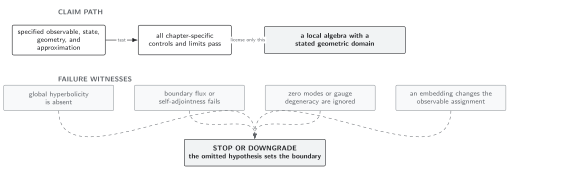
The omitted hypothesis sets the boundary of a curved-spacetime QFT claim; the validity and failure map is schematic and not to scale.
One calculation viewed at several levels
Section titled “One calculation viewed at several levels”A nonminimally coupled scalar on spatially flat FLRW is the recurring test case. The geometry page decides whether constant-time slices are Cauchy surfaces. The scalar page derives the field equation. The Green-operator page fixes causal response. The symplectic page checks conservation of the Wronskian. Algebraic quantization converts that pairing into commutation relations. Only after those steps may a state select a two-point function or a Fock realization.
The same sequence exposes failures. Adding a timelike boundary changes the Green operators and introduces flux terms. Compactifying space introduces zero modes. Changing conformal frame transports the classical equation only in the conformally invariant case. None of these changes can be repaired by renaming a vacuum.
Review the chapter
Section titled “Review the chapter”Background specification. Given a vector field on a spacetime with boundary, list the background, bundle, operator, constraint, boundary, phase-space, and algebra data. A successful answer distinguishes geometric input from state data.
Causal versus statistical information. Explain why replacing a quasifree state changes its Wightman function but not the retarded Green operator of a fixed free equation. The invariant check is unchanged causal support and commutator.
Surface independence. Starting from a conserved symplectic current, integrate over the region between two Cauchy surfaces. The two pairings agree precisely when flux through every remaining boundary vanishes.
Topology test. Compare Maxwell theory on locally flat spacetimes with spatial slices and . Local curvature agrees, but harmonic one-forms and global Wilson loops need not.
Failure diagnosis. If a formal mode basis exists on an AdS patch but contains negative eigenvalues of the chosen spatial extension, completeness does not establish stability. The boundary-condition page gives the repair criterion.
Where this chapter stops
Section titled “Where this chapter stops”Volume I retains the geometry, global analysis, and self-adjointness theorems. States, Hadamard Structure, and Microlocal Control adds ultraviolet-admissible states without manufacturing a preferred vacuum. Local Observables, Stress Tensors, and Anomalies constructs renormalized composites. The theorem-first functorial, microlocal, and boundary analysis belongs to Mathematical QFT.
References
Section titled “References”- Christian Bär, Nicolas Ginoux, and Frank Pfäffle, Wave Equations on Lorentzian Manifolds and Quantization, European Mathematical Society (2007), Open PDF, especially Chapters 3–4.
- Marco Benini, Claudio Dappiaggi, and Thomas-Paul Hack, “Quantum Field Theory on Curved Backgrounds: A Primer,” International Journal of Modern Physics A 28 (2013), 1330023, arXiv:1306.0527.
- Romeo Brunetti, Klaus Fredenhagen, and Rainer Verch, “The Generally Covariant Locality Principle—A New Paradigm for Local Quantum Field Theory,” Communications in Mathematical Physics 237 (2003), 31–68, arXiv:math-ph/0112041.
- Stefan Hollands and Robert M. Wald, “Quantum Fields in Curved Spacetime,” Physics Reports 574 (2015), 1–35, DOI, Open PDF.
Original QFT.org content:CC BY 4.0, unless an item supplies different terms. Third-party material retains its own terms.