

Unruh Effect and Uniformly Accelerated Detectors
The Unruh effect is an exact KMS and detector-response statement for uniform acceleration in the Minkowski vacuum. A detector following a complete hyperbola has a long-time detailed-balance temperature . Finite switching, nonuniform motion, altered states, and different couplings introduce corrections. The result does not imply that inertial observers see a pre-existing thermal radiation fluid or nonzero Minkowski-vacuum stress flux.
Required background. Detector Response Along Curved and Accelerated Worldlines supplies the response function; Ground, KMS, and Symmetry-Selected States supplies KMS structure; Rindler Wedges and the Bisognano–Wichmann Theorem supplies the wedge-algebra result.
Helpful background. Modular KMS Relations and Modular Correlators supplies detailed balance; Detector and instrument validation supplies finite-protocol tests.
Hyperbolic motion and the pulled-back vacuum
Section titled “Hyperbolic motion and the pulled-back vacuum”A uniformly accelerated worldline with proper acceleration is
with the transverse coordinates fixed. For a massless scalar in the four-dimensional Minkowski vacuum,
The imaginary proper-time periodicity is
Contour integration gives the stationary transition rate
understood by continuation for both signs of . For ,
This is detailed balance at . Unruh derives the accelerated-observer thermality and its field-theoretic setting in Unruh 1976, pp. 870–892.
At the algebraic level, the Minkowski vacuum restricted to a Rindler wedge is KMS with respect to boost flow. At the detector level, the same property appears after pulling the correlation function to the orbit of that flow. These are compatible statements, but the detector calculation additionally contains its gap, switching, and coupling.
First application: long-time detailed balance
Section titled “First application: long-time detailed balance”Take a smooth family whose interaction duration grows with . The finite response is
under the stationary scaling assumptions. Therefore
The convergence need not be uniform in large . Fewster, Juárez-Aubry, and Louko show that the duration and switch-on/off scaling required to resolve detailed balance depend sharply on the gap and on the Fourier decay of the switching Fewster, Juárez-Aubry, and Louko 2016, §§3–5.
Energy conservation is also operational. The external agent that maintains the detector’s acceleration and controls the coupling can supply the detector excitation energy. In the standard renormalization,
Thus thermal detector response does not establish an inertial stress-energy bath. Rindler number, wedge KMS structure, detector excitation, and inertial flux remain distinct.
Adversarial finite and nonuniform protocols
Section titled “Adversarial finite and nonuniform protocols”Shorten the interaction while holding fixed. Switching transients spoil exact detailed balance. Replace the hyperbola by a circular orbit with the same instantaneous acceleration. Its pulled-back Wightman function has different complex singularities and is not KMS at one gap-independent temperature. Inspect the inertial stress tensor: it remains the vacuum tensor.
The strongest surviving claim for finite or nonuniform motion is the calculated detector response for that protocol. The universal formula requires uniform acceleration, the Minkowski vacuum, the proper-time boost flow, and an exact KMS or controlled long-time limit.
Construction and failure maps
Section titled “Construction and failure maps”The construction map shows the Unruh chain: state plus hyperbolic worldline, regulated response, stationary Fourier transform, and only then a thermal interpretation.

Unruh temperature is a KMS and long-time response statement for boost proper time, not a universal local radiation-fluid claim; the map is schematic and not to scale.
The failure map asks whether acceleration has been confused with curvature or whether a finite transient has been called an exact thermal rate.
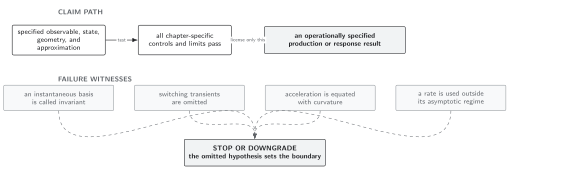
Exact is licensed by the complete hyperbolic KMS setting; finite protocols license only their controlled response. Schematic and not to scale.
Use the KMS row in Domain and failure conditions. Check state, wedge or trajectory, proper-time generator, uniform acceleration, switching family, detailed-balance window, perturbative order, external work, and inertial stress flux separately.
Check your understanding
Section titled “Check your understanding”Why does not contradict an accelerated detector’s excitation?
Solution
The two quantities are different observables. The detector samples a two-point function along a noninertial trajectory and exchanges energy with the agent maintaining its motion and switching. The inertial renormalized stress tensor measures local field energy flux and remains zero in the Minkowski vacuum.
Tolman Redshift, KMS Structure, and Local Temperature generalizes stationary temperature bookkeeping. Acceleration, Gravity, and the Limits of Equivalence-Principle Arguments states the comparison boundary. Hawking flux belongs to Chapter 6.
References
Section titled “References”- Christopher J. Fewster, Benito A. Juárez-Aubry, and Jorma Louko, “Waiting for Unruh,” Classical and Quantum Gravity 33 (2016), 165003, DOI, arXiv:1605.01316.
- Stephen A. Fulling, “Nonuniqueness of Canonical Field Quantization in Riemannian Space-Time,” Physical Review D 7 (1973), 2850–2862, DOI.
- William G. Unruh, “Notes on Black-Hole Evaporation,” Physical Review D 14 (1976), 870–892, DOI.
Original QFT.org content:CC BY 4.0, unless an item supplies different terms. Third-party material retains its own terms.