

Quantum Energy Inequalities in Curved Spacetime
A quantum energy inequality (QEI) bounds how negative a renormalized energy density can remain after smooth sampling, for a specified field, state class, curve, and stress prescription. The most robust curved-spacetime results are timelike worldline inequalities for free fields in Hadamard states. They do not imply pointwise positivity and cannot generally be converted into a four-dimensional null-worldline bound by boosting the observer.
Required background. Classical energy conditions and quantum violations supplies the pointwise contrast; quantum energy inequalities supplies the abstract bound; and the Hadamard parametrix supplies ultraviolet admissibility.
Helpful background. Renormalized stress-tensor ambiguities fixes finite local shifts, while test functions and distributions explains why the sampler must be smooth.
Timelike worldline inequalities
Section titled “Timelike worldline inequalities”Let be a smooth timelike curve parametrized by proper time, with unit tangent , and let be real. A QEI has the form
for every state in the theorem’s class. Here denotes the local geometric and renormalization data. An absolute QEI has a right-hand side determined by geometry and field parameters; a difference QEI bounds the stress relative to a specified reference Hadamard state. These are distinct statements.
For a minimally coupled scalar on a four-dimensional globally hyperbolic spacetime, Fewster and Smith establish an absolute curved-spacetime QEI using the local Hadamard expansion (Fewster and Smith 2008, Theorem 3.1). Its explicit bound involves the pullback of a locally constructed bidistribution and geometric correction terms. The theorem does not cover arbitrary interactions, non-Hadamard states, or nonsmooth switching.
In four-dimensional Minkowski spacetime, for a massless scalar and inertial ,
This normalization uses the weight . Writing a theorem with a sampler changes the apparent derivative structure and requires to admit the needed smooth square root.
The structure map shows that “QEI” becomes a usable statement only after the timelike curve, proper-time sampler, state class, field, dimension, and subtraction data have been supplied.

Inputs to a curved timelike QEI. The map is schematic and not to scale; the lower bound is a functional of the sampler and local geometry, not a universal constant or pointwise floor.
Static curved region and the short-sampling limit
Section titled “Static curved region and the short-sampling limit”Choose a geodesic segment inside a static region with curvature radius , distance from any boundary, and a compact sampler
For the flat massless bound,
The scaling is both dimensional and operational: shorter measurements permit more negative averaged energy. In a static curved region, a local expansion has the schematic hierarchy
where the displayed form means relative corrections in a regime where all ratios are small; coefficients depend on the field, coupling, curve, and sampler. One must use the actual curved theorem rather than this expansion when approaches any geometric scale.
The application is reproducible by stating , its width convention, , , the worldline, curvature invariants over the sampler support, reference state if any, and finite stress prescription. The decisive flat check is
Why the null limit fails
Section titled “Why the null limit fails”Boosting the timelike observer while holding a coordinate-time sampler fixed changes its proper-time width and the stress projection simultaneously. The limit is not uniform. In four-dimensional Minkowski QFT, Fewster and Roman construct states showing that no nontrivial state-independent null-worldline QEI of the analogous form exists (Fewster and Roman 2003, §§ II–III). ANEC can still hold because its complete, unsmeared null integral is a different limit with different hypotheses.
The adversarial cases are immediate:
- a non-Hadamard two-point function makes the local stress or theorem’s wavefront products inadmissible;
- a top-hat sampler has distributional derivatives and lies outside the smooth theorem;
- invalidates the short-sampling expansion; and
- taking a null boost while silently holding the wrong width fixed does not prove a null QEI.
The failure map locates these as domain failures, not small corrections to the same bound.
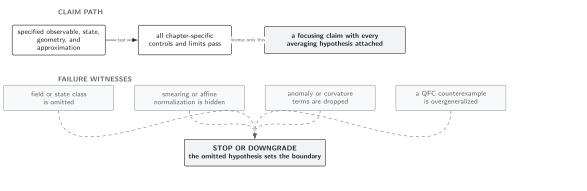
Failure modes of a timelike worldline QEI. The diagram is schematic and not to scale; a failed sampler or state hypothesis withdraws the theorem, while a long sampling time requires the full curved bound rather than its local flat limit.
Domain and failure conditions
Section titled “Domain and failure conditions”See the chapter domain and failure-conditions table. The explicit application concerns a free scalar, Hadamard states, a smooth compact proper-time sampler, and a timelike curve in a controlled static region. It does not establish a general interacting QEI, a boundary theorem, a pointwise bound, or a four-dimensional null-worldline inequality.
Exercise
Section titled “Exercise”Show that the flat bound scales as under .
Solution
Two derivatives give . Hence
References
Section titled “References”- Fewster, C. J., and S. P. Eveson. “Bounds on Negative Energy Densities in Flat Spacetime.” Physical Review D 58 (1998): 084010. DOI.
- Fewster, C. J., and T. A. Roman. “Null Energy Conditions in Quantum Field Theory.” Physical Review D 67 (2003): 044003; erratum 80 (2009): 069903. DOI.
- Fewster, C. J., and C. J. Smith. “Absolute Quantum Energy Inequalities in Curved Spacetime.” Annales Henri Poincaré 9 (2008): 425–455. DOI.
Original QFT.org content:CC BY 4.0, unless an item supplies different terms. Third-party material retains its own terms.