

Evaporation Endpoints and the Information Handoff
For a large, slowly evaporating black hole, QFT on a semiclassically evolving exterior can control Hawking fluxes and mean backreaction over a substantial interval. That success does not determine the final Planck-curvature regime, the microscopic factorization of Hilbert space, or a unique unitary information scenario. The controlled interval and the unresolved endpoint must be reported separately.
Required background. Observable-specific validity contracts fixes the predicted quantity; semiclassical breakdown diagnostics supplies response and fluctuations; semiclassical black-hole information limits supplies entropy scope; and black-hole evaporation and mean backreaction supplies the evolution equation.
Helpful background. Quantum extremal surfaces supplies a renormalized semiclassical entropy prescription, while recovery maps and approximate Markovianity supplies information-theoretic distinctions.
Marking the controlled evaporation interval
Section titled “Marking the controlled evaporation interval”For a quasi-stationary Schwarzschild-like hole, a useful adiabatic parameter is
with the instantaneous surface gravity. Curvature relative to the gravitational cutoff, the renormalized stress residual, the noise-driven metric covariance, and greybody evolution provide additional controls. Far from the endpoint of a macroscopic hole, these can be small and the outgoing flux at infinity is a meaningful semiclassical observable.
Hawking’s collapse calculation establishes thermality of late outgoing modes under its field, state, and geometry assumptions Hawking 1975, §§2–4, Eqs. (2.13)–(2.29). Mean evaporation then changes the mass on a much longer timescale. Neither step provides a solution through the regime in which the horizon curvature, fluctuations, or EFT corrections become order one.
Define a stopping time as the earliest retarded time at which any required error contract fails. Before , report flux, mass loss, and coarse entropy quantities with errors. After , preserve them as boundary data for the unresolved problem rather than extending the mean equation by assumption.
Information quantities and underdetermination
Section titled “Information quantities and underdetermination”The von Neumann entropy of “radiation” requires a factorization or algebraic subsystem and a state on it. In gravity, constraints and edge data make this nontrivial. A generalized-entropy or island calculation is a controlled semiclassical saddle prescription within its declared setup; interpreting it as a complete microscopic radiation state requires additional input.
Page’s random-state reasoning shows how unitary systems can produce an entropy turnover under Hilbert-space and typicality assumptions Page 1993, pp. 3743–3746. It does not derive those assumptions from semiclassical collapse. Conversely, monotonically increasing Hawking entropy at fixed semiclassical order does not by itself prove fundamental information loss.
The first application divides an evaporating model into intervals. For each interval tabulate , curvature over cutoff, mean-equation residual, smeared fluctuations, and the definition of entropy. Mark which observables remain controlled and which information questions already depend on a microscopic subsystem definition.
The structure map shows a controlled exterior history feeding, but not solving, the endpoint and information remainder.

Semiclassical evaporation licenses interval-specific flux, geometry, and entropy statements; endpoint dynamics and microscopic unitarity remain separate questions after the first failed control parameter. Schematic; not to scale.
Endpoint-independence test
Section titled “Endpoint-independence test”Construct several endpoint completions that agree on the same early Hawking flux and mean geometry but differ by a remnant, complete evaporation, bounce, or nonlocal transfer. Early semiclassical agreement cannot select among them. Reject any inference that silently imports its preferred endpoint into the earlier calculation.
The surviving output is stronger than agnosticism: it includes the state, outgoing correlators, conserved charges, entropy prescription, and error-bounded geometry at . See the chapter’s domain and failure conditions.
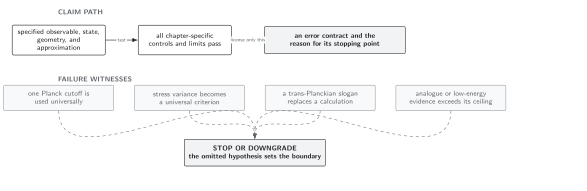
Early semiclassical radiation constrains every completion but does not uniquely determine endpoint geometry, subsystem factorization, or the microscopic information mechanism. Schematic; not to scale.
References
Section titled “References”- Hawking, S. W., “Particle Creation by Black Holes,” Communications in Mathematical Physics 43, 199–220 (1975), doi:10.1007/BF02345020.
- Page, D. N., “Information in Black Hole Radiation,” Physical Review Letters 71, 3743–3746 (1993), doi:10.1103/PhysRevLett.71.3743.
Original QFT.org content:CC BY 4.0, unless an item supplies different terms. Third-party material retains its own terms.