

Higher-Derivative Poles, Ghost Diagnostics, and Order Reduction
A finite higher-derivative truncation generally has more formal solutions than the EFT it approximates. If that truncated equation is solved exactly, its propagator can display extra poles and its time evolution can require extra initial data. Below the cutoff, the EFT instruction is instead to expand perturbatively or order-reduce. A pole becomes a genuine low-energy state only when matching places it inside the controlled domain and supplies its dynamics.
Required background. Curvature Operators and Field-Redefinition Redundancies supplies the higher-derivative terms; One-Loop Graviton EFT supplies their order; and Order Reduction and Runaway Prescriptions supplies the causal initial-value problem.
Helpful background. Spectra, Resolvents, Spectral Measures, and Functional Calculus supplies pole language, while Hilbert Positivity and Unitary Evolution supplies the residue test.
Exact poles of a truncated denominator
Section titled “Exact poles of a truncated denominator”Consider one projected graviton channel whose quadratic propagator has the toy form
If the denominator is treated exactly,
There is a second pole at , with opposite residue in this scalarized channel. In a fundamental local four-derivative theory that pole can signal an additional mode and, depending on signs and contour, a negative-norm or unstable sector. Stelle analyzes such exact quadratic-curvature theories in Stelle 1977, §§II–III, pp. 956–963.
An EFT truncated at makes a different claim. For ,
At this order the correction is the local term ; there is no additional low-energy pole. The formal pole samples momenta where the retained correction is order unity and all omitted , , and nonlocal terms can move or remove it.
The structure map therefore sends a candidate pole through a scale comparison before it is interpreted as a state.

Exact factorization of a finite truncation and perturbative EFT expansion answer different questions; only poles inside the matched validity domain can be assigned physical state content. The map is schematic and not to scale.
First application: order-reducing a sourced mode
Section titled “First application: order-reducing a sourced mode”Let a gauge-invariant linearized mode satisfy
with a declared retarded prescription. The leading equation is . Substituting it only in the higher-order term gives the reduced equation
It is second order and requires only the initial data of the leading theory. Expanding the exact Fourier-space response gives
with signs following . Solving the reduced equation produces the same series through . The extra homogeneous solution of is nonanalytic in the EFT expansion and is excluded by the perturbative boundary condition.
In gravity, varying and produces four-derivative corrections to the metric equation. Order reduction replaces their highest derivatives using the leading Einstein equation and its derivatives, while retaining the same gauge constraints and source conservation. Simon gives the systematic perturbative prescription and its relation to runaway branches in Simon 1990, §§II–III, pp. 3721–3728.
When the extra pole must be kept
Section titled “When the extra pole must be kept”The toy pole has magnitude
For a natural coefficient it lies at the cutoff and cannot be resolved by the truncation. If matching yields , the pole may lie parametrically below . One must then ask whether the complete matched amplitude has a stable pole with a controlled width and residue. If it does, the proper low-energy theory includes an explicit new degree of freedom or a resummed description; order reduction cannot erase a genuinely light state.
Conversely, a pole found only after resumming one operator while discarding all terms of the same EFT order is not evidence for a particle. A negative residue of that formal pole is a warning about exact treatment of the truncation, not by itself a proof that the low-energy EFT violates unitarity. Low-energy unitarity is tested order by order in amplitudes within the cutoff.
Runaways, constraints, and contours
Section titled “Runaways, constraints, and contours”Higher-time-derivative equations admit fast exponential branches when their characteristic roots lie near the cutoff. Simply choosing future boundary data to remove them can introduce acausal dependence. Order reduction avoids those branches perturbatively, but it is justified only when the higher-derivative correction remains small over the time interval considered. Secular accumulation can invalidate it even when every instantaneous frequency is low.
For metric perturbations, lapse and shift constraints remain constraints; they are not new propagating modes created by a curvature-squared term. Gauge fixing, constraint propagation, and the retarded or in–in contour must be applied before counting poles in a component propagator.
Domain and failure conditions
Section titled “Domain and failure conditions”The chapter comparison table requires the projected gauge-invariant channel, matched coefficients, cutoff, source, contour, initial data, and retained order. Exact higher-derivative gravity as a UV proposal lies outside this EFT result; a genuinely subcutoff matched state must be promoted rather than discarded.
The failure map distinguishes an above-cutoff root from a controlled low-energy pole.
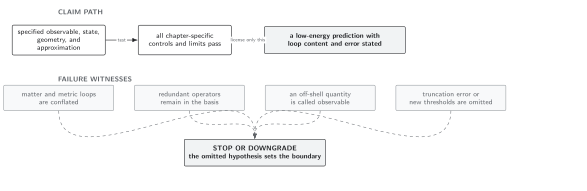
Pole interpretation is licensed only after comparing its scale and residue with the EFT cutoff and the complete matched amplitude; order reduction preserves the perturbative low-energy branch. The map is schematic and not to scale.
References
Section titled “References”- Simon, J. Z. “Higher-Derivative Lagrangians, Nonlocality, Problems, and Solutions.” Physical Review D 41, 3720–3733 (1990). doi:10.1103/PhysRevD.41.3720
- Stelle, K. S. “Renormalization of Higher-Derivative Quantum Gravity.” Physical Review D 16, 953–969 (1977). doi:10.1103/PhysRevD.16.953
Original QFT.org content:CC BY 4.0, unless an item supplies different terms. Third-party material retains its own terms.