

QNEC on Curved Backgrounds
The quantum null energy condition (QNEC) relates a local null stress to the diagonal second shape variation of entropy, per unit transverse area. On curved backgrounds, both sides are renormalized quantities and local geometric counterterms can matter. A valid statement must specify the entangling cut, null deformation, area-density convention, dimension, state and theory, local stationarity conditions, and the common scheme used for stress and entropy.
Required background. Renormalized stress-tensor ambiguities fixes ; QNEC supplies the flat-space inequality; and entropy shape variations supplies the second derivative.
Helpful background. Relative-entropy monotonicity is a proof mechanism, while ANEC is the integrated null condition obtained only in appropriate limits.
Entropy variation per transverse area
Section titled “Entropy variation per transverse area”Let be a codimension-two cut of a null hypersurface , with generators labelled by transverse coordinates and affine displacement . Write the outside entropy as . Its second variation contains a diagonal distribution,
Define , where is transverse area. In units , the local QNEC reads
This formula fixes the area convention; writing without saying whether it is an extensive variation or an area density is dimensionally ambiguous. Affine rescaling changes both sides by when the deformation variable and tangent are transformed together.
Flat-space QNEC has rigorous proofs in broad QFT domains; a general proof for relativistic QFT is given by Balakrishnan et al. (Balakrishnan et al. 2019, §§ 2–5). Curved space adds geometric terms. Fu, Koeller, and Marolf analyze the finite, scheme-independent curved-background domains rather than asserting a general curved-space theorem: their dimension-by-dimension conditions, including local stationarity and additional transverse-derivative restrictions, are stated in Fu, Koeller, and Marolf 2017, § 2, especially Eqs. (2.11)–(2.17), with the coefficient and derivation of Eq. (2.13) corrected in Fu, Koeller, and Marolf 2018 corrigendum, correction to Eq. (2.13).
The structure map emphasizes that entropy and stress belong to one renormalized variation problem. Computing them in unrelated schemes does not test QNEC.

Curved-background QNEC data. The map is schematic and not to scale; local stationarity, dimension, transverse-area normalization, theory and state, and common counterterms determine whether the displayed local inequality is scheme independent.
Free coherent-state check near a stationary cut
Section titled “Free coherent-state check near a stationary cut”Take a free scalar near a locally stationary cut with
and any additional curvature-derivative conditions required in the chosen dimension. Compare a coherent state with the reference vacuum in one regulator and subtraction scheme. The coherent displacement changes the one-point function but not the covariance matrix. Consequently, for the same regulated region,
while
for the minimally coupled null projection at the cut. The vacuum-subtracted QNEC becomes
This is a controlled free-field test, not a proof of the absolute curved QNEC. One must separately verify that the reference-state geometric terms obey the scheme-appropriate inequality.
For numerical reproduction, deform one small transverse cell of coordinate area , compute
and take followed by a controlled transverse-cell limit. The stress must be averaged or evaluated with the same transverse regulator. Reversing these limits can mix diagonal and off-diagonal entropy variations.
Higher-curvature counterterm test
Section titled “Higher-curvature counterterm test”Add a finite local term to the effective action and its associated entropy functional. It shifts
Only the combination
decides scheme independence. In dimensions and geometric settings where is not forced to vanish, the proposed local inequality is not a scheme-independent observable. Choosing a scheme in which it happens to hold supplies no universal theorem.
The adversarial test performs the stress shift but omits the entropy counterterm, then repeats with both included. A discrepancy in the first run is artificial; a nonzero in the consistent run is a real domain obstruction.
The failure map records that obstruction without converting it into a statement about ANEC or a restricted focusing proposal.
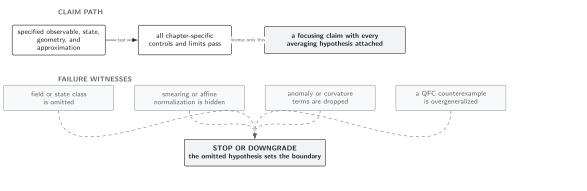
Failure conditions for curved QNEC. The diagram is schematic and not to scale; consistent higher-curvature variation of both stress and entropy distinguishes a removable scheme mismatch from a setting where the local inequality itself is scheme dependent.
Domain and failure conditions
Section titled “Domain and failure conditions”See the chapter domain and failure-conditions table. The coherent-state calculation is a vacuum-subtracted free-field test near a locally stationary cut with common stress/entropy regulation. The established absolute QNEC domain depends on dimension, theory, cut geometry, and counterterms. This page does not claim a universal curved-space theorem or infer QFC from QNEC beyond a stated gravitational expansion.
Exercise
Section titled “Exercise”Show that QNEC is covariant under for .
Solution
The tangent transforms as , so . The deformation derivative transforms as , hence . Both sides acquire the same positive factor.
References
Section titled “References”- Balakrishnan, S., T. Faulkner, Z. U. Khandker, and H. Wang. “A General Proof of the Quantum Null Energy Condition.” Journal of High Energy Physics 2019 (2019): 20. DOI.
- Fu, Z., J. Koeller, and D. Marolf. “The Quantum Null Energy Condition in Curved Space.” Classical and Quantum Gravity 34 (2017): 225012. DOI. Corrigendum, Classical and Quantum Gravity 35 (2018): 049501. Corrigendum DOI.
Original QFT.org content:CC BY 4.0, unless an item supplies different terms. Third-party material retains its own terms.