

Generalized Entropy and UV Renormalization
Generalized entropy is a single renormalized functional, not a finite geometric term plus an independently meaningful divergent matter entropy. Its definition ties the regulator and subtraction of to the renormalized couplings in the gravitational effective action.
Required background. Renormalization of gravitational couplings supplies the local EFT counterterms, and entropy counterterms supplies the surface subtraction. Helpful background. See universal geometric terms, the renormalized stress tensor, and horizon entanglement entropy.
One renormalized surface functional
Section titled “One renormalized surface functional”At a cutoff , write the local gravitational action schematically as
This is the site’s Lorentzian curvature and Einstein–Hilbert sign; the displayed higher-curvature coefficients are defined in that same basis. Its replica or convention-translated Noether-charge variation defines . The matter entropy has local surface divergences with exactly the allowed geometric structures. The renormalized object is
At leading order in four-dimensional Einstein gravity,
and the induced area counterterm in cancels the divergence of . Logarithmic curvature divergences renormalize and their corresponding entropy functionals. This relation was established in one-loop black-hole entropy calculations by matching effective-action and entanglement divergences Susskind and Uglum 1994, §§2–4, pp. 3743–3751.
Finite local counterterms remain possible. Therefore an isolated value of or may change with scheme, while a consistently transformed , its state differences, and appropriately fixed variations do not.
Renormalization-scale dependence supplies a compact consistency test. The running of the local gravitational entropy must cancel the explicit scale dependence of the matter term:
to the computed order. If the sum runs, either an allowed local surface operator is missing or the matter and gravitational calculations use different conventions. In an effective field theory this cancellation is order by order; unknown higher-dimension operators bound the precision when the surface curvature approaches the cutoff scale.
The finite answer also depends on which quantity is compared. State differences on one fixed surface cancel state-independent counterterms especially cleanly. Shape variations require the counterterms’ own shape derivatives. Absolute values additionally require finite renormalization conditions for the gravitational couplings. These three tasks should not be conflated.
First application: scalar area and curvature terms
Section titled “First application: scalar area and curvature terms”For a free scalar with correlation length much shorter than the horizon curvature scale, organize the regulated result as
The leading dimensionless coefficient cannot depend on finite except through the vanishing combination ; mass first appears in logarithmic and lower-order terms. The exact coefficients depend on the regulator, scalar coupling, and surface geometry. Renormalize and the curvature-squared coefficients using the same heat-kernel convention, derive their surface entropy from the same action, and only then take . For a stationary bifurcation surface, extrinsic-curvature terms vanish, simplifying but not eliminating the curvature counterterms.
The classification of area, curvature, and logarithmic terms for smooth black-hole cuts is reviewed in Solodukhin 2011, §§2–3, Eqs. (22)–(28).
The structure map displays this cancellation as one middle step, not as a post-processing adjustment. Inspect the joint flow of matter and gravitational terms into .

Generalized entropy is the jointly renormalized sum of matter and geometric entropy terms in one regulator and coupling scheme. Schematic; not to scale.
Domain and failure conditions
Section titled “Domain and failure conditions”The canonical domain table compares this EFT construction with replica and QES statements. Specify the state, algebra, surface, regulator, renormalization scale, operator basis, and finite-counterterm conditions.
Adversarial test. Change from proper-time cutoff to Pauli–Villars regularization in but leave numerically fixed. The resulting “motion” or entropy shift is a scheme mismatch. Transform the gravitational couplings and surface terms with the matter subtraction; the renormalized generalized-entropy comparison is restored.
The same check applies after changing the curvature-operator basis. Integrations by parts and field redefinitions reshuffle bulk and surface terms; a comparison is invariant only after boundary conditions and the complete entropy functional are translated with the couplings.
The failure map shows that separately finite-looking terms can still be inconsistently matched.
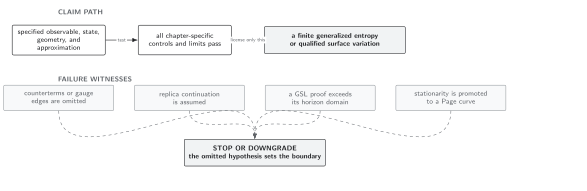
Unmatched scheme changes are not physical entropy changes; all local bulk and surface counterterms must transform together. Schematic; not to scale.
References
Section titled “References”- Solodukhin, S. N., “Entanglement Entropy of Black Holes,” Living Reviews in Relativity 14, 8 (2011), doi:10.12942/lrr-2011-8.
- Susskind, L., and J. Uglum, “Black Hole Entropy in Canonical Quantum Gravity and Superstring Theory,” Physical Review D 50, 2700–2711 (1994), doi:10.1103/PhysRevD.50.2700.
Original QFT.org content:CC BY 4.0, unless an item supplies different terms. Third-party material retains its own terms.