

Fine-Grained, Coarse-Grained, and Algebraic Entropy
The word “entropy” is useful only after one specifies the state, observable algebra, and operational question. In continuum QFT, the von Neumann entropy of a sharply bounded region is normally ultraviolet divergent, whereas relative entropy of two suitable states on the same local algebra can be finite and representation independent.
Required background. Regulated subregion entropy supplies the cutoff definition, and type-III local algebras explain why no density matrix for a sharp continuum region is generally available. Helpful background. See factorization failure and the operator-algebra bridge.
Four entropy objects
Section titled “Four entropy objects”For a regulated bipartition ,
is a fine-grained regulated entropy. It depends on the cutoff and factorization prescription. A coarse-grained entropy instead maximizes entropy subject to selected macroscopic constraints ,
and therefore depends on which information is discarded. Thermal entropy is one such coarse graining; it need not equal entanglement entropy.
For two normal states and on the same algebra, relative entropy is schematically
when a regulated density-matrix expression exists, with . Algebraically it is defined through the relative modular operator and retains positivity and monotonicity without assuming a tensor product. Araki’s construction supplies the continuum notion Araki 1976, §§2–3, pp. 809–820.
Finally, algebraic entropy data may mean relative entropy, modular spectrum, or entropy after choosing a split inclusion or a center. There is no unique number called “the algebraic entropy” for an arbitrary type-III factor. The algebra itself is part of the problem.
A useful continuum check is mutual information between separated regions,
defined through a common regulator or, more intrinsically, as a relative entropy. For positive separation, its leading boundary divergences cancel. As the separation closes, it diverges again, diagnosing the return of sharp-boundary correlations. A split inclusion similarly inserts a finite collar between nested regions and permits a type-I intermediary; its entropy depends on the collar, while algebraic inequalities do not. These constructions show precisely which part of finite-dimensional intuition can be recovered without pretending that the sharp local algebra factorizes.
First application: a Rindler wedge
Section titled “First application: a Rindler wedge”Let in Minkowski space and restrict the vacuum to . A short-distance regulator produces an area-divergent . The vacuum restricted to the wedge is KMS with respect to boosts, so an accelerated observer describes a thermal coarse graining at temperature . These are related descriptions but not equal finite numbers.
For a finite-energy perturbation of the vacuum , the wedge modular Hamiltonian is local,
and can be finite even though both regulated entropies diverge. The geometric boost flow is the special content of the Bisognano–Wichmann theorem Bisognano and Wichmann 1976, Thm. 3 and Eqs. (4.5)–(4.8).
The structure map places algebra choice before entropy arithmetic. Inspect how the same wedge supports different quantities because each answers a different operational question.

Fine-grained, relative, and coarse-grained entropies share state data but differ in algebra, regulator, and retained observables. Schematic; not to scale.
Domain and failure conditions
Section titled “Domain and failure conditions”The chapter’s canonical domain table records which entropy notion licenses each later horizon statement. Locally, write the tuple before manipulating entropy.
Adversarial test. If one writes for the sharp continuum wedge and treats as trace class, the type-III property and arbitrarily short-distance correlations invalidate the construction. Introducing a lattice, a split collar, or an edge prescription creates a legitimate regulated factorization, but its entropy is prescription dependent. Relative entropy on remains the strongest regulator-independent comparison.
Representation independence is another check. A change of Hilbert-space representation can alter density-matrix language while leaving the normal states and their relative entropy on the abstract algebra unchanged. Any proposed “horizon entropy” that changes under such a relabeling without a changed algebra or regulator is not yet an operational quantity.
The failure map should be read as a type check: a divergent fine-grained entropy cannot be silently replaced by a thermal entropy or by relative entropy.
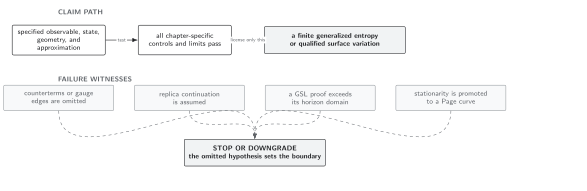
The cure for factorization failure is to declare a regulated split or use an algebraic quantity; the two choices answer different questions. Schematic; not to scale.
References
Section titled “References”- Araki, H., “Relative Entropy of States of von Neumann Algebras,” Publications of the Research Institute for Mathematical Sciences 11, 809–833 (1976), doi:10.2977/prims/1195191148.
- Bisognano, J. J., and E. H. Wichmann, “On the Duality Condition for a Hermitian Scalar Field,” Journal of Mathematical Physics 17, 303–321 (1976), doi:10.1063/1.522898.
Original QFT.org content:CC BY 4.0, unless an item supplies different terms. Third-party material retains its own terms.