

Spinor and Gauge Fields in Expanding Universes
Spinors and gauge fields inherit FLRW time dependence through different structures. Tetrads and the spin connection are essential for Dirac fields; gauge constraints remove unphysical photon polarizations. In four dimensions, free massless Dirac and Maxwell fields are conformally invariant and have no state-dependent production in the conformal vacuum.
Required background. FLRW mode quantization supplies the oscillator logic; spinors and tetrads supplies the spin connection; and curved gauge fields supplies gauge fixing. Helpful background. Review fermion and gauge Hadamard states.
Dirac and Maxwell canonical variables
Section titled “Dirac and Maxwell canonical variables”Choose the diagonal tetrad . For
the rescaled spinor satisfies
Each helicity sector is a two-level system. Its normalized spinors enforce
For , the rescaled equation is Minkowskian, so the conformal vacuum has . Expansion can produce massive spinors through the time dependence of , with Pauli exclusion bounding each occupation. Parker derives this spin- production problem and its zero-mass control directly Parker 1971, §§II–IV, pp. 349–356.
For Maxwell theory in four dimensions, use Coulomb gauge , . The two transverse polarizations obey
There is no free-photon production in the conformal vacuum; the conformal reduction of the four-dimensional Maxwell action gives the authoritative control Birrell and Davies 1982, §3.5, pp. 61–64. A mass, a time-dependent gauge kinetic function, charged matter, or an anomaly changes the theory and can produce excitations; it is not an exception to the free Maxwell statement.
First application: physical modes and constraints
Section titled “First application: physical modes and constraints”Construct helicity spinors with positive-frequency data at an adiabatic early time and verify both spinor completeness and the fermionic anticommutator. Independently evolve the two Maxwell transverse modes and monitor Gauss’s constraint. The massless limits reduce to flat equations after rescaling. These conformal controls complement the scalar result and sharpen the field-dependent conclusion of early analyses of particle creation in expanding universes Parker 1968, pp. 562–564.
Constraint-preserving comparison
Section titled “Constraint-preserving comparison”For a massive Dirac field, eliminating one helicity component produces a second-order equation with a term proportional to . That complex term does not signal nonunitary evolution; it records the first-order spinor coupling between components. Evolving both components and checking their conserved norm is safer than treating either scalar-like equation independently. The fermionic Bogoliubov relation has a plus sign, , so a bosonic normalization routine will silently violate Pauli exclusion.
For Maxwell theory, the physical phase space has two transverse canonical pairs. Coulomb gauge makes them explicit, while a covariant gauge adds longitudinal, timelike, and ghost variables whose contributions cancel in gauge-invariant observables. A count of every component oscillator therefore overcounts photons. The best cross-check is not equality of component mode functions between gauges but equality of transverse field-strength correlators such as after constraints and contact terms are treated consistently.
Massless conformal controls are also theory controls. Magnetogenesis from a coupling , massive-vector longitudinal production, or fermion production from a time-dependent Yukawa mass are valid but different models. Their extra background functions, strong-coupling limits, and stress must be declared before the corresponding spectra can be compared with the free results here.
The structure map separates physical mode evolution from gauge fixing and from later particle interpretation. Inspect the constraint branch before counting polarizations.

Spinor normalization and gauge constraints determine the physical mode space; conformal invariance removes free massless production in the conformal vacuum. Schematic; not to scale.
Domain and failure conditions
Section titled “Domain and failure conditions”Use the chapter’s canonical domain table. The Maxwell conclusion is four-dimensional and assumes a free conformal action; the spinor conclusion assumes a chosen spin structure and smooth tetrad.
Adversarial test. Repeat the Dirac calculation in a locally Lorentz-rotated tetrad and the Maxwell calculation in covariant gauge. After transforming spinors, constraints, ghosts, and inner products, physical norms and transverse correlators agree. A tetrad-dependent or a count including longitudinal/ghost modes is not a physical production result.
The failure map stops both artifacts before abundance or backreaction.
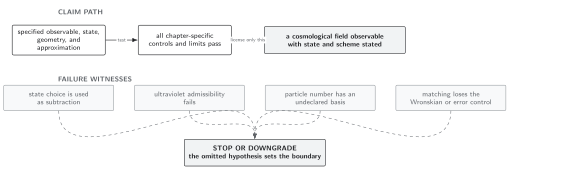
Production is meaningful only on the physical constrained mode space and must survive tetrad or gauge translation. Schematic; not to scale.
References
Section titled “References”- Birrell, N. D., and P. C. W. Davies, Quantum Fields in Curved Space, Cambridge Monographs on Mathematical Physics (Cambridge University Press, 1982), doi:10.1017/CBO9780511622632.
- Parker, L., “Particle Creation in Expanding Universes,” Physical Review Letters 21, 562–564 (1968), doi:10.1103/PhysRevLett.21.562.
- Parker, L., “Quantized Fields and Particle Creation in Expanding Universes. II,” Physical Review D 3, 346–356 (1971); erratum 3, 2546 (1971), doi:10.1103/PhysRevD.3.346.
Original QFT.org content:CC BY 4.0, unless an item supplies different terms. Third-party material retains its own terms.