

Greybody Scattering and Flux Accounting
Hawking thermality fixes a horizon occupation factor; the curved exterior filters it. Greybody factors are transmission probabilities obtained from a separate radial scattering problem with conserved flux and specified boundary conditions. They reshape the spectrum and set the luminosity seen at infinity.
Required background. Black-hole states supplies mode populations, curved-space Green functions fixes propagation and flux, and spectra and resolvents supplies the one-dimensional operator viewpoint.
Helpful background. Scalar propagators fixes normalization, and special functions from boundary data supports analytic approximations.
The Schwarzschild radial barrier
Section titled “The Schwarzschild radial barrier”For a massless minimally coupled scalar on Schwarzschild, separate
The radial equation is
with
For a unit wave incident from infinity,
The conserved Wronskian
gives
Massive fields or unequal asymptotic wave numbers require velocity factors; rotating or charged horizons replace the horizon frequency and can make the reflected flux exceed the incident flux.
The structure map assigns this radial problem its own box after thermality. Inspect the Wronskian checkpoint: energy conservation at both ends is the normalization test before any spectrum is folded.

Greybody scattering in the Hawking construction. The diagram is schematic and not to scale; the transmission coefficient is independent information not contained in or the state label.
The failure map tests the unit-transmission shortcut. Setting is a blackbody approximation whose error is frequency and partial-wave dependent, not a property of the horizon temperature.
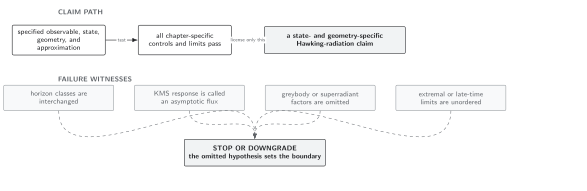
Failure boundary for flux accounting. This schematic, not-to-scale map downgrades a unit-transmission result to a horizon-source spectrum unless the radial potential is demonstrably transparent.
Application: the low-frequency scalar wave
Section titled “Application: the low-frequency scalar sss wave”Matched asymptotics for gives
Equivalently, the low-frequency scalar absorption cross section tends to the horizon area:
This equality is a useful normalization check, not merely an interpretation. Substituting only the term gives
The powers of cancel and the remaining area has the correct dimension. Higher partial waves begin at higher powers of , so they do not change the limit. Conversely, a numerical solution that approaches a nonzero constant as would produce a divergent cross section and signals incorrect flux normalization or boundary extraction.
For the Unruh state, this channel contributes
and the energy spectrum has one additional factor of . Page’s numerical emission calculation demonstrates how transmission and spin-dependent potentials reshape the ideal blackbody spectrum (Page 1976, §§ II–IV).
Setting overestimates the -wave number spectrum by a factor approximately at low frequency. It also populates high- modes below their centrifugal barriers. At high frequency the summed absorption approaches the geometric capture cross section, for Schwarzschild, but that limit does not make every partial wave transparent at every frequency.
A reproducible numerical solution integrates from both asymptotic ends or uses a stable transfer method, extracts and , and verifies the Wronskian residual before folding the result with the occupation factor. Convergence in radial domain, precision, and partial-wave cutoff are separate from perturbative QFT error.
Two further checks localize common failures. First, compute from the absorbed horizon flux and independently from ; their difference measures integration and fitting error. Second, increase until both the number and energy spectra converge over the entire reported frequency interval. A small error in total luminosity can otherwise conceal a poorly resolved spectral tail.
Domain and failure conditions
Section titled “Domain and failure conditions”The shared domain and failure-conditions table places scattering between thermality and flux. The formulas above assume a massless scalar, Schwarzschild asymptotics, unit incident flux, and a real radial potential. They license and the displayed spectrum. Massive thresholds require velocity factors; rotation or charge requires shifted horizon energy and can yield superradiance. Omitting the barrier downgrades the result to a horizon blackbody source, not an asymptotic luminosity.
Exercise
Section titled “Exercise”Derive from the Wronskian boundary values.
Solution
At infinity the incoming and reflected fluxes give . At the horizon, the ingoing transmitted wave gives . Equality of the constant Wronskian yields .
Handoff
Section titled “Handoff”For rotating or charged horizons, the horizon flux is weighted by a shifted frequency. Its sign can reverse, producing superradiant amplification and changing the thermal occupation factor.
References
Section titled “References”- Page, Don N. “Particle Emission Rates from a Black Hole: Massless Particles from an Uncharged, Nonrotating Hole.” Physical Review D 13 (1976): 198–206; erratum Physical Review D 14 (1976): 3260. doi:10.1103/PhysRevD.13.198.
- Visser, Matt. “Some General Bounds for One-Dimensional Scattering.” Physical Review A 59 (1999): 427–438. doi:10.1103/PhysRevA.59.427.
Original QFT.org content:CC BY 4.0, unless an item supplies different terms. Third-party material retains its own terms.