

Matter Contributions to Gravitational Matching
Matter matching asks what remains in the gravitational EFT after a specified matter field is integrated out. A matter determinant contains closed matter loops with any number of external background gravitons, but no internal graviton or ghost propagator. Its low-momentum expansion shifts gravitational Wilson coefficients; using those shifts and retaining the same heavy loop explicitly would count the same physics twice.
Required background. One-Loop Graviton EFT distinguishes metric–ghost loops from matter loops; Renormalization of Gravitational Couplings by Matter Loops supplies the matter counterterms; and Matching Conditions Beyond Tree Level supplies loop-level matching.
Helpful background. Decoupling Theorems and Threshold Corrections fixes the low-energy expansion, while Heat Kernels and the Schwinger–DeWitt Expansion supplies its local coefficients.
Which internal lines have been integrated out
Section titled “Which internal lines have been integrated out”For a real scalar with
integrating over at fixed gives
Expanding in generates one closed scalar loop with external gravitons. It does not generate a loop containing an internal graviton, because has not been integrated over. A later path integral over low-energy metric fluctuations uses the matched gravitational action and separately creates graviton and ghost loops. Mixed heavy-scalar–graviton graphs require their own matching calculation at the corresponding higher loop order.
For momenta and curvature scales small compared with , the scalar determinant has a local asymptotic expansion. In the site curvature and coupling convention, the curvature-squared heat-kernel density for a boundaryless four-dimensional region may be organized as
The last term is locally scheme dependent and becomes consequential with a boundary. The replacement explains why the conformal combination is here. Parker and Toms derive the scalar coefficients and their convention translations in Parker and Toms 2009, §3.6, pp. 168–176.
The same determinant also contains its lower heat-kernel orders. The term is proportional to and threshold-matches the vacuum-energy coupling, while contains and threshold-matches in the declared action convention. The worked example below deliberately isolates because its task is curvature-squared matching; it does not imply that heavy matter leaves the zero- and two-derivative gravitational couplings unchanged.
The structure map sends this heat-kernel information into matching before any low-energy metric loop is evaluated.

Integrating out a heavy scalar produces matter-loop threshold terms in gravitational Wilson coefficients; subsequent metric and ghost loops are distinct contributions. The map is schematic and not to scale.
First application: one heavy scalar
Section titled “First application: one heavy scalar”Choose the local basis and define by
The displayed gives
up to the stated total derivative and basis changes. With the gravitational action written as , equality of renormalized low-energy observables defines the threshold relation
Here is a finite, scheme- and basis-dependent matching constant. Its sign is fixed only after the definitions of and the effective action are fixed as above. Choosing avoids a large logarithm; running above and below the threshold then resums scale separation. Appelquist and Carazzone establish the low-energy expansion under its renormalizable-theory hypotheses in Appelquist and Carazzone 1975, §III, pp. 2862–2866.
To test the same coefficients in an observable, couple the metric to light external matter and consider momentum transfer . The heavy scalar contribution to the graviton two-point function is analytic,
where the are the tensor projectors obtained by expanding . Inserting the matched in the low-energy graviton exchange reproduces the full-theory amplitude through . Field redefinitions may trade Ricci operators for light-matter contact terms; both must be transformed before comparing amplitudes.
Double-counting test
Section titled “Double-counting test”Suppose the low-energy calculation uses above and also draws the heavy-scalar polarization loop. The contribution then appears twice. The repair is categorical: either retain as an active field and use high-energy coefficients, or remove it from propagating loops and use the low-energy matched coefficients. Near threshold, where a local expansion is inaccurate, one retains the full form factor or matches to an EFT with appropriate active modes.
This bookkeeping does not say that every matter effect is analytic. A light or massless field has nonanalytic cuts and remains active; its long-distance form factor cannot be absorbed into local . Nor does the calculation include pure metric or ghost loops, which are separately counted on the preceding page.
Domain and failure conditions
Section titled “Domain and failure conditions”The chapter comparison table requires the integrated species, mass and curvature hierarchy, boundary conditions, basis, subtraction scheme, active low-energy fields, and matched observable. If denotes the largest independent curvature scale measured in the apparatus-defined orthonormal frame, the local result requires and ; threshold and nonlocal regimes require the unexpanded form factor.
The failure map identifies duplicated heavy loops as a matching error, not an uncertainty estimate.
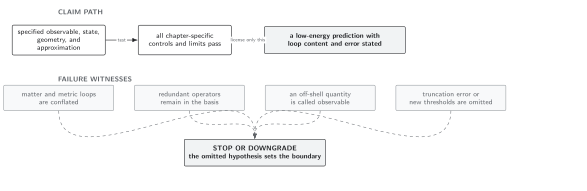
Heavy matter is either active in explicit loops or integrated into low-energy coefficients at a stated matching scale; mixing those descriptions without subtraction double counts the threshold. The map is schematic and not to scale.
References
Section titled “References”- Appelquist, T., and J. Carazzone. “Infrared Singularities and Massive Fields.” Physical Review D 11, 2856–2861 (1975). doi:10.1103/PhysRevD.11.2856
- Parker, L., and D. Toms. Quantum Field Theory in Curved Spacetime: Quantized Fields and Gravity. Cambridge: Cambridge University Press, 2009. doi:10.1017/CBO9780511813924
Original QFT.org content:CC BY 4.0, unless an item supplies different terms. Third-party material retains its own terms.