

Spinors, Tetrads, and Spin Connections
A curved Dirac field requires more than a metric: it needs an orientation and time orientation, a spin structure, a tetrad or orthonormal frame, a compatible spin connection, and a consistent adjoint. The tetrad converts spacetime indices into Clifford indices, while the spin connection makes local Lorentz changes a redundancy of the description. When these data exist, the Dirac current is conserved and supplies the positive inner product used in fermionic quantization.
Required background. Curved Spacetimes, Cauchy Surfaces, and Global Hyperbolicity fixes the causal setting; Spin Structures and Dirac Operators supplies the global lift from frames to spin frames; The Dirac Field supplies flat-space spinor dynamics and the adjoint.
Helpful background. Vector, Principal, and Associated Bundles explains associated spinor bundles; Bundle Connections, Curvature, Gauge Transformations, and Bianchi Identities supplies connection language.
Tetrads and the curved Clifford algebra
Section titled “Tetrads and the curved Clifford algebra”Let be a tetrad and its inverse:
Flat gamma matrices obey . The curved matrices
then satisfy . A tetrad is not unique. Under a local proper, orthochronous Lorentz transformation,
where is a lift to the spin group. A global lift exists only when the oriented orthonormal-frame bundle admits a spin structure.
The torsion-free spin connection is
with . The Dirac equation is
Squaring it gives a normally hyperbolic second-order operator with a curvature term. With the conventions above, the Lichnerowicz identity is most safely checked from the declared Riemann and Clifford signs before importing a source formula; the first-order equation, rather than a memorized sign in its square, fixes the theory.
Conserved current and inner product
Section titled “Conserved current and inner product”Use . If and solve the Dirac equation with real , then
obeys . On a spacelike Cauchy surface with future unit normal ,
In an orthonormal frame adapted to , the integrand is , so the form is positive. Stokes’ theorem makes it independent of when there is no flux through another boundary. This is the fermionic analogue of the scalar conserved pairing, but it is Hermitian and positive rather than symplectic.
Dappiaggi, Hack, and Pinamonti construct the classical Dirac field, its locally covariant algebra, and the relevant adjoints on globally hyperbolic spin spacetimes Dappiaggi, Hack, and Pinamonti 2009, §§2–3.
First application: an FLRW tetrad
Section titled “First application: an FLRW tetrad”In four dimensions, take
The Dirac equation becomes
Rescale . Then
For this is the Minkowski Dirac equation in conformal coordinates. The inner product is
which provides an immediate normalization check.
Now rotate the tetrad locally: , , and . The spin-connection inhomogeneous term cancels the derivative of , so and the inner product are unchanged. Components and connection coefficients change; observables do not.
Global obstruction and orientation test
Section titled “Global obstruction and orientation test”A tetrad can always be chosen locally. It does not follow that one exists globally, still less that the frame bundle has a spin lift. For example, in five dimensions take an ultrastatic spacetime
This is globally hyperbolic with compact Cauchy surface , but is not spin because its second Stiefel–Whitney class is nonzero. An ordinary global Dirac spinor bundle therefore does not exist. A local gamma-matrix calculation cannot remove that obstruction; one must change the field structure, for example to an admissible spin-c construction when the physical problem supplies the required line bundle.
Reversing tetrad orientation or time orientation also changes which connected component of the frame bundle is being lifted. It cannot be hidden in a component relabeling when chirality, charge conjugation, or the positive normal in the inner product is consequential.
Construction and failure maps
Section titled “Construction and failure maps”In the construction map, the “field bundle” box is literal for a Dirac field: a spinor bundle and spin connection must exist before the operator and conserved solution space can be formed.

The fermionic construction transports frame data through the Dirac operator to a positive conserved pairing and CAR algebra; the map is schematic and not to scale.
For the failure map, the adversarial witness is global: local tetrads can pass every coordinate check while the manifold has no spin structure. Orientation and adjoint consistency are independent checks.
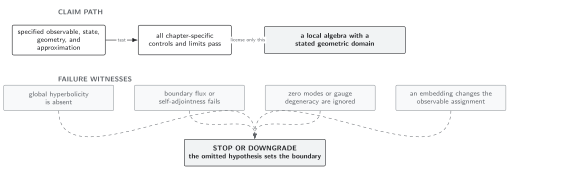
A curved Dirac field is licensed only on the stated spin background with compatible orientation and Hermitian structure; otherwise the field bundle itself must change. Schematic and not to scale.
The cross-field table is under Domain and failure conditions. On this page the decisive checks are the spin obstruction, tetrad signature, Clifford relation, spin-connection covariance, current conservation, and positivity on a future-directed Cauchy surface.
Common pitfalls
Section titled “Common pitfalls”A tetrad is not a new observable field here. It is a representation of the prescribed metric, related by local Lorentz gauge transformations. Dynamical tetrads belong to gravitational theories.
Local spin frames do not prove global existence. The obstruction is topological and must be checked on the whole spacetime or Cauchy surface.
The squared equation is not the full fermion theory. Squaring loses the first-order constraint and can introduce solutions not obeying the original Dirac equation.
References
Section titled “References”- Christian Bär, Nicolas Ginoux, and Frank Pfäffle, Wave Equations on Lorentzian Manifolds and Quantization, European Mathematical Society (2007), Open PDF, §§1.5 and 3.5.
- Claudio Dappiaggi, Thomas-Paul Hack, and Nicola Pinamonti, “The Extended Algebra of Observables for Dirac Fields and the Trace Anomaly of Their Stress-Energy Tensor,” Reviews in Mathematical Physics 21 (2009), 1241–1312, DOI, arXiv:0904.0612.
- H. Blaine Lawson Jr. and Marie-Louise Michelsohn, Spin Geometry, Princeton University Press (1989), Chapters II–III, publisher record.
Original QFT.org content:CC BY 4.0, unless an item supplies different terms. Third-party material retains its own terms.