

The Stress-Tensor Noise Kernel
The noise kernel is the connected, symmetrized covariance of the renormalized stress tensor at two spacetime points. It contains information absent from the semiclassical source , but it is still a quantum bi-distribution: positivity is asserted after smearing, and no classical random stress tensor or pointwise variance is assumed on this page.
Required background. Stress Bi-Tensors and Noise-Kernel Input supplies the separated-point composite operator and primed-index conventions; Quasifree States and Two-Point Functions supplies Wick factorization.
Helpful background. Wick Polynomials and Point Splitting explains local composite-field subtraction, while Connected Correlators and Cumulants fixes the connected subtraction.
Centered stress covariance
Section titled “Centered stress covariance”For a state , define
and, with the second tensor living at ,
This is the chapter’s fixed normalization. It implies exchange symmetry
and symmetry within each index pair. If the renormalized stress tensor obeys its Ward identity, then and as distributional identities, apart from explicitly retained contact terms. The anticommutator is essential: the stress commutator instead supplies causal response. These roles are separated in Hu and Verdaguer 2008, §§3.2 and 4.1, eqs. (11)–(12) and (22)–(27).
Let be real and set
Then
This smeared inequality is the covariance-positivity condition needed for a real Gaussian representation. It says nothing about the undefined expression .
The structure map locates this object before both the response kernel and the stochastic metric equation. Inspect the fork: the symmetric covariance and antisymmetric response are not recoverable from one another in a generic state.

The noise kernel is a matter-state input to stochastic gravity, not yet a metric fluctuation and not a replacement for the retarded response kernel. The map is schematic and not to scale.
First application: a Gaussian scalar on an ultrastatic spacetime
Section titled “First application: a Gaussian scalar on an ultrastatic spacetime”Take with , compact , and a free real scalar satisfying
Let be positive-frequency modes of a stationary quasifree state. Write the point-split stress tensor as a bidifferential operator acting on . Away from all partial diagonals, Wick’s theorem gives the connected stress covariance
with any state-independent local subtraction already included in the definition of . This is the general stress-bitensor construction specialized to a Gaussian scalar; explicit differential forms are given in Phillips and Hu 2001, §§II–III.
For a real compactly supported sampler , insert the mode expansion. In the ground state the smeared operator has a pair-creation part
where cancels in the centered operator. Direct contraction yields
The exact coefficient depends on the convention used to symmetrize , but the norm-square form and its sign do not. Conservation follows by integrating the Ward identity against ; for a pure-gauge sampler with compactly supported , integration by parts gives . Exchange symmetry is immediate from the real part. These are three independent checks: algebraic symmetry, the Ward identity, and covariance positivity.
Same mean stress, different fluctuations
Section titled “Same mean stress, different fluctuations”One oscillator mode already defeats the idea that the mean fixes the noise. Compare
Both have and no anomalous two-point function, so their contribution to the stationary mean stress is identical. Yet
A stress sampler sensitive to that mode therefore has different connected four-point data and a different noise kernel. Mean semiclassical backreaction cannot distinguish the states; stochastic gravity can at second order. For non-quasifree states, the connected four-point function must be supplied rather than reconstructed from .
Domain and failure conditions
Section titled “Domain and failure conditions”Use the chapter’s comparison table to locate this page at the “Gaussian stochastic” input layer. The result requires a state on the stress algebra, a renormalized stress prescription, and admissible test tensors. Boundaries, non-Hadamard singularities, or partial-diagonal restrictions may change the distributional domain. Coincidence extensions belong to the next page, metric propagation belongs to Einstein–Langevin dynamics, and the commutator cannot be inferred from .
The failure map highlights the first decisive mistake: replacing the smeared quadratic form by an unsmeared value at .
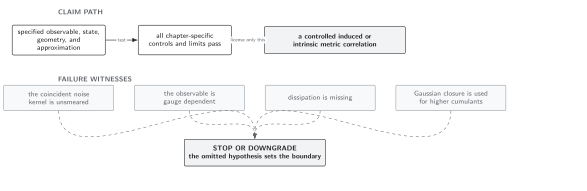
Covariance positivity licenses a Gaussian representation only on the declared test-function space; it does not license a pointwise random stress tensor. The map is schematic and not to scale.
Exercises
Section titled “Exercises”Show that is unchanged if a constant multiple of the identity is added to .
Solution
The same constant is added to , so it cancels in . Hence neither nor its variance changes. This does not remove derivative contact ambiguities in a renormalized product of two stress tensors.
References
Section titled “References”- Hu, B. L., and E. Verdaguer. “Stochastic Gravity: Theory and Applications.” Living Reviews in Relativity 11, 3 (2008). doi:10.12942/lrr-2008-3. Open PDF
- Phillips, N. G., and B. L. Hu. “Noise Kernel in Stochastic Gravity and Stress Energy Bitensor of Quantum Fields in Curved Spacetimes.” Physical Review D 63, 104001 (2001). doi:10.1103/PhysRevD.63.104001. Open PDF
Original QFT.org content:CC BY 4.0, unless an item supplies different terms. Third-party material retains its own terms.