

Contact, Exchange, and Seed Solutions
Seed solutions turn abstract Ward and singularity constraints into normalized boundary coefficients. A contact seed represents a local vertex in a chosen field basis; an exchange seed carries nonlocal propagation for a specified internal mass and spin. Differential operators can generate broader families, but they also generate boundary and contact terms that must be retained.
Required background. The object dictionary fixes the coefficient convention, cosmological Ward identities fix the differential constraints, and cubic interactions and bispectrum shapes supplies explicit inflationary vertices.
Helpful background. Scalar contact and exchange amplitudes provide the flat-space comparison, and derivative interactions and contact terms clarify boundary contributions.
A normalized contact seed
Section titled “A normalized contact seed”Let denote the usual positive-frequency Bunch–Davies field mode. In the ket-wavefunction convention used here, the bulk-to-boundary solution is
normalized to one at the late cutoff and damped on the ket contour. (The bra branch uses the conjugate solution.) For a local -field vertex with time-dependent weight , the stripped contact coefficient is
The coupling, overall branch phase, polarization tensors, and momentum delta function are restored according to the object convention. Integration by parts changes by endpoint pieces unless the boundary conditions make them vanish.
An elementary benchmark is a conformally rescaled scalar on the conformal half-space with a constant quartic interaction. After stripping the common coupling and branch phase, and
Thus the reduced real seed is proportional to . It has the expected degree , only a total-energy singularity, and no exchange-channel pole. The statement applies to this conformal variable and interaction; converting to a covariant de Sitter field can introduce scale factors, derivatives, and boundary terms.
Massive scalar exchange
Section titled “Massive scalar exchange”For an interaction , with exchanged comoving momentum
the -channel wavefunction seed is
is not an arbitrary Feynman propagator: it obeys the Bunch–Davies condition in the far past and the wavefunction boundary condition at . These conditions fix homogeneous additions.
For a scalar of mass in four-dimensional de Sitter, define
The two late-time behaviors are and . In the collapsed limit, the exchange seed contains nonanalytic powers determined by these weights. For , and the pair becomes oscillatory in . Local contact interactions produce analytic powers in and cannot remove this nonanalytic exchange signal.
Near a partial-energy singularity on a specified complex sheet,
the singular part factorizes into the normalized left and right three-point data times the appropriate internal two-point kernel. The power, phase, and whether one takes a residue or discontinuity depend on the mass and branch. The check is best performed by inserting a spectral representation of and comparing with the direct double integral.
Baumann, Duaso Pueyo, Joyce, Lee, and Pimentel construct the conformally coupled scalar exchange seed and weight-shifting maps to massless and spinning correlators (Baumann et al. 2020, §§ 3–5).
Differential generation and helicity
Section titled “Differential generation and helicity”Weight-raising, spin-raising, and momentum differential operators can map a scalar seed to other external weights or exchanged spins:
The helicity label is defined using transverse polarization tensors, and the induced contact term is part of the result. The operator must map both the Ward equation and its source; commuting it through a regulated integral may produce boundary contributions. A generated expression is accepted only after checking its weights, transversality, soft limits, channel residue, and absence of spurious singularities.
Equation-of-motion adversarial test
Section titled “Equation-of-motion adversarial test”Add an interaction proportional to a free equation of motion,
A local field redefinition removes the bulk operator, but integration by parts and the finite late boundary generate contact and boundary vertices. Compute the exchange coefficient in the original and redefined actions. After translating the external field and adding every induced term:
- the nonanalytic massive-exchange powers and factorization residues must agree;
- analytic contact coefficients may differ;
- an equal-time correlator agrees only after the operator redefinition is included.
Reject a seed basis that declares the two actions physically different because it omitted induced contacts. Maldacena’s treatment of inflationary cubic terms gives a canonical example of equation-of-motion operators moved into a nonlinear field redefinition (Maldacena 2003, Eqs. (3.9)–(3.12)).
The structure map shows contact and exchange seeds as different inputs to later singularity constraints. Inspect the nonlocal internal line and the explicit local-completion branch.

Contact, exchange, and differential seed construction. The diagram is schematic and not to scale; state, boundary conditions, normalization, helicity, and induced contact terms are part of each seed.
The failure map identifies basis artifacts. Inspect the stops for a wrong propagator, dropped endpoint term, unnormalized external mode, or differential operator that introduces a spurious pole.
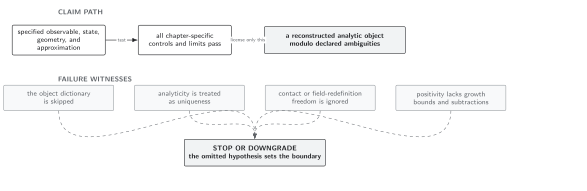
Failure conditions for cosmological seed solutions. The diagram is schematic and not to scale; nonlocal exchange data survive allowed basis changes, while local representatives need not.
These conditions refine the chapter’s domain and failure conditions. Their singularities are classified in total-energy and factorization singularities.
Exercise
Section titled “Exercise”Evaluate the regulated conformal contact integral
and take for .
Solution
Direct integration gives
The lower endpoint vanishes because . Therefore . Restoring the interaction’s branch factor determines whether the final wavefunction coefficient is real or imaginary in a given convention.
References
Section titled “References”- Baumann, D., C. Duaso Pueyo, A. Joyce, H. Lee, and G. L. Pimentel. “The Cosmological Bootstrap: Weight-Shifting Operators and Scalar Seeds.” Journal of High Energy Physics 2020, no. 12 (2020): 204. DOI. Open PDF.
- Maldacena, J. “Non-Gaussian Features of Primordial Fluctuations in Single Field Inflationary Models.” Journal of High Energy Physics 2003, no. 05 (2003): 013. DOI. Open PDF.
Original QFT.org content:CC BY 4.0, unless an item supplies different terms. Third-party material retains its own terms.