

Local Covariance, Isometries, and Background Embeddings
Local covariance expresses one theory consistently on many backgrounds. A causal isometric embedding carries observables from the smaller spacetime into the larger one, and composition of embeddings must agree with composition of algebra maps. This comparison is made before a state is chosen. Boundaries, background gauge fields, orientations, and bundle structures must be included in the objects and morphisms whenever the theory depends on them.
Required background. Local Field Algebras, Causality, and the Time-Slice Property supplies the net of observables; Curved Spacetimes, Cauchy Surfaces, and Global Hyperbolicity supplies the background category.
Helpful background. Local Composite-Operator Insertions motivates locally constructed fields; Differential Forms, Integration, and Stokes’ Theorem prepares background-form transformations.
A theory as a covariant assignment
Section titled “A theory as a covariant assignment”Let an object consist of an oriented, time-oriented globally hyperbolic spacetime together with every declared background structure required by the field. A standard morphism
is an orientation- and time-orientation-preserving isometric embedding whose image is causally convex. A locally covariant theory assigns an algebra to each object and an injective homomorphism
to each morphism, with
This is the generally covariant locality principle of Brunetti, Fredenhagen, and Verch Brunetti, Fredenhagen, and Verch 2003, §§2–3.
A locally covariant field is a compatible family of maps from test sections to algebras. For a scalar,
For a spinor, gauge potential, or charged field, must include the spin lift, bundle map, connection, and any orientation data. Metric covariance alone is insufficient when the field depends on more than the metric.
An isometry induces an algebra automorphism. A choice of state is invariant only if
Covariance of the theory does not imply invariance of every state.
First application: the same causal diamond in two universes
Section titled “First application: the same causal diamond in two universes”Let be a relatively compact causally convex region that embeds isometrically into globally hyperbolic spacetimes and :
The algebra maps consistently into both and . Any algebraic relation determined entirely inside —the equation of motion, the causal commutator, and covariance of a local field—is transported by these embeddings. The remote geometries of and do not alter that local relation.
States behave differently. A state on pulls back to , but it need not extend uniquely to , and a preferred state on need not correspond to one on . This is why the local comparison is made at the algebra level before state-dependent expectation values.
The statement also has a boundary condition. If has a timelike boundary that can causally influence , then the local dynamics may depend on the chosen boundary theory. One must either work with a category that records that boundary data or restrict to a causally isolated subregion where the same Green operator is obtained.
Adversarial embedding tests
Section titled “Adversarial embedding tests”First replace a causally convex embedding by an isometric embedding whose image admits a causal curve that leaves and re-enters. The metric pullback is still correct, but propagation in the larger spacetime can connect points through the exterior. The naive algebra map need not preserve the intended causal relations.
Second, keep the local metric fixed while changing a distant boundary condition. If signals from the boundary can return to the region, the causal propagator and observable assignment can change. If no causal curve reaches the boundary within the domain considered, local covariance licenses only that restricted comparison—not a statement about the entire global algebra.
Third, change a background gauge connection while preserving the metric. A charged field detects the holonomy, so an embedding that forgets the connection is not a morphism of the full background. The necessary background structures must be transported together.
Construction and failure maps
Section titled “Construction and failure maps”The construction map emphasizes that the field bundle and causal domain are inputs to the local algebra. For this page, an embedding is admissible only when it transports those inputs and preserves the causal comparison.

Local covariance compares background-dependent algebras before state-dependent expectation values; the construction map is schematic and not to scale.
In the failure map, inspect the witness “an embedding changes the observable assignment.” It detects a missing background structure, lost causal convexity, or an unrecorded boundary condition.
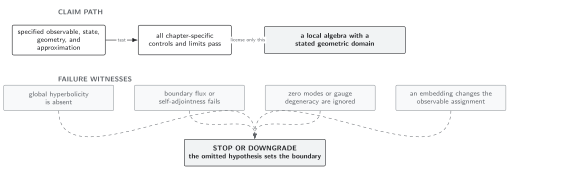
Only embeddings in the declared background category license an algebra map; an omitted connection or boundary condition changes the theory rather than its presentation. Schematic and not to scale.
See the chapter comparison under Domain and failure conditions. The page-specific decisive check is functorial preservation of the full background and causal structure. Failure requires restricting the domain or enlarging the category; it cannot be repaired by choosing a different state.
Check your understanding
Section titled “Check your understanding”Does an isometric inclusion automatically define a locally covariant morphism?
Solution
No. In the standard globally hyperbolic category it must also preserve orientation and time orientation and have causally convex image. It must transport every additional background structure used by the field. A boundary-sensitive theory further requires compatible boundary data or a restricted causally isolated domain.
Relative Cauchy Evolution and Background Response turns these embeddings into a controlled comparison under a compact background perturbation. The theorem-first categorical framework and dynamical locality remain in Volume XVI.
References
Section titled “References”- Romeo Brunetti, Klaus Fredenhagen, and Rainer Verch, “The Generally Covariant Locality Principle—A New Paradigm for Local Quantum Field Theory,” Communications in Mathematical Physics 237 (2003), 31–68, DOI, arXiv:math-ph/0112041.
- Christopher J. Fewster and Rainer Verch, “Algebraic Quantum Field Theory in Curved Spacetimes,” in Advances in Algebraic Quantum Field Theory, Springer (2015), 125–189, DOI, arXiv:1504.00586.
- Stefan Hollands and Robert M. Wald, “Quantum Fields in Curved Spacetime,” Physics Reports 574 (2015), 1–35, DOI, Open PDF, §§2 and 4.
Original QFT.org content:CC BY 4.0, unless an item supplies different terms. Third-party material retains its own terms.