

Curved Channels, Communication, and Entanglement Harvesting
A curved spacetime does not by itself define a communication channel. A channel appears only after one fixes an encoding, localized interactions, causal propagation, an accessible receiver algebra, a decoding, and a resource-bounded task. This chapter turns those choices into operational maps, then separates genuine signal transmission from pre-existing field correlations, deterministic redshift from noise, and restricted access from destruction of information.
Helpful background. Completely Positive Maps and Causal Quantum Channels supplies the abstract channel language, while Localized Probe and Detector Models supplies local couplings. Green Operators, Causal Propagators, and State-Dependent Two-Point Functions distinguishes causal response from state covariance. Detector Response Along Curved and Accelerated Worldlines supplies the proper-time detector response used in accelerated protocols.
A channel is an operational construction
Section titled “A channel is an operational construction”Let a sender system and receiver system couple to a real scalar field through compactly supported interaction densities. Schematically,
Here encodes a message, and are localized couplings, is field propagation on the stated geometry and state, denotes only a declared restriction to inaccessible observables or modes, and is the receiver decoding. The task must additionally name a metric—error probability, fidelity, distinguishability, or an asymptotic rate—and a resource constraint.
For a free field, two kernels play different roles. With the site convention
the causal response is fixed by and the field equation. The symmetrized two-point function
depends on the state and supplies fluctuations. A nonzero between two interaction regions can generate correlated detector outcomes even when vanishes there; it is therefore not a signaling kernel. This response–fluctuation separation is the organizing principle of the chapter and is consistent with the algebraic construction of relativistic communication channels on globally hyperbolic spacetimes Barcellos and Landulfo 2024, §§ II–IV.
Domain and failure conditions
Section titled “Domain and failure conditions”This is the chapter’s canonical comparison table. Every row specifies a task rather than attributing an intrinsic “channel quality” to curvature. “Validation” names the decisive control, not a maturity rating.
| Protocol class | Geometry, state, and worldlines | Coupling and encoding | Accessible output algebra | Causal exchange | Noise or restriction mechanism | Resource and task | Metric or capacity notion | Decisive validation or downgrade |
|---|---|---|---|---|---|---|---|---|
| Local probe channel | Globally hyperbolic background; declared Hadamard state; compact probe supports | Smeared monopole or oscillator coupling; finite code alphabet | Probe observables after field trace | Smeared retarded kernel | Field covariance, detector preparation, switching | Coupling budget and sender energy; one-shot transmission | Output distinguishability or fidelity | Delete the output algebra or resource bound: the operational task becomes undefined |
| Stationary Gaussian channel | Stationary geometry and quasifree state | Linear oscillator couplings; quadrature encoding | Selected receiver quadratures plus declared leakage modes | Gain matrix from retarded response | Added covariance from field and receiver | Mean excitation bound; repeated-use assumptions | Gaussian fidelity, coherent information, or classical rate | Replacing by a Wightman function confuses correlations with signal |
| Tail-mediated channel | Curved spacetime violating strong Huygens propagation | Compact source and detector switching | Receiver detector algebra | Timelike support inside the null cone | State noise remains separate | Finite interaction time and energy | Signaling estimator or induced channel norm | Correlation outside direct null support is not evidence until the commutator is tested |
| Accelerated-probe channel | Declared inertial and accelerated trajectories; proper-time clocks | Local detector coupling and timed modulation | Accelerated receiver observables | Trajectory-pulled retarded kernel | Unruh response, switching transients, mismatch | Proper-time duration, acceleration, coupling, energy | Gain and added noise; not detector temperature alone | Background clicks can change while causal gain does not, and conversely |
| Redshifted wavepacket link | Static or stationary geometry; specified emitter and receiver frames | Normalized wavepacket code with redshift-aware decoder | Full received mode family or an explicit subsystem | Causal propagation between wavepackets | Mode mismatch, loss, tracing, receiver noise | Local sender and receiver energy conventions | Overlap, transmissivity, fidelity | On the complete mode algebra a unitary frequency relabeling is not decoherence |
| Spacelike harvesting | Hadamard state; spacelike-separated compact supports | Two initially uncorrelated probes | Joint probe algebra | Zero between the supports | State anticommutator and local excitation | Coupling order, separation, switching, smearing | Negativity or another declared witness | Curvature has no universal monotonic effect; use a matched flat control |
| Timelike or tail-connected extraction | Timelike or interior-null-cone support | Same detector protocol with causal connection retained | Joint probe algebra | Generally nonzero | State correlations plus exchange | Same perturbative and detector controls | Final entanglement with exchange decomposition | If the result disappears when the commutator term is removed, call it exchange-assisted rather than pure harvesting |
| Horizon-restricted operations | Wedge or exterior local algebras; state and split collar declared | Completely positive local operations | Named von Neumann algebras, not a geometric tensor factor | Limited by causal accessibility | Algebraic restriction and operational coarse graining | Allowed operations, communication, copies | Witness value or distillable task | A formal trace over a region is not licensed without a subsystem construction |
| State-transfer link | Static or accelerated laboratories with calibrated clocks | Bosonic or qubit code plus receiver mode matching | Full decoding algebra including leakage | Retarded transfer amplitude | Loss, mode mismatch, state noise | Energy, bandwidth, time, control pulses | Entanglement fidelity or worst-case fidelity | High overlap with one selected mode does not establish a high-fidelity channel |
| Energy-constrained coding | Declared single-use or memory channel and local Hamiltonians | Code family over uses | Decoder and any assistance stated | Already contained in the channel map | Loss, thermal noise, time dependence | Mean or maximum energy, bandwidth, coding limit | Classical, quantum, private, or assisted capacity | An unconstrained bosonic rate or untranslated redshifted energy is not comparable |
| Tomographic deployment | Fixed clocks, frames, wavepackets, calibration, and drift model | Informationally complete preparations and observables | Calibrated receiver instrument | Estimated causal gain with support check | Estimated covariance and systematic model | Sample size and preparation budget | Confidence region for channel parameters | Changing the clock or basis after calibration can mimic physical drift |
| Analogue or astronomical test | Laboratory effective metric or astrophysical propagation model | Platform-specific preparation | Measured platform observables | Platform response only unless a protocol is implemented | Instrumental and environmental systematics | Declared experimental resources | Observable-level likelihood or witness | Agreement with an analogue dispersion relation does not confirm gravitational information transfer |
Read the chapter in order
Section titled “Read the chapter in order”- Curved-Spacetime Channel Deployment Contract fixes the geometry, state, couplings, clocks, accessible observables, task, and resources.
- From Propagators and Response Functions to Channel Maps derives causal gain and state-dependent noise from smeared kernels.
- Causal Support, Signaling, and Global Geometry treats light-cone support, tails, horizons, and topology.
- Accelerated Detector Communication Channels separates trajectory-dependent response, proper-time timing, signal gain, and added noise.
- Redshift, Restricted Access, and Effective Channel Noise distinguishes deterministic frequency conversion from mismatch, tracing, and receiver noise.
- Entanglement Harvesting in Curved Spacetime computes detector negativity and uses matched flat fixtures.
- Correlation Extraction versus Causal Exchange on Curved Backgrounds decomposes anticommutator and commutator contributions.
- Horizon-Restricted Local Operations and Distillability replaces informal region traces by accessible local algebras and split inclusions.
- Entanglement Distribution and State Transfer Through Curved Fields evaluates a complete decoded channel rather than one mode overlap.
- Energy-Constrained Capacity Under Redshift and Acceleration states coding tasks with local Hamiltonians and finite resources.
- Relativistic Protocols, Clocks, Encoding, and Channel Tomography makes calibration and coordinate changes explicit.
- Evidence, Analogue Systems, and Astrophysical Claim Limits classifies what present experiments do and do not establish.
Construction and failure maps
Section titled “Construction and failure maps”The construction map keeps the physical propagation stage between the sender and receiver couplings. Inspect its lower checkpoint: commutator support, resource accounting, and reference-frame transformation must be verified before the reduced receiver map is interpreted.

A reproducible channel separates causal propagation from receiver restriction, noise, and the task-specific performance measure; curvature alone is not a noise mechanism. Schematic; not to scale.
The failure map identifies four common overclaims. Each lower witness removes a required element of the operational statement, so the conclusion must stop or be narrowed at that boundary.
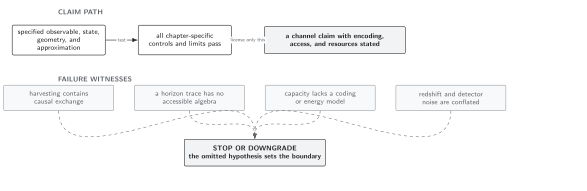
Channel claims are licensed only with specified observables, state, geometry, encoding, access, and resources; the four displayed witnesses force a precise downgrade. Schematic; not to scale.
Handoffs
Section titled “Handoffs”Causal Channels and Relativistic Communication develops the abstract channel, coding, harvesting, and protocol theory used here. Particles, Detectors, and Nonadiabatic Production owns response functions and particle interpretation. A reproducible calculation can provide the computational checks; mutable experimental claims require a dated research record rather than silent promotion into a durable theorem.
References
Section titled “References”- Barcellos, Ian Bernardes, and André G. S. Landulfo. “Relativistic Quantum Broadcast Channel.” Physical Review D 109 (2024): 065020. DOI. Open PDF.
- Fewster, Christopher J., and Rainer Verch. “Algebraic Quantum Field Theory in Curved Spacetimes.” In Advances in Algebraic Quantum Field Theory, edited by Romeo Brunetti, Claudio Dappiaggi, Klaus Fredenhagen, and Jakob Yngvason, 125–189. Cham: Springer, 2015. DOI. Open PDF.
Original QFT.org content:CC BY 4.0, unless an item supplies different terms. Third-party material retains its own terms.