

Observable-Specific Validity and Error Contracts
Validity is a relation among an observable, a state, a spacetime domain, a resolution, an approximation, and an accuracy target. Assigning one label to an entire geometry hides the fact that a mean field, a smeared fluctuation, and a late-time correlator probe different distributions and accumulate different errors.
Required background. The fixed-background-to-quantum-gravity regime taxonomy supplies the approximation levels; gravitational-EFT validity supplies cutoff criteria; numerical self-consistency and error budgets supplies reproducible tolerances; and energy and entropy bounds supplies hypothesis-sensitive inequalities.
Helpful background. Quasi-de Sitter validity supplies duration effects, while cosmological-bootstrap status supplies evidence and analyticity qualifications.
The error contract
Section titled “The error contract”Specify
is the observable with its smearing or detector response, the state, the causal domain, and the operational resolutions, the vector of expansion parameters, and the acceptable absolute or relative error. Relative error alone is unsuitable near a zero of the observable, so the acceptance condition should use a mixed norm such as
Curvature control is measured by an invariant apparatus-frame scale, for example with the largest relevant orthonormal-frame component or eigenvalue scale of the Riemann tensor—not by alone, which vanishes on Ricci-flat black-hole backgrounds. Other entries can include , , a secular parameter , and a response-weighted fluctuation measure.
Errors should be propagated with their correlations. Renormalization-scale variation, numerical discretization, state truncation, and EFT omission are not automatically independent, so adding their magnitudes in quadrature can understate the uncertainty. A conservative contract records a covariance model or gives separate bounded components. It also identifies a validation observable—such as a Ward identity, Wronskian, conserved flux, or regulator-independent nonanalytic term—that tests a different aspect of the calculation from the headline prediction.
Three observables on one background
Section titled “Three observables on one background”Consider a Hadamard field state on a weakly curved FLRW region.
First, the local mean is defined up to the accepted local curvature ambiguities fixed by renormalized gravitational couplings. Its contract tests adiabatic order, curvature derivatives, state dependence, and the residual of the semiclassical Einstein equation.
Second, the stress covariance is a bidistribution. For test tensors , define
Its verdict changes with the support and bandwidth of . There is no universal pointwise variance-to-mean-squared criterion. Kuo and Ford’s early fluctuation proposal is useful historically precisely when read with its smearing and denominator limitations Kuo and Ford 1993, §§II–IV, Eqs. (2.1)–(4.9).
Third, a late-time correlator can accumulate enhancements while the local mean remains adiabatically controlled. Its contract includes the observation time, infrared definition, gauge completion, loop order, and any resummation remainder.
Classifying these three objects separately is the first application: one geometry can receive “controlled mean,” “controlled only after finite smearing,” and “fixed order expired after ” simultaneously. These statements are consistent because their contracts differ.
The contract is revised rather than discarded when more information arrives. Improving detector resolution changes and may require more counterterms; extending the time interval changes the secular entry; measuring a smaller signal tightens the mixed tolerance. This makes validity a reproducible scientific comparison, not a permanent label attached at publication.
The structure map turns the contract into a repeatable decision sequence.

The same background supports distinct contracts for a local mean, a smeared covariance, and a duration-sensitive correlator; no geometry-wide label replaces them. Schematic; not to scale.
Resolution and duration adversarial test
Section titled “Resolution and duration adversarial test”Hold the geometry and state fixed while narrowing , lengthening the observation interval, and tightening . The fluctuation bandwidth grows, secular parameters change, and more EFT orders may be required. A verdict that remains identical without recomputing these quantities is not observable-specific.
Report the strongest surviving statement and which hypothesis caused every downgrade. If only an unsmeared composite fails, preserve detector responses at finite resolution. If only late fixed order fails, preserve finite-time results and identify a resummation problem. See the chapter’s domain and failure conditions.
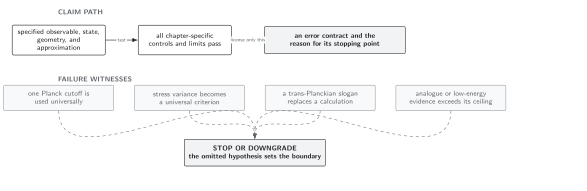
A regime verdict fails if it ignores changes in operational resolution, elapsed duration, or tolerance that alter the actual expansion and fluctuation parameters. Schematic; not to scale.
References
Section titled “References”- Kuo, C.-I., and L. H. Ford, “Semiclassical Gravity Theory and Quantum Fluctuations,” Physical Review D 47, 4510–4519 (1993), doi:10.1103/PhysRevD.47.4510.
Original QFT.org content:CC BY 4.0, unless an item supplies different terms. Third-party material retains its own terms.