

Cosmological Symmetry and Ward Identities
Late-time de Sitter isometries act as three-dimensional conformal transformations on boundary momentum data. They strongly constrain wavefunction coefficients and correlators, but they do not select the state, impose locality, or remove contact solutions. In quasi-de Sitter space the same equations acquire controlled symmetry-breaking sources rather than remaining exact.
Required background. The object dictionary fixes which boundary object is constrained. Inflationary symmetry breaking and decoupling supplies the quasi-de Sitter regime, and momentum-space Ward identities supplies the general conformal generators.
Helpful background. Soft limits and consistency relations explains when a long mode acts as a symmetry transformation.
Momentum-space conformal generators
Section titled “Momentum-space conformal generators”Let denote a primed scalar boundary coefficient in spatial dimensions, after removing the momentum delta function. If the operators have weights , exact dilation covariance requires
The special-conformal Ward operator is
with away from anomalous or contact sources. Momentum conservation means only momenta are independent; applying the generator before or after eliminating one momentum requires a consistent prescription.
For spinning objects, rotations also constrain the tensor basis, transversality conditions remove gauge-redundant polarizations, and acts on polarization tensors. A scalar equation cannot be applied componentwise to helicity amplitudes without those spin terms.
Scalar three-point solution
Section titled “Scalar three-point solution”For three scalar primaries, the nonlocal conformal solution can be represented by a triple- integral,
Acting with the dilation and special-conformal generators reduces to integrations by parts in . When the endpoint terms vanish, the integral solves the homogeneous identities. When the integral diverges, renormalization produces local or semilocal counterterms and possibly an anomalous Ward identity. Bzowski, McFadden, and Skenderis derive this representation and classify its renormalized singular cases (Bzowski, McFadden, and Skenderis 2014, Eqs. (4.10)–(4.13) and §§ 6–7).
The corresponding direct bulk coefficient has the form
where is the normalized bulk-to-boundary mode for the selected Bunch–Davies branch. Continuing with the same branch prescription maps the nonlocal part of this integral to the triple- solution. The coupling and branch phase fix ; boundary terms fix the local completion. This comparison solves the manifest application without identifying directly with an in-in three-point function.
Arkani-Hamed, Baumann, Lee, and Pimentel solve the de Sitter scalar and spinning Ward systems and match them to bulk exchange data (Arkani-Hamed et al. 2020, §§ 3–5).
Slow-roll breaking and soft sources
Section titled “Slow-roll breaking and soft sources”In quasi-de Sitter space, time-dependent couplings and the rolling background break the exact generators. The correct equations are schematically
where the sources are computed from background beta functions, insertions of the symmetry-breaking operator, and boundary terms. At leading slow roll, , but a small source can integrate to a logarithm and need not produce a uniformly small correction over an arbitrarily long range.
Soft consistency relations follow only when the long mode is adiabatic, the state respects the relevant residual diffeomorphism, and late-time evolution does not add an independent mode. Pimentel derives the wavefunctional Ward identity behind inflationary squeezed limits (Pimentel 2014, Eqs. (3.11)–(3.17)).
Homogeneous-solution adversarial test
Section titled “Homogeneous-solution adversarial test”Start from a nonlocal that solves the exact identities. Add a symmetry-compatible local or semilocal solution and a particular slow-roll solution :
The Ward equations determine neither nor a boundary condition for the inhomogeneous problem. Compare the nonlocal part with the direct bulk integral, then vary and a controlled source . Any uniqueness claim that changes is rejected. The strongest surviving statement is the symmetry-compatible solution space with specified anomaly and boundary data.
The structure map locates Ward identities before locality and state selection. Inspect how they constrain a defined object but leave a homogeneous branch for later input.

Exact and softly broken cosmological Ward identities. The diagram is schematic and not to scale; symmetry fixes a solution space rather than a unique physical correlator.
The failure map emphasizes contact and breaking sources. Inspect the stops for applying exact de Sitter equations in slow roll, omitting spin terms, or discarding a renormalized local solution.
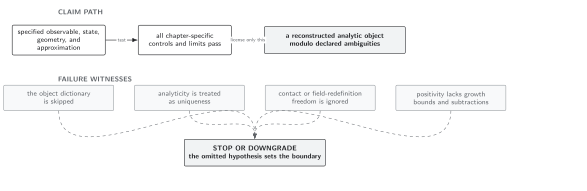
Failure conditions for cosmological symmetry constraints. The diagram is schematic and not to scale; slow-roll breaking enters as a computed source, not as an unqualified exact symmetry.
These qualifications refine the chapter’s domain and failure conditions. Explicit representatives are built in contact, exchange, and seed solutions.
Exercise
Section titled “Exercise”Show that a scalar primed -point function satisfying the dilation identity is homogeneous of degree .
Solution
The Ward identity is
Euler’s theorem for homogeneous functions then gives
Local anomalies can add logarithms and an inhomogeneous source, in which case this pure scaling law is modified.
References
Section titled “References”- Arkani-Hamed, N., D. Baumann, H. Lee, and G. L. Pimentel. “The Cosmological Bootstrap: Inflationary Correlators from Symmetries and Singularities.” Journal of High Energy Physics 2020, no. 04 (2020): 105. DOI. Open PDF.
- Bzowski, A., P. McFadden, and K. Skenderis. “Implications of Conformal Invariance in Momentum Space.” Journal of High Energy Physics 2014, no. 03 (2014): 111. DOI. Open PDF.
- Pimentel, G. L. “Inflationary Consistency Conditions from a Wavefunctional Perspective.” Journal of High Energy Physics 2014, no. 02 (2014): 124. DOI. Open PDF.
Original QFT.org content:CC BY 4.0, unless an item supplies different terms. Third-party material retains its own terms.