

Energy and Entropy Bounds: Hypotheses and Handoffs
“Entropy is bounded by energy” is not one proposition. Depending on the observable, it can mean positivity of relative entropy, a timelike sampled-stress inequality, ANEC on a complete generator, QNEC at a null cut, a proposed focusing law for generalized entropy, or an entropy comparison along a lightsheet. These statements have incompatible regions, state classes, dimensions, renormalization data, and proof status. This page classifies them through the chapter’s canonical matrix and directs each unresolved question to the subject that owns its missing input.
Required background. Causal, thermodynamic, and stability constraints separates necessary tests; the energy–information bounds status map supplies the information-theoretic classification; and generalized-entropy renormalization fixes the gravitational entropy.
Helpful background. Relative entropy and Bekenstein-type bounds supplies the modular inequality, QFC status separates focusing variants, and species and regulator dependence tracks ultraviolet assumptions.
Classifying the six statements
Section titled “Classifying the six statements”Use the chapter’s domain and failure-conditions matrix as the single comparison table. Its columns ask for the averaged or varied object, field and state domain, geometry and normalization, renormalization data, status, and decisive failure. Applying those columns gives the following six classifications.
Bekenstein-type relative-entropy bound. For a region algebra and a reference state with modular Hamiltonian ,
so the exact result is
This is a theorem whenever the relative entropy and modular-energy difference exist. A formula such as follows only after specifying a geometry whose modular Hamiltonian is known and controlling the localization step that replaces by a size times energy. Casini’s vacuum-subtracted formulation explains why the species-sensitive vacuum entropy is not itself the bounded quantity (Casini 2008, §§ 2–3).
Timelike QEI. The object is a smooth worldline average,
bounded below by a functional of the sampler, trajectory, geometry, field, reference state, and finite prescription. It is a theorem only in the domain of the cited QEI. It is not an entropy bound, and in four dimensions it cannot be converted into a general null-worldline QEI by boosting the observer.
ANEC. The object is the complete affine integral
Its established forms are theorems for specified theories, states, causal geometries, boundary conditions, convergence assumptions, and usually achronal complete curves. It is neither a finite-segment QEI nor a local entropy variation. Losing completeness or introducing a reflecting boundary is a change of problem, not a small correction.
QNEC. The local comparison is
with the entropy derivative understood per transverse area. Flat-space QNEC has broad proofs, including the general relativistic-QFT proof of Balakrishnan et al. (Balakrishnan et al. 2019, §§ 2–5). Curved-background versions require the dimension, local cut geometry, and common stress–entropy counterterms stated on the curved QNEC page. “QNEC in curved space” without those qualifiers is too broad.
QFC. The object is a functional variation of quantum expansion on a null hypersurface. Original pointwise, stronger, restricted, and smeared formulations are different propositions. As of August 2026, the original form is not a universal theorem: it has a weak-curvature Gauss–Bonnet counterexample in (Fu, Koeller, and Marolf 2017, §§ 2–3), while restricted focusing is proved only in specified model classes, including a class of two-dimensional JT-plus-QFT systems that also contains counterexamples to stronger forms (Franken et al. 2026, §§ 3–4). A cutoff-scale smearing proposal is evidence for its declared EFT statement, not a repair that retroactively proves pointwise QFC.
Quantum covariant entropy bound. The object is a difference of one renormalized between two cuts on a fixed set of null generators. A nonpositive quantum expansion, an applicable finite focusing or no-crossing result, and a caustic-free interval imply
The corresponding matter-entropy form subtracts the same geometric entropy functional at both ends. This is a conditional consequence of the chosen focusing input. It is not a theorem inherited automatically from the classical covariant entropy conjecture or from QNEC at the initial cut.
The structure map makes the classification operational: first identify the observable and support, then supply state, geometry, normalization, and scheme, and only then attach a theorem or evidence status.

Classification by observable and support. The diagram is schematic and not to scale; Bekenstein-type, QEI, ANEC, QNEC, QFC, and covariant-entropy statements enter different rows of the canonical matrix rather than forming a strength hierarchy.
A minimum complete claim
Section titled “A minimum complete claim”A bound can be evaluated only after the following data are present.
- Observable: stress projection, modular energy, matter entropy, or generalized entropy.
- Support: point, timelike curve, complete null generator, region, cut, or lightsheet.
- State and theory: field content, interactions, ultraviolet regularity, reference state, and boundary conditions.
- Geometry: dimension, curvature and acceleration scales, causal assumptions, and any local stationarity condition.
- Normalization: sampler and width convention, affine scale, transverse-area measure, and deformation direction.
- Renormalization: stress prescription, entropy regulator removal, gravitational counterterms, and finite coupling convention.
- Logical status: theorem and exact hypotheses, conditional consequence, controlled model, numerical evidence, conjecture, counterexample, or open question.
These fields also prevent false comparisons. A lower bound with dimension on a timelike average cannot be ranked numerically against an affine ANEC integral without choosing scales and normalization. A QNEC saturation result cannot be substituted for an integrated QFC statement. A relative-entropy theorem remains rigorous even when a heuristic estimate is unavailable.
Missing-data adversarial test
Section titled “Missing-data adversarial test”Consider the claim:
The entropy in a region is bounded by its energy.
No entropy is named: it could be von Neumann entropy, vacuum-subtracted entropy, relative entropy, generalized entropy, or a coarse-grained entropy. No region, reference state, energy generator, dimension, field theory, gravity approximation, or renormalization prescription is given. The correct classification is therefore unclassified. Guessing “Bekenstein bound” would silently add the essential content.
Adding “a Rindler half-space, vacuum reference state, normal state , and modular energy” promotes the claim to the exact relative-entropy theorem
Adding instead “two cuts of a null lightsheet with one fixed , no caustic, and a stated focusing theorem” produces a conditional covariant-entropy comparison. Adding only a radius and total energy does not decide which of these was intended and does not prove .
The same stopping rule applies to phrases such as “negative energy is bounded” and “entropy focuses.” If the sampler or null deformation is absent, the statement remains unclassified. If every field is supplied except theorem status, the strongest surviving statement may be a model calculation rather than a theorem.
The failure map identifies the first absent datum and directs the reader to the corresponding subject.
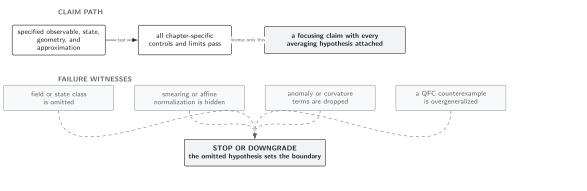
Stopping rule for incomplete bound claims. The diagram is schematic and not to scale; supplying one missing noun does not license the conclusion when a different domain, scheme, or status field remains absent.
Subject handoffs
Section titled “Subject handoffs”Use energy–information localization for modular theory, operational work, abstract QEIs, and information-theoretic proofs. Use generalized-entropy renormalization when area, Wald-like terms, edge terms, or species dependence enter. Use the proof-first null-energy bounds treatment for functional-analytic theorem domains. Use QFC status for dated higher-curvature, smearing, and model-specific evidence. Holographic entropy-cone and boundary-duality inequalities require their own holographic hypotheses and are not extensions of this chapter’s curved-spacetime matrix.
Domain and failure conditions
Section titled “Domain and failure conditions”See the chapter domain and failure-conditions matrix. The classification uses the exact observable and support as its first discriminator and records theorem status as of August 2026 where the subject is evolving. It does not rank unlike bounds by a universal strength, erase regulator dependence, or infer a gravity statement from a fixed-background QFT inequality.
Exercise
Section titled “Exercise”Classify the statement “” when the curve is a finite null segment in a four-dimensional curved spacetime.
Solution
It is not ANEC as defined here because the curve is not complete, and it is not a general four-dimensional null-worldline QEI because no such state-independent analogue follows from the timelike theorem. Without a field, state, smearing prescription, boundary conditions, affine normalization, and a finite-segment theorem, the statement remains unclassified. A model calculation may evaluate the integral, but its sign is not supplied by the named general results.
References
Section titled “References”- Balakrishnan, S., T. Faulkner, Z. U. Khandker, and H. Wang. “A General Proof of the Quantum Null Energy Condition.” Journal of High Energy Physics 2019 (2019): 20. DOI.
- Casini, H. “Relative Entropy and the Bekenstein Bound.” Classical and Quantum Gravity 25 (2008): 205021. DOI.
- Franken, V., S. Kaya, F. Rondeau, A. Shahbazi-Moghaddam, and P. Tran. “Tests of Restricted Quantum Focusing and a New CFT Bound.” Journal of High Energy Physics 2026 (2026): 111. DOI.
- Fu, Z., J. Koeller, and D. Marolf. “Violating the Quantum Focusing Conjecture and Quantum Covariant Entropy Bound in d ≥ 5 Dimensions.” Classical and Quantum Gravity 34 (2017): 175006. DOI.
Original QFT.org content:CC BY 4.0, unless an item supplies different terms. Third-party material retains its own terms.