

Matter Effective Actions in Curved Spacetime
A matter effective action packages the vacuum effects of specified quantum fields on a prescribed classical geometry. Its value depends not only on a differential expression but also on an operator domain, boundary conditions, zero-mode prescription, analytic continuation, determinant phase, subtraction scheme, and the observable one intends to extract. This chapter develops those choices as part of the calculation and keeps matter loops separate from graviton and gravitational-ghost loops.
Helpful background. Heat Kernels, Zeta Functions, and Spectral Determinants supplies the spectral constructions; The 1PI Effective Action and Mean-Field Equations supplies the Legendre-transform meaning; and Renormalized Stress Tensor: Axioms and Curvature Ambiguities explains the allowed local metric variations.
The matter-loop contract
Section titled “The matter-loop contract”For the site’s Lorentzian convention,
Heat-kernel calculations use a separately declared Riemannian problem. For a scalar, this chapter adopts
Thus a source using the conventional positive coupling writes . After factoring out , the first local coefficient is
which vanishes at the site’s conformal value. This is the chapter’s quickest curvature-sign check. The Euclidean symbols are not obtained by merely replacing with while leaving every curvature convention untouched; the matched operator above defines the translation.
For a real boson with a positive, self-adjoint Euclidean operator,
after regularization and renormalization. The prime removes declared zero modes. Fermionic integration supplies the statistics sign and commonly requires squaring a Dirac operator plus a separate phase analysis. A negative eigenvalue requires a spectral cut or contour; it is not hidden inside the prime. These qualifications are part of the determinant definition Vassilevich 2003, §§ 2.1–2.2 and Eqs. (2.21)–(2.34).
The Euclidean determinant normally computes an equilibrium or analytically continued quantity. A Lorentzian in–out determinant computes a vacuum amplitude and can be complex. A causal mean equation instead requires a closed-time-path, in–in construction. Varying a Euclidean or Feynman effective action and then relabeling its kernel “retarded” is not a causal prescription.
The structure map shows the route from a defined matter operator through spectral representations to local, nonlocal, anomalous, imaginary, and variational outputs. Inspect especially the branch at which short-proper-time information ceases to determine infrared response.

Matter-loop calculations share an operator and subtraction input but separate into local asymptotics, global spectral data, nonlocal kernels, instability phases, and metric variations. Schematic; not to scale.
Choose a route
Section titled “Choose a route”- One-Loop Matter Effective Actions in Curved Space defines what is integrated out and what is held classical.
- Proper-Time, Zeta, and Determinant Prescriptions fixes domains, zero modes, scales, and spectral cuts.
- Heat Kernels and the Schwinger–DeWitt Expansion extracts short-proper-time ultraviolet data.
- Seeley–DeWitt Coefficients and Curvature Invariants derives the local coefficients and convention checks.
- Heat Kernels with Boundaries and Conical Singularities adds boundary, corner, and defect contributions.
- Worldline Methods in Curved Space rewrites the same trace as a particle path integral with a regulated measure.
- Renormalization of Gravitational Couplings by Matter Loops matches ultraviolet poles onto local gravitational terms.
- Mass Thresholds, Decoupling, and Curvature Expansions states the hierarchy behind inverse-mass expansions.
- Matter-Induced Nonlocal Form Factors retains momentum dependence and branch information.
- Anomaly-Induced and Nonlocal Actions integrates the trace anomaly while exposing homogeneous ambiguities.
- Imaginary Effective Actions and Vacuum Instability relates determinant phases to vacuum persistence only after an independent production check.
- Effective-Action Variation, Stress Tensors, and Consistency Checks compares metric variations with conservation, anomaly, and point splitting.
Domain and failure conditions
Section titled “Domain and failure conditions”The table is the canonical chapter comparison. “Causal output” means that a real-time contour has actually supplied a retarded kernel; it does not follow from covariance or from a Euclidean formula.
| Method or output | Operator, contour, and global data | Ultraviolet treatment | Licensed regime and result | Threshold, imaginary, and causal meaning | Decisive downgrade |
|---|---|---|---|---|---|
| Matter one-loop determinant | Hessian of the integrated matter field; metric classical; state or Euclidean boundary data declared | Local counterterms through the required adiabatic/heat-kernel order | One-loop matter contribution to a specified 1PI or vacuum functional | No graviton/ghost loop; causal response only after in–in construction | Changing the integrated field, gauge fixing, or contour changes the object |
| Proper time and zeta | Positive elliptic on a stated self-adjoint domain; zero modes removed explicitly | Analytic continuation plus scale | Equivalent determinant after matching the same subtractions | Negative modes need a cut and can create a phase | An unreported kernel, cut, or multiplicative anomaly invalidates equality |
| Local heat-kernel asymptotics | Smooth Laplace-type operator, normally without singular strata | coefficients | Local ultraviolet divergences and large-mass asymptotics | Does not determine large- infrared physics or a state | Using a finite local series at large invents nonlocal information |
| Seeley–DeWitt recursion | Connection, endomorphism, Riemann convention, and invariant basis fixed | Coefficients or with notation declared | Reproducible curvature polynomials and bundle traces | Total derivatives depend on boundaries; basis coefficients are not all observables | A sign translation applied to but not or corrupts the result |
| Boundaries and cones | Elliptic boundary condition or self-adjoint extension; defect regularization fixed | Bulk plus half-integer, surface, corner, or tip terms | Localized counterterms for that domain | Replica interpretation requires a separate continuation and entropy prescription | Treating a cone as smooth misses defect terms and possible logarithms |
| Worldline representation | Same ; periodic loop, center-of-mass zero mode, measure ghosts, regulator fixed | Finite scheme counterterm restores the intended Hamiltonian | Alternative evaluation of heat kernels and determinants | Not a replacement of QFT by fundamental particle mechanics | Dropping the measure or scheme counterterm produces false noncovariance |
| Gravitational-coupling matching | Matter in a chosen local basis | Renormalize , , and curvature-squared couplings | Matter contribution to running and matching | Pure-gravity beta functions remain absent | Field redefinitions move redundant coefficients; comparing them basis-free is meaningless |
| Heavy-mass expansion | Eigenvalues/momenta and curvatures small relative to | Match local terms at a stated threshold | Series in and with truncation estimate | Mass-independent beta functions alone do not display physical decoupling | or removes the expansion |
| Nonlocal form factors | Full spectral or momentum dependence and branch prescription retained | Local polynomial ambiguity subtracted separately | Kernels such as and threshold functions | Euclidean, Feynman, and retarded continuations answer different questions | Inserting a Feynman kernel into a causal equation violates the observable contract |
| Anomaly-induced action | Anomaly coefficients, conformal class, Green function, and boundary data fixed | Scheme-dependent or local term declared | A particular solution of the Weyl-variation equation | Weyl-invariant functionals and homogeneous solutions remain free | The anomaly alone does not determine the full stress tensor or state |
| Imaginary in–out action | In/out vacua and or spectral cut fixed | Real local counterterms do not remove physical absorptive parts | Vacuum-persistence exponent after mode normalization | when the vacuum amplitude is defined | A lone negative mode or contour phase is not automatically particle production |
| Metric variation and response | Renormalized functional and allowed variations fixed | Finite curvature counterterms varied consistently | Conserved in–out/Euclidean stress and symmetric second variation | Retarded response and noise require in–in and connected correlators | Mixing schemes between action and stress breaks the Ward-identity comparison |
The failure map collects the quickest ways to invalidate a calculation. Its central lesson is that an apparently correct local coefficient cannot repair an undefined domain, an uncontrolled hierarchy, or a wrong real-time continuation.
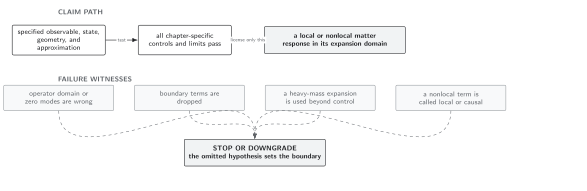
Domain, hierarchy, loop content, and contour failures have different repairs; none is cured by changing only the subtraction scale. Schematic; not to scale.
A reproducible handoff
Section titled “A reproducible handoff”A usable result names: the integrated matter multiplet; the classical backgrounds; the Euclidean or Lorentzian operator and its domain; boundary and zero-mode treatment; determinant phase; regulator and finite renormalization conditions; local curvature basis; expansion parameters and remainder estimate; state or contour; and the functional derivative that defines the observable. Executable coefficient checks must retain the same basis, regulator, truncation, and validation identities. Metric and ghost loops continue in One-Loop Graviton EFT, while causal mean evolution continues in In–In Effective Actions and Causal Backreaction.
References
Section titled “References”- Bastianelli, Fiorenzo. “Path Integrals in Curved Space and the Worldline Formalism.” In Path Integrals and Anomalies in Curved Space, 2005 lecture review. arXiv.
- Gorbar, Eduard V., and Ilya L. Shapiro. “Renormalization Group and Decoupling in Curved Space.” Journal of High Energy Physics 2003, 021 (2003). DOI.
- Hawking, Stephen W. “Zeta Function Regularization of Path Integrals in Curved Spacetime.” Communications in Mathematical Physics 55 (1977): 133–148. DOI.
- Riegert, Ronald J. “A Non-Local Action for the Trace Anomaly.” Physics Letters B 134 (1984): 56–60. DOI.
- Vassilevich, Dmitri V. “Heat Kernel Expansion: User’s Manual.” Physics Reports 388 (2003): 279–360. DOI. Open PDF.
Original QFT.org content:CC BY 4.0, unless an item supplies different terms. Third-party material retains its own terms.