

Horizon Entanglement Entropy
Entanglement across a smooth horizon has the same leading ultraviolet structure as entanglement across any smooth codimension-two surface. The area law is therefore a local QFT statement, not by itself a microscopic count of black-hole states; its regulator dependence is removed only when it is combined with geometric counterterms.
Required background. Black-hole thermodynamics supplies the horizon setting; UV divergences and the area law supplies the short-distance expansion; and replica branched geometries supplies the conical construction. Helpful background. Review type-III algebras and the Bisognano–Wichmann theorem.
Local ultraviolet structure at a horizon cut
Section titled “Local ultraviolet structure at a horizon cut”Choose a smooth spatial cut of area and a regulator length . In spacetime dimensions the regulated entropy has the local expansion
The are scalars built from intrinsic curvature, the two extrinsic curvatures, ambient curvature, masses, and couplings. Power-law coefficients depend on regulator details. In even dimension, logarithmic coefficients can encode universal anomaly data once the field theory, surface geometry, and subtraction convention are fixed Solodukhin 2011, §§2–3, Eqs. (22)–(28).
The origin of the leading term is local. Modes with wavelength between and a macroscopic scale correlate across a layer of thickness comparable to their wavelength. Translational invariance along a locally planar cut makes the number of such cells proportional to . A stationary horizon matters globally for state regularity and thermodynamic interpretation, but not for this local counting.
First application: a replica defect at a horizon
Section titled “First application: a replica defect at a horizon”For a regulated reduced state,
Near , the -fold Euclidean geometry has angular period . Heat-kernel coefficients acquire terms supported on the codimension-two defect; differentiating at reproduces the same area and curvature invariants as the cutoff calculation. This matching is local and perturbative. It assumes a specified operator domain, boundary conditions, zero-mode prescription, and a continuation near .
For a free minimally coupled scalar in four dimensions, a proper-distance cutoff gives schematically
where is nonuniversal. The result to retain is the geometric form and its cancellation against the renormalization of gravitational couplings, not a regulator-independent numerical “number of horizon states” Susskind and Uglum 1994, §§2–3, pp. 3743–3748.
State dependence provides an important check. Two Hadamard states have the same local singularity structure, so the divergent surface terms cancel in a consistently regulated difference
whenever the entropy difference exists. What remains probes long-distance correlations and excitation data rather than the universal vacuum singularity. Relative entropy is often better controlled because it combines this entropy difference with modular energy. By contrast, a non-Hadamard state can introduce extra short-distance singularities that are not absorbed by the standard state-independent gravitational counterterms.
Smoothness is equally consequential. Corners, conical intersections, boundaries, or a cut meeting another defect produce additional localized invariants. One must then use a boundary- or corner-capable heat-kernel expansion; the smooth-horizon coefficients cannot simply be extrapolated.
The structure map shows this regulated calculation feeding into generalized entropy. Inspect the transition from a local defect coefficient to a jointly renormalized functional.

Horizon entanglement has a local surface expansion; its divergent coefficients become physical only through a consistent generalized-entropy renormalization. Schematic; not to scale.
Domain and failure conditions
Section titled “Domain and failure conditions”Compare this regulated object with the others in the chapter’s canonical domain table. The local expansion assumes , a smooth cut, and a state with standard Hadamard short-distance singularity.
Adversarial test. Repeat the calculation with a lattice, Pauli–Villars fields, and proper-time cutoff while holding the state and surface fixed. The leading power-law coefficient and finite constant generally change. Local logarithmic or state-difference data may survive after matched subtractions. Therefore the bare is not a finite horizon observable.
A dimensional check is immediate: in four dimensions is dimensionless, while a massive correction may enter as , not as an arbitrary mass-dependent coefficient multiplying the leading divergence in the limit.
The failure map separates regulator dependence from genuine state dependence and from singular surfaces where the smooth heat-kernel expansion fails.
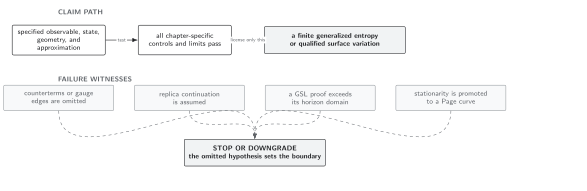
A regulator change is harmless only when the corresponding geometric couplings and surface terms are transformed with it. Schematic; not to scale.
Handoff
Section titled “Handoff”Generalized entropy and UV renormalization performs the required cancellation; conical entropy treats defect and contact contributions systematically.
References
Section titled “References”- Solodukhin, S. N., “Entanglement Entropy of Black Holes,” Living Reviews in Relativity 14, 8 (2011), doi:10.12942/lrr-2011-8.
- Susskind, L., and J. Uglum, “Black Hole Entropy in Canonical Quantum Gravity and Superstring Theory,” Physical Review D 50, 2700–2711 (1994), doi:10.1103/PhysRevD.50.2700.
Original QFT.org content:CC BY 4.0, unless an item supplies different terms. Third-party material retains its own terms.