

GNS Representations, Local Normality, and Local Quasiequivalence
The Gelfand–Naimark–Segal construction turns a state into a Hilbert-space representation, but a single curved-spacetime theory can have many globally inequivalent representations. Local normality and local quasiequivalence ask the physically sharper question: after restricting to observables in a bounded region, do the representations admit the same normal state space, or folium? For quasifree Hadamard states, the answer is often yes even when their global particle descriptions are inequivalent.
Required background. Local Field Algebras, Isotony, Einstein Causality, and Time-Slice Evolution supplies the regional algebras. Quasifree States and Two-Point Functions supplies the state class. Operator Algebras and Positive Functionals supplies representations and normal states.
Helpful background. Restricted States on Subregions explains restriction without assuming a tensor factor. Why Continuum Subsystems Do Not Factorize prevents an inappropriate density-matrix interpretation.
From a state to its representation
Section titled “From a state to its representation”For a state on a unital -algebra , define the null left ideal
The completion of in the inner product
is a Hilbert space . Left multiplication gives a representation , and the class of the identity is a cyclic vector satisfying
The triple is unique up to unitary equivalence. This theorem does not say that GNS representations of two different states are unitarily equivalent.
Local comparison
Section titled “Local comparison”Let be a relatively compact open region of the globally hyperbolic spacetime and its local algebra. A state is normal relative to on if its restriction can be written
for a positive trace-class operator on . This formula represents a normal functional on ; it does not assert a factorization .
Two representations are quasiequivalent on when they generate the same folium of normal states there. Equivalently, the correspondence extends to a normal star isomorphism of the generated von Neumann algebras. Unitary equivalence is stronger; equality of a few expectation values is weaker.
The states are locally normal, or the representations locally quasiequivalent, when the corresponding regional property holds for every relatively compact open .
First application: globally different, locally comparable
Section titled “First application: globally different, locally comparable”Take two quasifree Hadamard states and of the Klein–Gordon field with smooth real potential on the same globally hyperbolic spacetime. Their two-point functions differ smoothly. For every relatively compact open region , Verch’s theorem states that their restricted GNS representations are quasiequivalent Verch 1997, Theorem 3.6(b), PDF pp. 28–30. The quasifree and Hadamard assumptions, the Klein–Gordon Weyl algebra, the spacetime hypotheses, and relative compactness of are part of the result.
The conclusion is deliberately local. The Bogoliubov coefficient comparing global mode splittings may fail the Hilbert–Schmidt test, and the total particle number may diverge, while every local algebra associated with such a region still has mutually normal state restrictions. Thus a global Fock-space obstruction does not prevent local comparison of preparations and measurements.
Adversarial test: global divergence is not a local proof
Section titled “Adversarial test: global divergence is not a local proof”For a homogeneous infinite-volume transformation, the antilinear map has the form
On nonatomic momentum space, this multiplication-reflection operator is noncompact, hence not Hilbert–Schmidt, whenever is nonzero on a set of positive measure. This establishes failure of a global unitary implementer even when the density integral is finite. If that integral diverges, the particle-number density also diverges; if it converges, it still does not become the global Shale norm. Neither case establishes that the restricted representations on are disjoint.
For a general, non-diagonal quasifree comparison, one must test the actual covariance operators rather than a single momentum profile. The exact global quasiequivalence criterion requires agreement of the induced topologies together with a Hilbert–Schmidt condition on square-root covariance operators Araki and Yamagami 1982, main theorem, PDF pp. 283–285. A local claim requires the corresponding regional analysis or a theorem whose local hypotheses have been checked.
The strongest conclusion surviving the global divergence alone is global Fock inequivalence. A claim of local inequivalence requires separate regional evidence.
Domain and failure conditions
Section titled “Domain and failure conditions”The construction map begins with a state rather than a preferred Hilbert space: the GNS representation is derived from that state. Local quasiequivalence is a separate comparison after restriction to a regional algebra, and Hadamard control supplies the ultraviolet hypothesis used by the principal free-field theorem.

GNS construction, local quasiequivalence, Hadamard admissibility, and physical selection answer distinct questions even when one state satisfies all of them. Schematic; not to scale.
A divergent global particle number is not one of the decisive local failure witnesses. The page-local test must instead compare restricted covariances or folia; without that step, only global Fock inequivalence is licensed.
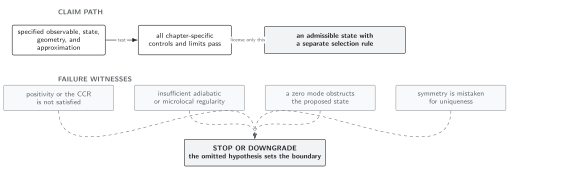
The claimed domain determines the test: global particle divergence controls global implementation, whereas local inequivalence needs evidence on the chosen local algebra. Schematic; not to scale.
The chapter-scale distinction is summarized in Domain and failure conditions.
Handoffs
Section titled “Handoffs”Hadamard Admissibility and the Two-Point Wavefront Criterion supplies the ultraviolet hypothesis behind the principal local comparison theorem. Bogoliubov Transformations and Unitary Implementability supplies the global contrast. Proof-level folia and local quasiequivalence continue in Local Normality, Quasiequivalence, and Folia.
References
Section titled “References”- Araki, Huzihiro, and Shigeru Yamagami. “On Quasi-Equivalence of Quasifree States of the Canonical Commutation Relations.” Publications of the Research Institute for Mathematical Sciences 18 (1982): 283–338. DOI; Open PDF.
- Verch, Rainer. “Continuity of Symplectically Adjoint Maps and the Algebraic Structure of Hadamard Vacuum Representations for Quantum Fields on Curved Spacetime.” Reviews in Mathematical Physics 9 (1997): 635–674. DOI; Open PDF.
Original QFT.org content:CC BY 4.0, unless an item supplies different terms. Third-party material retains its own terms.