

Quantum Expansion and Covariant Entropy Bounds
Quantum expansion is the null shape derivative of generalized entropy. If an applicable focusing statement prevents a nonpositive quantum expansion from becoming positive, integrating it between two cuts gives a generalized covariant entropy bound. The derivation is local to a chosen null hypersurface and ends at the first caustic, generator loss, scheme change, or failure of the focusing hypothesis.
Required background. The QFC and its status identifies the available focusing variant; generalized-entropy renormalization fixes ; and Raychaudhuri focusing fixes the classical limit.
Helpful background. Curved QNEC supplies the local nongravitational limit, while relative entropy and horizon laws supplies an independent information-theoretic route in selected settings.
Quantum expansion along a lightsheet
Section titled “Quantum expansion along a lightsheet”For cuts of a null hypersurface,
Let a one-parameter family move each generator forward with . Then
If on the deformed generators throughout the segment,
For Einstein gravity,
so the result becomes
Higher-curvature theories replace area by the full renormalized gravitational entropy functional. Using area alone while retaining higher-curvature equations is inconsistent.
Original QFC would make nonincreasing directly. The pointwise restricted implication does not by itself prove sign preservation: a smooth cubic can cross zero with vanishing first derivative. A restricted-QFC derivation of a finite entropy bound must therefore supply the stronger finite-deformation statement, a differential inequality with the regularity and uniqueness needed for comparison, or an equivalent no-crossing theorem in its model. Neither statement permits evolution past a caustic without specifying how lost or intersecting generators and entropy algebras are treated.
The structure map shows the typed handoff: a declared focusing variant preserves the sign of quantum expansion, which is then integrated—not assumed—to obtain an entropy comparison.

From quantum expansion to a covariant entropy bound. The map is schematic and not to scale; the entropy definition, focusing variant, generator set, deformation direction, and caustic-free interval remain fixed throughout.
Weakly perturbed cut
Section titled “Weakly perturbed cut”Take a compact initial cut with a uniform small quantum expansion
and advance it by with . Suppose the applicable focusing result gives
through , and no generator forms a caustic or leaves the chosen lightsheet. Then
and
This is stronger than mere nonincrease for the controlled segment. In a perturbative calculation, evaluate , , and to the same order. If the first caustic estimate is , choose with an error margin larger than the neglected corrections.
A limiting check sends the quantum entropy derivative and higher-curvature couplings to zero. Then , and the condition reduces to the classical nonexpanding lightsheet and area form proposed in Bousso 1999, Eqs. (1.1)–(1.2).
Caustic and entropy-definition adversarial tests
Section titled “Caustic and entropy-definition adversarial tests”At a caustic, the cross-sectional area degenerates and the generator labelling used in the functional derivative ceases to be one-to-one. Continuing the same integral through it double-counts or loses degrees of freedom. Stop at the caustic or reformulate the region and prove a new entropy comparison.
A second failure computes with one set of counterterms at and a different generalized entropy at . The difference then contains an arbitrary local shift and no bound follows. The same gravitational entropy functional, outside algebra, regulator removal, and finite scheme must be used at both cuts.
The original quantum covariant bound proposed with QFC has explicit higher-curvature counterexamples (Fu, Koeller, and Marolf 2017, § 3). A smeared or restricted focusing input may support a modified bound only after its separate hypotheses are checked.
The failure map prevents a conditional entropy consequence from being advertised as universal.
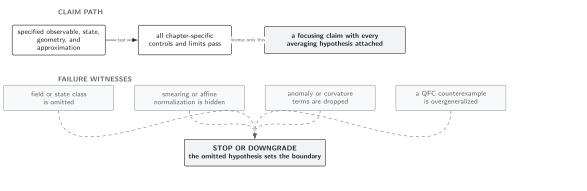
Failure conditions for integrating quantum expansion. The diagram is schematic and not to scale; the licensed interval ends before the first caustic or failed focusing hypothesis, and both endpoint entropies use one renormalized definition.
Domain and failure conditions
Section titled “Domain and failure conditions”See the chapter domain and failure-conditions table. The perturbative application assumes smooth cuts, fixed generators, forward deformation, one generalized-entropy prescription, nonpositive initial , an applicable focusing result, and a caustic-free interval. It does not establish the original QFC, a universal higher-curvature bound, or a continuation through generator crossings.
Exercise
Section titled “Exercise”Derive the Einstein-gravity entropy bound from .
Solution
Integrating gives
Rearranging yields
References
Section titled “References”- Bousso, R. “A Covariant Entropy Conjecture.” Journal of High Energy Physics 1999 (1999): 004. DOI.
- Bousso, R., Z. Fisher, S. Leichenauer, and A. C. Wall. “Quantum Focusing Conjecture.” Physical Review D 93 (2016): 064044. DOI.
- Fu, Z., J. Koeller, and D. Marolf. “Violating the Quantum Focusing Conjecture and Quantum Covariant Entropy Bound in d ≥ 5 Dimensions.” Classical and Quantum Gravity 34 (2017): 175006. DOI.
Original QFT.org content:CC BY 4.0, unless an item supplies different terms. Third-party material retains its own terms.