

Local Supersymmetry and Supergravity as Low-Energy EFT
Supergravity is the effective field theory obtained when supersymmetry is local and the graviton and gravitino are dynamical. It is not the same problem as placing a rigid supersymmetric QFT on a nondynamical curved background. The low-energy description is organized by local supersymmetry, diffeomorphisms, local Lorentz symmetry, derivative order, supersymmetry-breaking scales, and the cutoff—without assuming a string compactification or ultraviolet completion.
Required background. Applying EFT Power Counting to Gravity supplies gravitational counting, while Graded Spacetime Symmetry and the Supersymmetry Theorems supplies the rigid algebra.
Helpful background. Rigid Supersymmetry from Nondynamical Supergravity Backgrounds fixes the contrasting background construction, and Loops, Counterterms, and Closure of an EFT Expansion supplies loop closure.
The local multiplet and its gauges
Section titled “The local multiplet and its gauges”In four-dimensional minimal supergravity, the on-shell gravity multiplet contains the vierbein and a Majorana gravitino . Its gauge symmetries include diffeomorphisms, local Lorentz transformations, and local supersymmetry. Schematically,
Closure without using equations of motion requires auxiliary fields. In the old-minimal off-shell formulation these are a complex scalar and a real vector; other formulations use different auxiliaries. They are algebraic at two derivatives and do not represent asymptotic particles. Integrating them out must be done consistently across every invariant.
After canonical normalization, the two-derivative action has the schematic site-sign form
The relative coefficients and auxiliary terms are fixed by local supersymmetry. Gauge fixing now includes the spin-two gauge complex, local Lorentz gauge, and the fermionic local-supersymmetry gauge with its commuting ghost sector. Deser and Zumino’s original construction exhibits the cancellation between Einstein and Rarita–Schwinger variations Deser and Zumino 1976, pp. 335–337.
The structure map inserts supergravity after gravitational power counting because supersymmetry restricts whole operator multiplets rather than changing the need for a cutoff.

Supergravity EFT counts complete local-supersymmetry invariants and all associated gauge sectors; auxiliary fields enforce off-shell closure but are not automatically propagating states. The map is schematic and not to scale.
First application: two and four derivatives
Section titled “First application: two and four derivatives”Let be the characteristic physical energy, the gravitino mass when local supersymmetry is broken, and the EFT cutoff. A two-derivative amplitude obeys the gravitational count
with determined by external legs and topology. The leading local corrections are not arbitrary isolated curvature terms; they are supersymmetric completions,
where and are dimensionless and the component brackets begin with dimension-four curvature invariants, together with their correlated gravitino, auxiliary, and possibly matter interactions. Let denote the largest independent curvature scale sampled in a physical frame. The explicit therefore gives a dimension-four Lagrangian and makes the relative effect
A one-loop supermultiplet contributes a further and its complete state-dependent mass spectrum. Supersymmetric cancellations can remove particular coefficients, but broken multiplet splittings and the regulator must be included before claiming a cancellation. The component and superspace organization, including old- and new-minimal auxiliaries, is given in Freedman and Van Proeyen 2012, chs. 16–18.
If a higher-derivative invariant gives an auxiliary field a formal kinetic term, the extra pole must be compared with . Below the cutoff the term is inserted perturbatively unless matching establishes a genuine light multiplet. Exact treatment of a finite truncation can manufacture false states just as in nonsupersymmetric gravity EFT.
Rigid-background adversarial test
Section titled “Rigid-background adversarial test”In rigid curved-space supersymmetry, one freezes a supergravity multiplet to background values that solve generalized Killing-spinor conditions and sends the gravitational coupling out of the dynamical problem. The vierbein, gravitino source, and auxiliaries are not integrated over. They generate no graviton, gravitino, or supergravity-ghost loops.
Promoting those sources to dynamical fields without adding the supergravity action, constraints, gauge fixing, and counting invents degrees of freedom and loop diagrams. Conversely, freezing a genuine supergravity field removes physical backreaction. The choice is determined by the theory being approximated, not by notation shared between the two constructions.
Domain and failure conditions
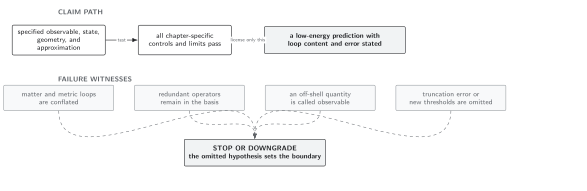
Section titled “Domain and failure conditions”The chapter comparison table licenses a supergravity result only after the off-shell formulation, auxiliary prescription, supersymmetry-breaking data, gauge complex, active multiplets, regulator, cutoff, and observable are named. Complete model catalogs and compactification data lie outside this page.
The failure map’s loop-classification branch catches the rigid/dynamical confusion directly.
Rigid curved-background supersymmetry and dynamical supergravity share source fields but differ in integration variables, constraints, ghosts, and Planck-suppressed loops. The map is schematic and not to scale.
References
Section titled “References”- Deser, S., and B. Zumino. “Consistent Supergravity.” Physics Letters B 62, 335–337 (1976). doi:10.1016/0370-2693(76)90089-7
- Freedman, D. Z., and A. Van Proeyen. Supergravity. Cambridge: Cambridge University Press, 2012. doi:10.1017/CBO9781139026833
Original QFT.org content:CC BY 4.0, unless an item supplies different terms. Third-party material retains its own terms.