

Rigid Supersymmetry from Nondynamical Supergravity Backgrounds
Rigid supersymmetry on a curved manifold is obtained by coupling the field theory to a compatible off-shell supergravity multiplet and then freezing that multiplet as background data. Its bosonic fields remain nondynamical sources, its fermionic fields are set to zero, and their supersymmetry variations must vanish. In a minimal four-dimensional formulation the decisive condition is the gravitino variation; in extended formulations, gaugino or dilatino variations may supply additional equations. Gravity is never integrated over in this construction.
Required background. Supercurrent multiplets and rigid-background compatibility determines which off-shell supergravity formulation the theory can couple to.
Helpful background. Spin structures and Dirac operators supplies the spin bundles in which the supersymmetry parameters live.
The rigid limit is a source construction
Section titled “The rigid limit is a source construction”Write the off-shell background multiplet schematically as
where the are bosonic auxiliary or background gauge fields and the denote any additional background fermions. The rigid limit requires
The gravitino equation is differential in the spinor parameter and algebraic in some auxiliary fields. Other fermion variations, when present, add algebraic or differential constraints. Once the complete system has a global solution, the supergravity transformation laws restricted to the frozen background give transformations of the QFT multiplets. Off-shell closure matters because localization deforms fields away from their equations of motion; an on-shell algebra is not by itself a symmetry of the full integration space.
The decoupling construction is formulated in Festuccia and Seiberg 2011, §1 and §§2, 6. It has four logically separate outputs:
- the full set of equations obeyed by the supersymmetry parameters and background fields;
- the background-dependent matter transformations and curvature couplings;
- the even symmetry generated by the square of each chosen odd transformation;
- the global bundles, boundary conditions, and quantum Ward identities on which that algebra acts.
Solving a local gravitino equation establishes only the first item.
The shared chain below shows where these four outputs enter the localization argument. In its second stage, freezing bosonic sources and setting all background fermions to zero is followed by solving every fermionic variation globally; only then is the complete even symmetry available for the later cohomological and contour tests.
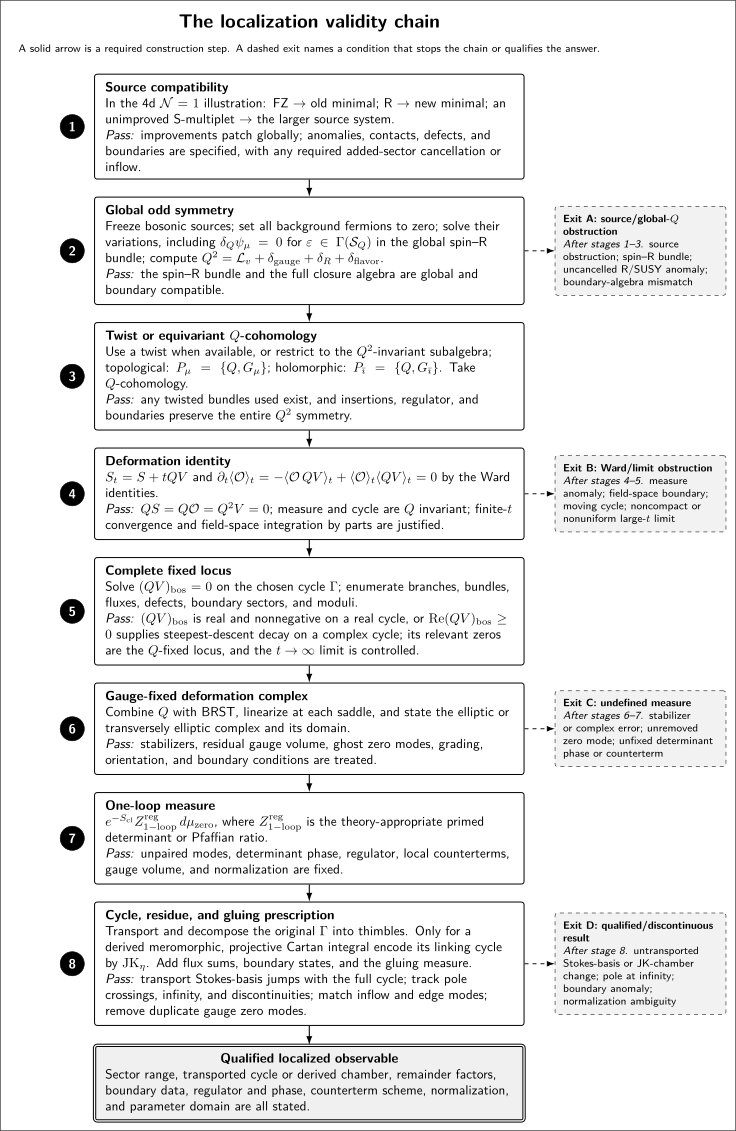
The rigid-background stage freezes bosonic supergravity sources, sets all background fermions to zero, solves all of their supersymmetry variations on the global spin–R bundle, and records the full square . A local solution, an on-shell-only closure relation, an integration cycle lacking the required reality and nonnegativity or real-part decay, or uncancelled boundary flux leads to a dashed failure exit rather than to a localization theorem. The full diagram is schematic and not to scale; supercharge and R-charge normalizations are theory dependent.
The reflowing text equivalent of the eight-stage chain preserves every input, construction, pass condition, output, and failure exit for narrow-screen and print reading.
Four-dimensional new-minimal equations
Section titled “Four-dimensional new-minimal equations”Consider a four-dimensional theory with an R multiplet. On a smooth oriented Riemannian four-manifold, new-minimal supergravity supplies an R connection and a conserved auxiliary vector , with . Using
and the conventions of Dumitrescu, Festuccia, and Seiberg, the two chiral parameters obey
Here has R charge and has R charge . This displayed equation fixes the convention: reversing the R-charge convention, orientation, or definition of changes correlated signs elsewhere. The equations, their bundle assignments, and their geometric consequences are given in Dumitrescu, Festuccia, and Seiberg 2012, eqs. (1.11)–(1.12), §§2–3, and Appendix A.
Euclidean reality requires special care. The spinors and are independent complex sections, not Lorentzian Majorana conjugates, and and may be complex. A reflection structure or field-space integration cycle may later select a compatible real slice, but it is additional data rather than a consequence of the Killing-spinor equation. The complex background convention is explained in Dumitrescu, Festuccia, and Seiberg 2012, §2; Festuccia and Seiberg exhibit a supersymmetric Euclidean theory that is not reflection positive away from the conformal case Festuccia and Seiberg 2011, §4.
Deriving the square of the supercharge
Section titled “Deriving the square of the supercharge”Suppose both parameters are present and define
Apply a derivative to and use both spinor equations. In the symmetrized derivative, the terms cancel because the two spinors have opposite charge, while the terms cancel by the two-component sigma-matrix identities. Hence
so is a complex Killing vector. For a gauge-neutral field of R charge , the algebra is
while . Here is the appropriate tensor or spinorial Lie derivative. Notice that the R connection in the algebra is the shifted combination , even though the Killing-spinor equation above is written with ; dropping this shift changes on every R-charged field. On gauge-charged fields the derivative must also be made fully gauge covariant, including the compensating dynamical-gauge transformation; background flavor connections are treated similarly. These statements are Dumitrescu, Festuccia, and Seiberg 2012, eqs. (1.13)–(1.15).
For the combined odd transformation ,
with all gauge and background transformations understood. If only is present, then is nilpotent and there is no mixed bilinear in its square. Both cases are useful; they lead to different cohomological complexes.
Before using the algebra, verify it on every multiplet, including auxiliaries and ghosts. If denotes the integrated localizing functional, one needs
which means invariance under the entire even transformation, not just under the spacetime isometry. A total derivative is harmless only when its integral vanishes or is cancelled by boundary data. The same test applies to insertions, gauge conditions, and the field-space contour.
A local solution is not yet a rigid background
Section titled “A local solution is not yet a rigid background”Commuting two covariant derivatives relates the Riemann tensor to the R and auxiliary-field curvatures. These integrability conditions efficiently rule out backgrounds, but they do not produce a global section. One must still check transition functions, flux quantization, smoothness, defects, and boundaries. Those global questions are developed on the next page.
There is no universal Killing-spinor equation independent of the current multiplet. Old-minimal supergravity uses different scalar and vector auxiliaries; extended supersymmetry brings additional R-symmetry bundles and background fermions; conformal supergravity instead leads to conformal Killing-spinor systems. Translating a result requires matching:
- signature and spinor conjugation;
- R-charge and gauge-covariant-derivative signs;
- normalization of auxiliary fields;
- orientation and gamma-matrix conventions;
- whether closure is off shell or uses equations of motion.
Boundary conditions and nondynamical gravity
Section titled “Boundary conditions and nondynamical gravity”On a manifold with boundary, a bulk solution is only the start. The even transformation generated by must preserve the boundary, the variational principle must select a set of boundary conditions closed under , and the bulk action may require boundary terms or boundary degrees of freedom. Explicit flat-space constructions show why invariance of the bulk Lagrangian up to a total derivative is not enough and how supersymmetric boundary-condition orbits arise Belyaev and van Nieuwenhuizen 2008, §§2–4.
Finally, the frozen-source construction neither integrates over and the auxiliary fields nor imposes their supergravity equations of motion. A background may preserve rigid supersymmetry while solving no dynamical gravity theory. Conversely, a supersymmetric supergravity solution is unusable for a QFT whose supercurrent multiplet cannot couple to that formulation.
Common pitfalls
Section titled “Common pitfalls”Checking only one fermion variation. In minimal four-dimensional examples the gravitino equation may be the entire background system. In extended or matter-coupled supergravity, every frozen background fermion must also have vanishing variation.
Using supergravity equations of motion. They are not part of the rigid construction. Imposing them unnecessarily discards valid nondynamical backgrounds.
Equating a local spinor with a supercharge. A local solution can fail to patch or can live in a bundle unavailable to the QFT. The global spin-R structure is part of the answer.
Exercises
Section titled “Exercises”1. Flat-space limit. Set on flat . Solve the displayed new-minimal equations and identify the resulting bilinear.
Solution
Both equations reduce to , so the spinors are constant. Their bilinear is a constant translation vector, and the mixed anticommutator closes on translation plus any field-dependent gauge transformation in the gauge multiplet.
2. A forbidden deformation. Suppose and is invariant under but has nonzero R charge. Can be added while preserving ?
Solution
No. Its variation is . One must choose an R-neutral functional, or modify it so that it is invariant under the full even symmetry.
3. One chiral parameter. If but a nonzero global solution exists, what is the square of in the displayed new-minimal algebra? Does the absence of invalidate the supercharge?
Solution
The same-chirality anticommutator vanishes, so . The mixed vector is absent because it requires a parameter of the opposite R charge, but the nilpotent supercharge is perfectly valid. Its observables are organized by ordinary -cohomology rather than by an equivariant square generated by .
References
Section titled “References”- Belyaev, Dmitry V., and Peter van Nieuwenhuizen. “Rigid Supersymmetry with Boundaries.” Journal of High Energy Physics 2008, no. 4 (2008): 008. doi:10.1088/1126-6708/2008/04/008. Open preprint.
- Dumitrescu, Thomas T., Guido Festuccia, and Nathan Seiberg. “Exploring Curved Superspace.” Journal of High Energy Physics 2012, no. 8 (2012): 141. doi:10.1007/JHEP08(2012)141. Open preprint.
- Festuccia, Guido, and Nathan Seiberg. “Rigid Supersymmetric Theories in Curved Superspace.” Journal of High Energy Physics 2011, no. 6 (2011): 114. doi:10.1007/JHEP06(2011)114. Open preprint.
Next step
Section titled “Next step”Turn a local solution into a genuine symmetry by checking its global spin-R bundle and patching data.
Original QFT.org content:CC BY 4.0, unless an item supplies different terms. Third-party material retains its own terms.