

Framed BPS States, Line Defects, and Defect Moduli
A framed BPS state is a supersymmetric state in the presence of a specified defect. The defect changes the Hilbert space, selects a preserved subalgebra, and supplies a heavy core around which ordinary BPS particles can bind. Its spectrum is therefore not the bulk BPS spectrum with one extra charge appended: boundary conditions, global form, scalar couplings, and the core–halo split are part of the definition.
The -phase, charge-torsor, halo, and wall-crossing formulas below are for a four-dimensional theory at a regular Coulomb-branch point, where the infrared gauge theory is Abelian and its electromagnetic charges form a local system . The opening operator-definition checklist is more general, but the later formulas should not be exported unchanged to an arbitrary line defect or spacetime dimension.
Required background. BPS solitons and extended charges supplies the projector logic, while disorder operators explains singular boundary data. Helpful background. Genuine line operators and charge lattices distinguishes an allowed line from a merely formal electric–magnetic label.
Defining the line before counting states
Section titled “Defining the line before counting states”Place a straight line defect along time at the spatial origin. A complete definition names:
- the ultraviolet operator or singular boundary condition;
- its electric, magnetic, flavor, and discrete charges, including the global gauge group;
- scalar couplings required by supersymmetry;
- the phase selecting the preserved supercharges;
- counterterms and framing conventions localized on the line;
- the vacuum at spatial infinity.
For an abelianized Wilson–’t Hooft line, the magnetic boundary condition is schematically
so the flux through a linking sphere obeys
This keeps the site’s canonical gauge field and ; a charge- Wilson factor is . A BPS completion also imposes a singularity for an adjoint scalar whose sign and phase are tied to . Dirac quantization, Weyl equivalence, screening, and the chosen global form decide which pairs define genuine lines.
Changing the scalar singularity while keeping fixed can change the preserved subalgebra and hence the framed index. The charge label alone is not the operator.
The framed Hilbert space and its charge torsor
Section titled “The framed Hilbert space and its charge torsor”Radial quantization around the line, or ordinary Hamiltonian quantization with the line extending through time, gives a defect Hilbert space
Here is the vacuum and is generally a torsor for the bulk charge lattice : differences of two framed charges lie in , but a preferred zero need not exist. Choosing a reference core charge lets one write
where is the total halo charge carried by bound bulk particles. A different reference shifts and oppositely without changing the physical total charge. This torsor-valued charge decomposition and the framed Hilbert space are developed in Gaiotto, Moore, and Neitzke 2013, § 3.1, eqs. (3.1)–(3.3), pp. 13–14, PDF.
The preserved algebra makes the phase convention reproducible. Choose a phase with and define
In this normalization, after subtracting the line’s divergent rest energy,
Positivity gives the framed energy bound
and saturation is the exact projector
These reality-related generators preserve four Poincaré supercharges. Changing the definition of requires changing and the sign in the bound together; the displayed package follows Gaiotto, Moore, and Neitzke 2013, eqs. (2.1)–(2.2) and (3.5)–(3.8), arXiv:1006.0146.
Core and halo states
Section titled “Core and halo states”Far from the line, a bulk BPS particle of charge feels long-range electromagnetic and scalar fields sourced by the core. When its central-charge phase and the defect phase allow a supersymmetric equilibrium, it can form a halo. The Dirac pairing
controls the electromagnetic angular momentum and the degeneracy of orbital states. The sign of a phase-dependent stability parameter determines on which side of a wall the halo has positive radius. At the wall the radius diverges, the bound state joins the continuum, and the framed spectrum jumps.
This picture is controlled when the halo radius is much larger than the core size and constituent Compton wavelengths. It predicts universal wall-crossing factors but not the microscopic core degeneracy. Near a nonabelian core or when halos overlap strongly, the simple multicenter approximation can fail.
A one-halo Abelian fixture
Section titled “A one-halo Abelian fixture”Work in a regular patch whose infrared theory is gauge theory with one unit-electric-charge BPS hypermultiplet. This is a local effective model near a Coulomb-branch singularity, not a claim that the standalone theory is a UV-complete theory. Choose, at ,
with
Set and take , with all other vanilla indices zero in this toy spectrum. These are the model and charge conventions of Gaiotto, Moore, and Neitzke 2013, § 4.2, eq. (4.6), p. 29, PDF.
The integer is magnetic and is electric. In the canonical field normalization used above, has and Wilson factor . Its scalar boundary condition is chosen with the phase so that it preserves the displayed generators .
For this fixture, assume that the ultraviolet completion and global form make the integer lattice above the genuine line lattice: in particular, needs no attached surface, and the hypermultiplet has unit electric charge. Assume also that there are no extra defect-localized ground states and normalize the reference core index to one. A different global form can restrict the allowed line labels, while screening can identify labels that were distinct before dynamical matter was included; in either case must be replaced by an allowed primitive magnetic label.
Take and choose the reference core
The sectors involved in the crossing below are the affine sequence . The particle species relevant to the crossing is
Let on a chosen lift of the phase. Name the adjacent chambers
They meet at the framed BPS wall , where . The semiclassical radius is
Thus has no positive-radius halo, while does, and the radius diverges at the crossing. This is the stability test of Gaiotto, Moore, and Neitzke 2013, eqs. (3.9) and (3.23), pp. 15 and 18, PDF; the chamber names are Gaiotto, Moore, and Neitzke 2013, eqs. (4.7)–(4.9), p. 29, PDF. Because the pairing has absolute value one, the relative orbital multiplet has spin zero and one state. For a hypermultiplet that state supplies one fermionic creation operator, so its allowed occupations are zero and one, as follows from Gaiotto, Moore, and Neitzke 2013, § 3.3, eqs. (3.24)–(3.29), pp. 19–20, PDF.
Framed protected indices
Section titled “Framed protected indices”A framed index traces over defect BPS states after removing universal noncompact or center-of-mass factors appropriate to the line. Package the charge sectors into a generating function
The underlined symbol emphasizes that this is a framed index, not the bulk index . The formal variables multiply with a sign or quantum-torus factor determined by the charge pairing and refinement convention. Those conventions must be fixed before comparing formulas.
For the Abelian fixture, use the unrefined twisted-torus convention
The corresponding elementary halo automorphism is
Before the oriented crossing , only the reference core contributes:
Adding the single allowed halo gives
The final plus sign is not inserted by hand: because the pairing is one. Consequently the framed indices in are , with no sector for from this halo species. This is the specialization of Gaiotto, Moore, and Neitzke 2013, § 4.2, eq. (4.10), p. 30, PDF; the definitions are Gaiotto, Moore, and Neitzke 2013, eqs. (3.32) and (3.36), p. 21, PDF. Reversing the path removes the halo factor and returns the monomial .
Because runs from to , it is the inverse of the direction in Gaiotto, Moore, and Neitzke 2013, eq. (3.34), p. 21, PDF; therefore the gain-of-halo map is , while the reverse path uses .
The charge-role bands in the next figure place this core—halo calculation beside the bulk-particle and extended-object sectors. Its lower flow is a separate bulk rank-two fixture, not the line-defect example above.
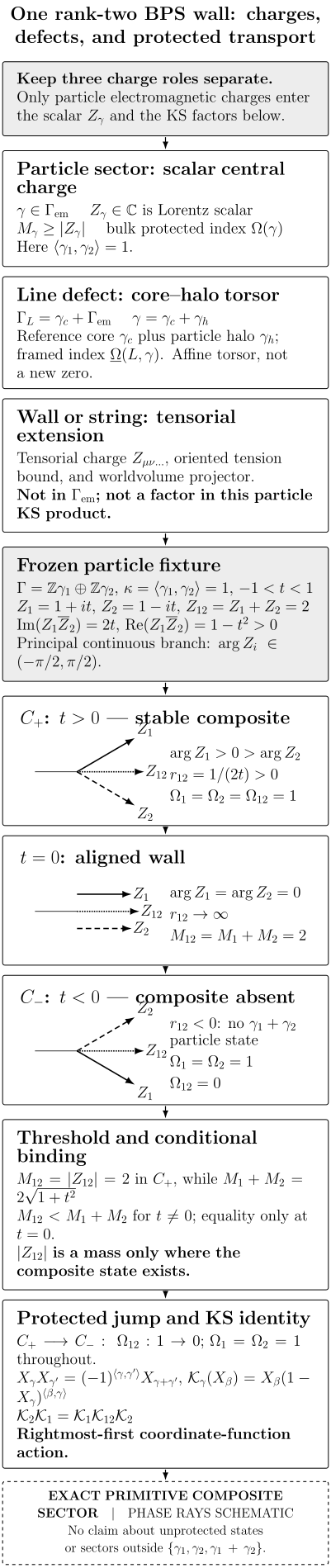
A line-defect sector is the affine torsor : choosing a reference core does not turn it into a new particle charge lattice, and bulk particles supply halo translations. The lower chamber flow independently shows a bulk primitive composite becoming absent while both seed particles remain. Phase-ray angles are schematic. The structured fixture and charge-role table records the exact sectors, hypotheses, source locators, and checks.
Crossing a framed BPS wall conjugates or multiplies by a halo factor constructed from bulk indices. The transformation is universal because it follows from adding or removing halo Fock states. It determines the protected jump, not every unprotected defect excitation.
Framed spectra can be more informative than bulk spectra. Consistency of their jumps for many line defects leads to the Kontsevich–Soibelman wall-crossing identity. In this sense a heavy probe turns a change in the bulk particle spectrum into a computable transformation of defect observables.
Defect moduli and monopole bubbling
Section titled “Defect moduli and monopole bubbling”An ’t Hooft defect prescribes a singular magnetic charge near the line, but smooth monopoles can approach and partially screen it. This monopole bubbling changes the effective magnetic charge seen away from the core while preserving the ultraviolet defect. The associated moduli space consists of Bogomolny solutions with a prescribed singularity and asymptotic data.
Consequently, a line labeled by an ultraviolet coweight can contribute to several effective charge sectors. Quantizing the defect moduli space, including singular strata and normalizability conditions, supplies framed states. Treating the ultraviolet coweight as a fixed unscreened infrared charge would miss these sectors. The singular-monopole moduli-space analysis is given in Moore, Royston, and Van den Bleeken 2014, JHEP 10, article 142, arXiv:1404.5616.
The same lesson holds more generally: defect-localized zero modes, boundary degrees of freedom, and smooth solitons bound to the defect must be included when they are part of its definition. Their moduli are physical only when their kinetic norm is finite.
Fusion and operator products
Section titled “Fusion and operator products”Bring two parallel BPS lines together while preserving a common supercharge. Their operator product expands into line defects,
and the framed generating functions multiply in the corresponding charge algebra. Noncommutativity can appear in refined or compactified settings through the symplectic pairing. Fusion is sensitive to line ordering, global form, and local counterterms; it is not simply vector addition of core charges. For the Wilson–’t Hooft operator algebra, see Kapustin and Saulina 2009, pp. 327–365, arXiv:0710.2097.
This provides a valuable cross-check: the framed spectrum assigned to a line should be compatible with known line-operator products and with wall-crossing transformations.
Common pitfalls
Section titled “Common pitfalls”Counting bulk particles as framed states automatically. A bulk BPS particle contributes only if it forms a normalizable supersymmetric state in the defect background. Phase alignment, charge pairing, and boundary conditions matter.
Identifying the core charge with the total charge. Halo particles and monopole bubbling shift the infrared charge sector. The total charge lies in a torsor; a core–halo decomposition requires a reference choice.
Specifying only a Wilson–’t Hooft pair. Scalar couplings, singular data, global form, and the preserved phase distinguish inequivalent supersymmetric lines with the same formal pair.
Exercises
Section titled “Exercises”Use the Abelian fixture data to reconstruct its chamber jump.
- Compute both ordered pairings of and .
- Use the halo-radius formula to decide whether or supports the bound state.
- Determine the orbital spin and the possible occupation numbers of the hypermultiplet halo.
- Apply and the twisted multiplication law to recover the generating functions on both sides of the wall.
Solution
The pairing convention gives
In , , so and there is no bound state. In the imaginary part is negative, hence . The orbital spin is , so there is one fermionic orbital with occupations .
Therefore
while
The second term is precisely the one-halo sector. In the protected halo Fock-space construction the one orbital generates an exterior algebra, so there is no second occupation.
References
Section titled “References”- Gaiotto, Davide, Gregory W. Moore, and Andrew Neitzke. “Framed BPS States.” Advances in Theoretical and Mathematical Physics 17 (2013): 241–397. arXiv:1006.0146.
- Kapustin, Anton, and Natalia Saulina. “The Algebra of Wilson–’t Hooft Operators.” Nuclear Physics B 814 (2009): 327–365. arXiv:0710.2097.
- Moore, Gregory W., Andrew B. Royston, and Dieter Van den Bleeken. “Parameter Counting for Singular Monopoles on .” Journal of High Energy Physics 10 (2014): 142. arXiv:1404.5616.
Original QFT.org content:CC BY 4.0, unless an item supplies different terms. Third-party material retains its own terms.