

Infrared Phases and the Conformal Window
The infrared regime of massless SQCD is governed not by one slogan but by a sequence of qualitatively different descriptions. The rank inequalities can be derived cleanly; the physical labels require more care. Below, exact means a protected holomorphic, index, or anomaly statement under named hypotheses; controlled means a declared weak-coupling expansion exists; and duality-supported means the conclusion also uses Seiberg’s infrared electric–magnetic equivalence. The latter has passed stringent anomaly, deformation, moduli-space, and protected-observable checks, but it is not a mathematical theorem and does not make unprotected strong-coupling observables calculable.
Required background. Quantum-modified moduli and s-confinement supplies the exact low-rank boundary cases. Holomorphic and canonical couplings and the NSVZ relation supplies the beta-function conventions. Helpful background. Ultraviolet and infrared fixed points explains the evidence needed to distinguish a fixed point from slow running.
The theory whose phases are being classified
Section titled “The theory whose phases are being classified”Unless stated otherwise, take four-dimensional Lorentzian gauge theory with , pairs , no masses, no tree superpotential, and the simply connected global form. The one-loop electric coefficient is
Thus the electric variables are asymptotically free only for . For the same Lagrangian can be treated as a cutoff effective theory with an infrared-free gauge coupling, but it is not a UV-complete asymptotically free theory by itself.
Fundamental matter breaks the electric center one-form symmetry and screens a fundamental probe. Consequently “confinement” below never means an exact fundamental Wilson-loop area law. It means that the appropriate massless infrared variables are gauge-invariant composites and no gauge boson remains in the infrared description. Chiral symmetry realization, massless spectrum, and line-operator behavior are separate observables.
The figure gives the complete rank skeleton before the derivations. Read the low-flavor ladder from left to right, then inspect the running axis: solid boundaries are exact rank statements, shaded interiors are duality-supported, and the narrow edge regions are perturbatively controlled only in a Veneziano-type limit in which the fractional distance from the edge is small.
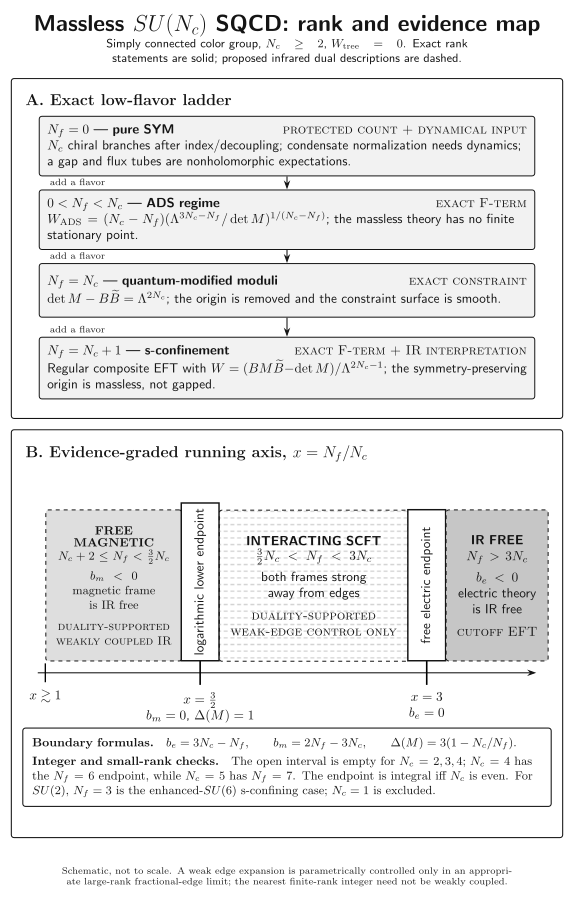
Evidence-graded rank map for massless simply connected SQCD, schematic and not to scale. The lower boundary satisfies both and , but those tests share the magnetic dictionary and exact R-charge input; they are an overdetermined consistency check, not two independent proofs. The endpoint exists only for even , the free-magnetic integer interval can be empty, and requires its enhanced-flavor dictionary. Structured figure data.
The regime-by-regime semantic table below is the text equivalent of every interval, endpoint, control statement, and exception in the figure.
Exact special regimes
Section titled “Exact special regimes”Nf = 0: pure super-Yang–Mills
Section titled “Nf = 0: pure super-Yang–Mills”The anomaly fixes the allowed condensate phases, while the Witten index and holomorphic decoupling give supersymmetric branches. Establishing a nonzero condensate magnitude requires dynamical input; once normalized in a declared holomorphic scheme, its phases are . A mass gap and flux-tube dynamics are standard, strongly supported nonholomorphic conclusions, not consequences of the anomaly, index, or Veneziano–Yankielowicz superpotential alone. The inputs and their limits are separated on Pure super-Yang–Mills vacua and domain walls.
0 < Nf < Nc: ADS runaway
Section titled “0 < Nf < Nc: ADS runaway”The exact superpotential
has no stationary point at finite in the massless theory. The correct statement is therefore “runaway,” not a vacuum phase. Adding generic masses stabilizes the fields and produces the expected pure-theory vacua after holomorphic decoupling.
Nf = Nc: quantum-modified moduli
Section titled “Nf = Nc: quantum-modified moduli”The exact constraint removes the classical origin. There are supersymmetric vacua on a smooth moduli space, with flavor symmetry broken differently on different branches. This is sometimes called confinement with chiral symmetry breaking, but the phrase suppresses the branch dependence and the presence of massless moduli.
Nf = Nc + 1: s-confinement
Section titled “Nf = Nc + 1: s-confinement”The fields and their exact polynomial superpotential give a regular effective description also at the origin. The vacuum variety itself has singular strata, including the origin, because additional composites become massless there; the point is that no extra gauge variables or singular superpotential are needed. The origin preserves the nonanomalous continuous flavor symmetry and contains massless composites. This is the cleanest s-confining SQCD example; it is not a gapped phase.
These four statements use holomorphy, anomalies, index information, moduli counting, and mass deformations but do not use the full electric–magnetic duality conjecture. Their unified derivation appears in Intriligator and Seiberg 1996, §§ 4.1–4.3, arXiv PDF pp. 12–19.
Magnetic rank and the two open intervals
Section titled “Magnetic rank and the two open intervals”For , Seiberg’s proposed infrared description has gauge group
magnetic quarks , a dimension-one elementary singlet , and . A matching scale relates it to the engineering-dimension-two electric composite, schematically ; rescaling changes and but not the infrared dictionary. The magnetic one-loop coefficient is
The signs of and divide the remaining range.
Nc + 2 ≤ Nf < 3Nc/2: free magnetic phase
Section titled “Nc + 2 ≤ Nf < 3Nc/2: free magnetic phase”Here but . The electric theory becomes strong while the magnetic gauge and Yukawa couplings run to zero in the infrared. The magnetic quarks, gauge multiplet, and meson therefore provide a weakly coupled long-distance description. The rank inequality is perturbative; identifying this description with the electric infrared theory is duality-supported. It is called “free magnetic,” not confining, because an infrared gauge field survives.
The interval contains integers only when the ranks permit them. For example, at the inequality has no solution; at , is the first free-magnetic example. Writing a phase name without first checking that the integer interval is nonempty is a common source of false examples.
3Nc/2 < Nf < 3Nc: interacting non-Abelian Coulomb phase
Section titled “3Nc/2 < Nf < 3Nc: interacting non-Abelian Coulomb phase”Both descriptions are asymptotically free, so each becomes strongly coupled toward the infrared. The duality proposal and superconformal constraints support flow to one interacting fixed point described by either theory. The anomaly-free candidate -charge gives
At , , the scalar unitarity bound. This locates where the proposed interacting assignment must end; by itself it does not prove the free-magnetic phase. The magnetic beta-function sign together with Seiberg’s dictionary supplies that interpretation. The equality of this boundary with is a powerful overdetermined check, although both calculations share rank and duality inputs.
Within the open interval the fixed point is perturbatively controlled near in electric variables and near in magnetic variables only in a Veneziano-type limit: take with fixed and then make the fractional distance from the chosen edge small. At fixed small ranks, being the nearest available integer does not by itself make the coupling parametrically weak. Away from both edges, the fixed-point claim and dictionary are duality-supported. Exact superconformal R-charge selection can be sharpened by -maximization Intriligator and Wecht 2003, §§ 1–2, arXiv PDF pp. 1–8, while protected indices supply additional protected-spectrum tests rather than a proof of the unprotected fixed point. The foundational duality and conformal-window argument is Seiberg 1995, §§ 2–4, arXiv PDF pp. 4–14.
Endpoints are not interior points
Section titled “Endpoints are not interior points”When is an integer, the lower endpoint has , and the meson and magnetic variables approach free-field dimensions. The cubic magnetic coupling is marginally irrelevant; the endpoint is most precisely described as a logarithmically free magnetic boundary, not as a generic interacting member of the open conformal window. For , for example, is this endpoint and the open free-magnetic interval is empty.
At , . The electric gauge coupling is marginally irrelevant near the origin, giving a free infrared endpoint; the theory is not asymptotically free. For , and the electric theory is infrared free but has a Landau pole in the ultraviolet. Thus “free electric” is an infrared statement plus a UV-cutoff qualification.
For , pseudoreality enhances the flavor symmetry to and reorganizes mesons and baryons. In particular, is the -symmetric s-confining theory, not a nontrivial logarithmically free magnetic gauge theory; the first integer inside its open conformal window is . The numerical inequalities remain useful, but anomaly tables and operator dictionaries must be recomputed in the enhanced symmetry. The notation does not describe a non-Abelian gauge theory.
How strong is each conclusion?
Section titled “How strong is each conclusion?”Three logically distinct evidence classes should be kept visible:
- Exact structural checks: nonanomalous symmetries, ‘t Hooft anomalies, holomorphic decoupling, quantum constraints, and protected chiral operators.
- Controlled dynamical checks: a small electric or magnetic coupling near a boundary, so beta functions and operator dimensions can be computed.
- Duality checks: matching moduli spaces, deformations, anomalies, baryons, and flows between different ranks. These strongly constrain the proposed equivalence but are mutually connected consequences of one dictionary, not dozens of independent proofs.
The vanishing of and the saturation belong to different calculations, but they reuse the same ranks, exact R-symmetry, and proposed magnetic dictionary. Their agreement is therefore a consistency loop, not statistically or logically independent evidence. The regime map, including the free-magnetic and non-Abelian Coulomb terminology, was developed in Seiberg 1995, arXiv PDF pp. 4–14 and organized with explicit evidence limits in Intriligator and Seiberg 1996, § 5, arXiv PDF pp. 20–27. Its exact anomaly and holomorphy tests remain valid; the assertion of a common interacting fixed point remains an infrared-duality claim.
Exact results and evidence by regime
Section titled “Exact results and evidence by regime”These tables are a claim-by-claim stop rule. Start in the first column, verify every hypothesis, and do not carry a conclusion past the stated failure test. Formula fields, endpoint inclusion, beta coefficients, anomaly checks, and threshold powers are generated from the same structured record as the machine-readable table; interpretive and source fields retain their evidence date and scope.
SQCD, pure gauge theory, and dynamical breaking
Section titled “SQCD, pure gauge theory, and dynamical breaking”| Domain or model | Theory hypotheses and global form | Light variables and invariant relations | Exact or protected record | Infrared interpretation | Logical status and control | Inputs shared with other checks | What remains uncontrolled | Small-rank or global-form exception | Primary source and evidence date | Explicit failure test |
|---|---|---|---|---|---|---|---|---|---|---|
| UV SQCD theory card, Nf > 0 | Simply connected SU(Nc); massless fundamental–antifundamental pairs; zero tree superpotential; the holomorphic scale convention and finite normalization are fixed before coefficients are compared. |
Q, Q-tilde; mesons and, when rank permits, baryons; classical rank and Plücker relations. |
be = 3Nc − Nf; local and mixed anomaly coefficients; faithful connected non-R symmetry after its finite kernel is removed. |
A complete ultraviolet input card from which exact deformations and candidate infrared descriptions can be tested. | Exact kinematics, perturbative anomaly data, and a one-loop coefficient; no infrared phase follows by itself. | The same charges enter holomorphy, anomaly matching, superconformal R assignments, and both electric and magnetic beta tests. | Kähler geometry, spectrum, vacuum existence, duality, and confinement. | For Nf=2, flavor cubic anomalies vanish but mod-two Witten anomalies can remain; SU(2) color has enhanced SU(2Nf) flavor. |
Intriligator–Seiberg 1996, §§ 2–3, arXiv PDF pp. 4–12; checked 2026-08-24. | Fail if a claimed symmetry acts trivially modulo a gauge center, a mixed gauge anomaly is nonzero, or a classical relation has the wrong rank. |
| Nf = 0 | Pure simply connected SU(Nc) SYM; exact rigid supersymmetry; declared local-operator and scale normalization. |
Glueball operator S and Nc chiral branches; the electric center one-form symmetry is present. |
Index and holomorphic decoupling give Nc branches; the anomaly permits the corresponding condensate phases. |
Gapped confining vacua with flux tubes are the standard physical picture. | Branch count and chiral relations are protected; nonzero normalization uses dynamics; the gap and flux tubes are dynamical expectations. | The anomaly, index, decoupling path, and compactified monopoles constrain overlapping parts of the result. | The mass spectrum, string tensions, and existence of every proposed BPS wall. | For general simple groups the count is h∨, while center order need not equal h∨; centerless groups still have chiral branches. |
Witten 2000, §§ 3.1 and 4.2; Kac–Smilga 1999, § 1; Intriligator–Seiberg 1996, § 4.1, arXiv PDF pp. 12–15; checked 2026-08-24. | Fail any claim of an exact gap or wall spectrum that was inferred only from the holomorphic superpotential. |
| 0 < Nf < Nc | Massless SU(Nc) SQCD in the finite scheme fixed by the one-instanton anchor. |
Meson M on a generic Higgs branch; baryons are absent; det M ≠ 0 in the local formula. |
WADS=(Nc−Nf)(Λ^(3Nc−Nf)/det M)^(1/(Nc−Nf)), with local branch choice. |
No stationary point at finite M; the massless theory runs toward large field. Generic masses yield isolated vacua. |
Exact Wilsonian F-term under its hypotheses; the weakly coupled large-field runaway is controlled, but its metric is not holomorphically fixed. | Symmetries, zero modes at Nf=Nc−1, holomorphic recursion, and independently normalized pure-SYM decoupling. |
The Kähler potential at strong field-space loci and nonchiral observables. | The Nc=2 operator basis is Pfaffian; det M=0 is outside the local ADS coordinate patch. |
Intriligator–Seiberg 1996, § 4.1, arXiv PDF pp. 12–15; checked 2026-08-24. | Fail if the expression has the wrong dimension or R-charge, does not reproduce the Nf=Nc−1 instanton, or violates one-flavor scale matching. |
| Nf = Nc | Massless simply connected SU(Nc) SQCD; the same composite and scale normalization as in adjacent ranks. |
M, B, B-tilde with det M − B B-tilde = Λ^(2Nc). |
The quantum-modified chiral constraint; no physical superpotential is generated on the constraint surface. | A smooth supersymmetric moduli space whose classical origin is removed; symmetry realization depends on the branch. | Exact chiral relation. Smoothness follows by differentiating the constraint; the Kähler metric is not determined. | Holomorphy, anomalies, mass deformation to ADS, and decoupling from the s-confining rank. | Metric distances, masses, and scattering along the moduli space. | For SU(2), Nf=2, use Pf V = Λ^4 and the enhanced SU(4) flavor symmetry. |
Seiberg 1994, § 4, arXiv PDF pp. 7–10; checked 2026-08-24. | Fail if the gradient of the constraint vanishes on the surface, if the origin is retained, or if a mass deformation misses the ADS scale power. |
| Nf = Nc + 1 | Massless simply connected SU(Nc) SQCD; all composites retained. |
M, B, B-tilde and W=(B M B-tilde − det M)/Λ^(2Nc−1). |
Polynomial confining superpotential, its F-term relations, anomaly matching, and mass flow to the quantum-modified rank. | A regular composite effective description, including a massless symmetry-preserving origin; the vacuum variety still has singular strata. | Exact Wilsonian F-term plus the s-confining infrared interpretation. The canonically normalized cubic is marginally irrelevant at the free endpoint. | Composite anomalies, deformations, and the same normalization chain used for lower ranks. | The exact Kähler potential and normalization of nonchiral correlators. | For SU(2), Nf=3, use W=−Pf V/Λ^3 with enhanced SU(6) flavor. |
Seiberg 1994, § 5, arXiv PDF pp. 10–15; checked 2026-08-24. | Fail if the composite anomalies do not match, the F-terms miss the classical relations, or one-flavor decoupling misses the quantum constraint. |
| Nc + 2 ≤ Nf < 3Nc/2 | Massless SQCD plus Seiberg’s magnetic dictionary; the integer interval must be nonempty. | SU(Nf−Nc) magnetic gauge field, q, q-tilde, elementary dimension-one Mm, and W=y Mm q q-tilde. |
bm=2Nf−3Nc<0; anomaly, baryon, moduli, and deformation matches. |
Free magnetic infrared phase with a surviving weakly coupled gauge field. | Infrared freedom is perturbative once the magnetic description is accepted; the identification with the electric theory is duality-supported. | The same duality dictionary supplies the magnetic rank, R-charges, anomalies, and deformation map. | A first-principles proof of equivalence and generic unprotected electric observables. | The interval is empty for Nc=3; SU(2) color uses enhanced flavor; the lower endpoint is excluded. |
Seiberg 1995, §§ 2–4, arXiv PDF pp. 4–14; checked 2026-08-24. | Fail if magnetic anomalies, baryon charges, rank-changing mass flows, or the sign of bm disagree. |
| 3Nc/2 < Nf < 3Nc | Massless SQCD, the proposed electric–magnetic equivalence, and an interacting superconformal endpoint. | Electric and magnetic variables; protected chiral operators obey the common superconformal R assignment. | Δ(M)=3(1−Nc/Nf)>1; anomaly and deformation matches; exact R selection can use a-maximization. |
Interacting non-Abelian Coulomb phase described by either duality frame. | Duality-supported throughout; perturbatively controlled only parametrically near either edge in a large-rank fractional-edge limit. | The unitarity and beta-function boundary tests share the rank, R-charge, and magnetic dictionary. | Generic unprotected dimensions and OPE data away from the edges, and a mathematical construction of the fixed point. | At fixed small ranks the nearest integer need not be weakly coupled; accidental symmetries require a revised R analysis. | Seiberg 1995, §§ 2–4, arXiv PDF pp. 4–14; Intriligator–Wecht 2003, §§ 1–2, arXiv PDF pp. 1–8; protected evidence through 2003, checked 2026-08-24. | Fail a proposed dictionary if an exact anomaly, chiral dimension, deformation, or protected index is inconsistent in the two frames. |
| 3–2 model, weak-λ hierarchy | SU(3)×SU(2) with one standard chiral generation and generic renormalizable tree coupling; g2/λ ≫ 1 in the displayed calculable regime. |
Gauge invariants on the D-flat manifold and the exact SU(3) ADS term. |
The F-equations are incompatible; minimization gives v∼Λ3 λ^(−1/7) and positive energy scaling V∼Λ3^4 λ^(10/7). |
A stable calculable vacuum with spontaneous supersymmetry and R-symmetry breaking in the declared hierarchy. | Exact F-term obstruction plus controlled semiclassical model calculation; not a general theorem about chiral gauge theories. | The same charges enter gauge consistency, faithful U(1)X/Z6, anomalies, the tree term, and the minimization. |
Other coupling regimes, arbitrary Kähler corrections near strong field, and a general chiral-theory classification. | An omitted runaway, singular branch, or a regime with g2/λ not large invalidates the displayed minimization. |
Shacham 2012, § 2, arXiv PDF pp. 3–8; checked 2026-08-24. | Fail if a simultaneous F-flat solution exists on the complete physical domain, the Hessian has a tachyon, or the minimum leaves the controlled hierarchy. |
Compactification and order of limits
Section titled “Compactification and order of limits”| Regime | Spin structure, holonomy, and scale order | Relevant saddles or variables | Claimed result | Status | Source scope | What is not transported | Failure mode |
|---|---|---|---|---|---|---|---|
| Finite small spatial circle | Periodic gaugino; center-symmetric holonomy selected dynamically; N L Λ ≪ 1 for SU(N). |
N fundamental monopole events, including the affine event; their product reassembles one instanton. |
The monopole superpotential, discrete vacua, condensate phases, and an abelian mass gap are semiclassically calculable. | Controlled semiclassical expansion for the named protected and long-distance observables. | Davies–Hollowood–Khoze 2003, §§ 4–5. | A proof of smooth decompactification or all four-dimensional spectral data. | Fail when the lightest W-boson scale is no longer parametrically above strong dynamics. |
| Strict three-dimensional limit | L→0 with g3²=g4²/L fixed, so the four-dimensional instanton factor tends to zero. |
The affine monopole term disappears; only the non-affine Toda terms remain. | The Coulomb coordinate runs away rather than producing the finite-circle four-dimensional vacua. | Controlled but different limit. | Davies–Hollowood–Khoze 2003, § 4, Eq. (4.18). | The finite-L vacuum count. |
Fail if “small circle” is silently identified with strict three dimensions. |
| Decompactification | Increase L at fixed finite N and periodic spin structure. |
The abelian saddle expansion eventually loses parametric control. | Protected holomorphic quantities may agree if no singularity or phase transition intervenes. | Continuity assumption, observable by observable. | Hollowood–Khoze–Lee–Mattis 1999, abstract and discussion. | Unprotected masses, string tensions, and wall existence. | Fail at a phase transition, singular branch, or nonuniform limit. |
| Thermal circle | Antiperiodic gaugino; thermal ensemble. | Thermal holonomy potential and thermal excitations, not supersymmetric monopole balance. | A thermal center transition may occur. | Different physical theory; no supersymmetric-continuity inference. | Spin-structure distinction is exact. | Periodic-circle vacuum claims. | Fail any argument that cites a thermal result for the spatial periodic theory without a new continuation. |
| Large N before small L | The W-boson spacing scales as 1/(N L). |
An increasingly dense tower of off-diagonal modes. | The fixed-N abelian semiclassical hierarchy need not survive. |
Order-of-limits warning. | The scale relation is perturbative and exact at the center-symmetric background. | Uniform large-N continuity. |
Fail when N L Λ is not small even though L Λ is. |
SU(2) lattice evidence |
Periodic adjoint Majorana fermion in the explored finite-mass and finite-cutoff window. | Lattice order parameters and spectrum proxies. | Center stability and no observed intervening transition in the sampled regime. | Numerical evidence, not a theorem of continuum all-N SYM. |
Bergner–Piemonte–Ünsal 2018, §§ 4–5. | Other ranks, the continuum limit, and masses outside the simulation window. | Fail if cutoff, volume, mass, or rank extrapolations are presented as directly simulated facts. |
Nothing in this map may be extrapolated mechanically to nonsupersymmetric QCD. The superpotential, chiral ring, holomorphy, anomaly-free symmetry, and weakly coupled magnetic description do essential work. Removing the gaugino or squarks removes those arguments even if the symbols remain.
Common pitfalls
Section titled “Common pitfalls”Treating every rank range as a vacuum phase. Massless SQCD with runs away and has no finite vacuum. A mass deformation creates vacua, but that is a different theory.
Including endpoints silently. Both and have vanishing one-loop coefficients on one side and logarithmic qualifications. Use open intervals for the interacting conformal window.
Using “confinement” as one universal observable. Composite infrared variables, a mass gap, center symmetry, Wilson-loop behavior, and chiral symmetry realization can disagree. State which one is meant.
Exercises
Section titled “Exercises”1. Classify three examples
Section titled “1. Classify three examples”Classify massless SQCD with and state the evidence type for each label.
Solution
is s-confining, an exact composite description. is the logarithmically free magnetic endpoint, supported by duality plus a weakly coupled magnetic limit; it is not inside the open interacting window. lies in , the duality-supported interacting non-Abelian Coulomb phase. It is not parametrically close to the electric Banks–Zaks edge at , so neither electric nor magnetic variables are necessarily very weakly coupled.
2. Recover the lower boundary twice
Section titled “2. Recover the lower boundary twice”Locate the lower edge of the proposed conformal window from (a) the magnetic one-loop coefficient and (b) the meson unitarity bound. Then state why agreement does not prove the free-magnetic interpretation.
Solution
(a) changes sign at . Below it the proposed magnetic theory is infrared free. (b) gives . Equality means reaches the free-scalar bound, so the proposed interacting assignment must end there. The two calculations share the exact R-charge and magnetic dictionary; identifying the weak magnetic variables with the electric infrared theory still uses Seiberg duality.
3. Test the integer intervals
Section titled “3. Test the integer intervals”For , list all integers in the open free-magnetic interval and identify any special lower endpoint.
Solution
For , the open interval is empty and is simultaneously and ; it is the enhanced- s-confining theory. For , is empty. For , is empty, while is the logarithmic lower endpoint. For , the interval contains ; there is no integer lower endpoint because is half-integral.
References
Section titled “References”- Bergner, Georg, Stefano Piemonte, and Mithat Ünsal. “Adiabatic Continuity and Confinement in Supersymmetric Yang–Mills Theory on the Lattice.” Journal of High Energy Physics 2018, no. 11 (2018): 092. doi:10.1007/JHEP11(2018)092.
- Davies, Nick M., Timothy J. Hollowood, and Valentin V. Khoze. “Monopoles, Affine Algebras and the Gluino Condensate.” Journal of Mathematical Physics 44 (2003): 3640–3656. doi:10.1063/1.1586477. Open PDF.
- Hollowood, Timothy J., Valentin V. Khoze, Won-Young Lee, and Michael P. Mattis. “Breakdown of Cluster Decomposition in Instanton Calculations of the Gluino Condensate.” Nuclear Physics B 570 (2000): 241–266. doi:10.1016/S0550-3213(99)00503-9. Open PDF.
- Intriligator, Kenneth, and Nathan Seiberg. “Lectures on Supersymmetric Gauge Theories and Electric–Magnetic Duality.” Nuclear Physics B Proceedings Supplements 45BC (1996): 1–28. DOI; arXiv PDF.
- Intriligator, Kenneth, and Brian Wecht. “The Exact Superconformal R-Symmetry Maximizes a.” Nuclear Physics B 667 (2003): 183–200. doi:10.1016/S0550-3213(03)00459-0. Open PDF.
- Kac, Victor G., and Alexei V. Smilga. “Vacuum Structure in Supersymmetric Yang–Mills Theories with Any Gauge Group.” Nuclear Physics B 571 (2000): 515–554. doi:10.1016/S0550-3213(99)00875-5. Open PDF.
- Seiberg, Nathan. “Exact Results on the Space of Vacua of Four-Dimensional SUSY Gauge Theories.” Physical Review D 49 (1994): 6857–6863. doi:10.1103/PhysRevD.49.6857. Open PDF.
- Seiberg, Nathan. “Electric–Magnetic Duality in Supersymmetric Non-Abelian Gauge Theories.” Nuclear Physics B 435 (1995): 129–146. DOI; arXiv.
- Shacham, Tomer. “On the Vacuum Structure of the 3–2 Model.” Journal of High Energy Physics 2012, no. 5 (2012): 087. doi:10.1007/JHEP05(2012)087. Open PDF.
- Veneziano, Gabriele, and Shimon Yankielowicz. “An Effective Lagrangian for the Pure Supersymmetric Yang–Mills Theory.” Physics Letters B 113 (1982): 231–236. DOI.
- Witten, Edward. “Supersymmetric Index in Four-Dimensional Gauge Theories.” Advances in Theoretical and Mathematical Physics 5, no. 5 (2001): 841–907. doi:10.4310/ATMP.2001.v5.n5.a1. Open PDF.
Original QFT.org content:CC BY 4.0, unless an item supplies different terms. Third-party material retains its own terms.