

Supersymmetric Action Principles and Component Reduction
Component reduction is a controlled projection, not a transcription exercise. One expands each superfield in a fixed convention, multiplies in Grassmann order, selects the measure’s top component, records spacetime total derivatives, and only then eliminates auxiliary fields. Keeping those stages separate makes it possible to verify the result twice: once by the manifestly supersymmetric superspace construction and once by direct component transformations.
This page carries out the workflow for four-dimensional rigid chiral multiplets. It keeps off shell through the invariance check and then derives the on-shell scalar and Yukawa interactions. Gauge fixing and vector multiplets are added on later pages.
Required background. Superspace Measures, F-Terms, D-Terms, and Component Extraction fixes the measure and projection conventions. Off-Shell Closure and Auxiliary Fields explains why must be retained for an off-shell closure test.
Helpful background. The Action Principle and Field Equations supplies the boundary-sensitive variational framework.
Canonical chiral superfields fix the reduction data
Section titled “Canonical chiral superfields fix the reduction data”Use chiral superfields
with and the metric. The rigid two-derivative action is
is real and is holomorphic. For the canonical reduction take ; the nonlinear Kähler case is derived on the next geometry page. The dimensions are
The off-shell supersymmetry transformations in this convention may be chosen as
Their commutator is a translation on all three fields without using any field equation. A source using the mostly-plus metric or another raising convention may display different intermediate signs; the invariant checkpoints are the translation algebra, positive kinetic energy, and the pole spectrum.
Reduce the canonical chiral action in four passes
Section titled “Reduce the canonical chiral action in four passes”Pass 1: select the D-term
Section titled “Pass 1: select the D-term”Before integrating by parts, the selected coefficient is
The two scalar second-derivative terms and the symmetric fermion kinetic term each differ from their first-derivative form by a spacetime divergence. One integration by parts therefore gives
The two forms define the same action only when the boundary term vanishes or is cancelled. Keeping a “discarded derivative” line in the calculation prevents a boundary-sensitive problem from silently inheriting a closed-manifold answer.
Pass 2: select the F-term
Section titled “Pass 2: select the F-term”Taylor expansion terminates because has two components:
Therefore the complete off-shell component Lagrangian is
Every term has mass dimension four. The factor is required because is symmetric while is symmetric in flavor indices after the antisymmetric spinor contraction. Detailed component constructions and the comparison with superspace appear in Gates et al. 1983, chs. 4–5, Open PDF and Weinberg 2000, §§26.1–26.4, pp. 55–82.
Pass 3: verify invariance before eliminating auxiliaries
Section titled “Pass 3: verify invariance before eliminating auxiliaries”Vary using the three transformations above. The independent cancellation channels are:
| terms after variation | source terms | result |
|---|---|---|
| and its conjugate | fermion kinetic term and | cancel without an equation of motion |
| and its conjugate | scalar and fermion kinetic terms | one spacetime divergence after integration by parts |
| and | cancel because | |
| variation of | vanishes by the two-component Schouten identity | |
| and | the variation of the holomorphic F-term | combine into |
The conjugate F-term supplies the conjugate divergence. Thus the complete remainder is
No equation of motion is needed. This is the decisive independent check of the Grassmann reduction. If the cancellation requires the Dirac equation or the scalar equation, either the claimed closure status is wrong or a term has been lost.
Pass 4: eliminate algebraically
Section titled “Pass 4: eliminate FFF algebraically”Treat and as independent variables in the variation. Their equations are
Completing the square makes the sign transparent:
The on-shell Lagrangian is consequently
follows from the positive canonical Kähler metric. The reduced transformations close only after the fermion equation is used, because has converted an independent auxiliary into a composite field. Auxiliary elimination is exact at the classical two-derivative level; it is not a low-energy approximation. It can become more subtle if higher-derivative operators give the nominal auxiliary derivatives or multiple algebraic branches.
A polynomial reduction with all coefficients visible
Section titled “A polynomial reduction with all coefficients visible”For one field, choose
Then
and
Eliminating gives
together with fermion mass and Yukawa coupling in the expansion around . Around a supersymmetric vacuum satisfying , the fermion mass parameter is and the quadratic scalar potential is . Thus the complex scalar and Weyl fermion have the same pole mass . That equality is an invariant check of the factor , the auxiliary sign, and the vacuum expansion.
The reduction transcript
Section titled “The reduction transcript”A reproducible calculation can be recorded as this compact table:
| stage | retained data | check that must pass |
|---|---|---|
| superspace input | , , measure, reality, gauge and boundary data | dimensions, chirality, gauge invariance |
| Grassmann selection | every selected monomial and coefficient | derivative order and Berezin signs |
| component rearrangement | integrations by parts and discarded divergences | boundary compatibility |
| off-shell action | propagating and auxiliary fields | variation is a total derivative; the transformation algebra closes off shell without equations |
| auxiliary equation | algebraic Hessian and branch | substitution solves the same equation and preserves reality |
| on-shell action | kinetic, masses, Yukawa and potential | positivity and multiplet mass degeneracy |
The same stages appear in the reduction flow below, so the calculation remains intelligible without the diagram. An independent symbolic cross-check is useful, but it cannot replace the declared convention or the direct component variation.
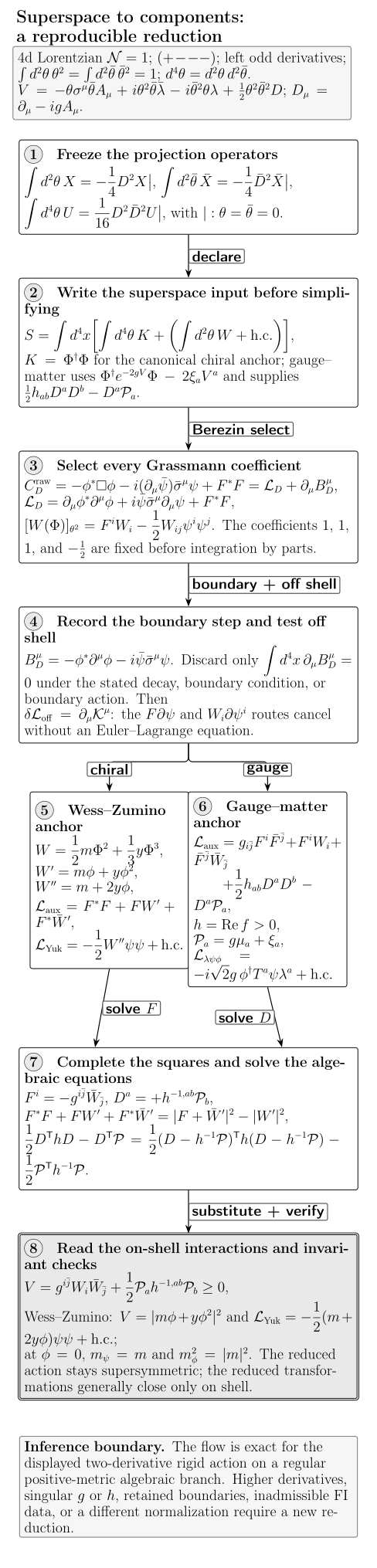
Read from top to bottom: freeze the projectors, retain the boundary current, check off-shell invariance and closure separately, and only then complete the and squares. The two branches reproduce the cubic Wess–Zumino Yukawa and mass check and the gauge–matter convention , , . The drawing is an exact transcript for the displayed rigid two-derivative systems but is schematic and not to scale. Structured reduction transcript (JSON).
Common pitfalls
Section titled “Common pitfalls”Eliminating before the closure check. This turns an off-shell realization into an on-shell one and can hide a missing term behind a fermion equation of motion.
Conjugating during Euclidean reduction. In Euclidean signature, barred and unbarred fields are generally independent on the complexified field space. A reality relation is part of the chosen integration cycle, not an automatic algebraic step.
Completing the square with the wrong kinetic sign. If has been mis-signed, the apparent scalar potential may be unbounded or have the wrong sign in the Lagrangian. Check the Hamiltonian and the mass spectrum, not just the appearance of .
Exercises
Section titled “Exercises”1. Reproduce the Yukawa coefficient. Expand through .
Solution
Using and gives
The two identical ways of choosing one and two identical ways of choosing the fermion components are already encoded in the derivative formula; no additional factorial should be inserted.
2. Diagnose a closure claim. After setting , why can two supersymmetry transformations on produce a fermion equation-of-motion term?
Solution
Off shell, is an independent transformation chosen so the algebra closes. After elimination, must instead be computed from . The difference between those two variations is proportional to the fermion equation. The reduced fields therefore realize the same algebra only on shell.
Where the method is used
Section titled “Where the method is used”Wess–Zumino Models analyzes the polynomial example vacuum by vacuum. Kähler Sigma Models replaces the flat auxiliary metric by , and Gauge–Matter Systems adds vector auxiliaries and moment maps.
References
Section titled “References”- Gates, S. James, Marcus T. Grisaru, Martin Roček, and Warren Siegel. Superspace, or One Thousand and One Lessons in Supersymmetry. Reading, MA: Benjamin/Cummings, 1983, chs. 4–5. Open PDF, arXiv v5.
- Weinberg, Steven. The Quantum Theory of Fields, Volume III: Supersymmetry. Cambridge: Cambridge University Press, 2000, §§26.1–26.4, pp. 55–82. DOI.
Further reading
Section titled “Further reading”- Wess, Julius, and Jonathan Bagger. Supersymmetry and Supergravity. 2nd ed. Princeton, NJ: Princeton University Press, 1992, chs. 4–5.
Original QFT.org content:CC BY 4.0, unless an item supplies different terms. Third-party material retains its own terms.