

Chiral, Vector, Linear, and Field-Strength Superfields
Standard four-dimensional superfields are distinguished by two kinds of data: differential constraints and gauge equivalences. Chirality leaves the off-shell components ; a real vector prepotential contains gauge-removable components and yields the chiral field strength ; a real linear constraint leaves a scalar, a Weyl fermion, and a divergence-free vector dual to a two-form gauge field. The same convention must be used for every expansion, projection, Bianchi identity, and component count.
Required background. Supercovariant Derivatives, Chirality, and Integrability supplies , , chiral coordinates, and projection conventions. Gauge Fields, Redundancy, and Observable Content supplies the distinction between a prepotential and its gauge-invariant content.
Helpful background. Coupling to Background Gauge Fields and Bundles explains how gauge fields and currents are coupled without confusing a local potential with global bundle data.
Chiral superfields
Section titled “Chiral superfields”In four-dimensional Lorentzian superspace, a chiral scalar satisfies
where . In ordinary coordinates,
The independent projections are
For a canonically normalized matter multiplet,
The off-shell real count is bosonic components and four fermionic components. Products and holomorphic functions of chiral superfields are chiral because obeys the graded Leibniz rule. This elementary fact underlies superpotentials, but action construction belongs to the next chapter.
A real vector prepotential
Section titled “A real vector prepotential”An Abelian vector multiplet is described by a dimensionless real scalar superfield
Before gauge fixing, a convenient component expansion is
Here are real, while and are Weyl spinors. The derivative terms are chosen so that the named component projections transform simply. An unconstrained real superfield has real components.
The Abelian supergauge equivalence is
This is the supergauge construction of Salam and Strathdee 1974, pp. 477–482.
The scalar, spinor, and auxiliary components of remove . The resulting Wess–Zumino representative is
Its residual transformation is the ordinary gauge transformation
with and invariant in the Abelian theory. Wess–Zumino gauge is a choice of representative, not a supersymmetry-invariant subspace. A supersymmetry transformation must be followed by a field-dependent chiral supergauge transformation to restore it.
The chiral field strength
Section titled “The chiral field strength”Define
It is chiral:
because a third barred derivative vanishes in two-component spinor space. Under the Abelian supergauge transformation,
For chiral, commuting through leaves spacetime derivatives annihilated by the remaining barred derivative; for antichiral, . Thus depends only on the gauge-equivalence class of .
In Wess–Zumino gauge its chiral-coordinate expansion is
The antisymmetric part of is selected by , so no separate antisymmetrization is required in that term. The minus sign of the descendant follows from applying the declared left-acting superspace derivatives to ; with the site’s convention it is also the sign that gives the positive barred-first gaugino kinetic term in the field-strength action. The dimensions are
The Abelian superspace Bianchi identity is
At component level its vector part is ; its lowest projections also encode the reality of . This identity shows why a chiral spinor is more constrained than an arbitrary chiral spinor superfield.
For a non-Abelian group, with the connection and coupling absorbed into for this formula,
It transforms covariantly rather than invariantly, and its Abelian linearization is again . Restoring the coupling, generator normalization, and global gauge form is mandatory before constructing an action or discussing genuine line operators. Weinberg 2000, §§ 27.1–27.3, pp. 113–131 develops the prepotential, Wess–Zumino gauge, field strength, and Bianchi identity in a convention that must be translated as a complete package.
Real linear superfields
Section titled “Real linear superfields”A real linear superfield obeys
Rather than hide convention-sensitive derivative coefficients in a long coordinate expansion, define its independent components by projections:
Here the bracket in the last line is the ordinary operator commutator, not the graded anticommutator. The linear constraints determine every higher coefficient from derivatives of , , and . In particular,
The second line follows from ; the last equality uses both linear constraints. Thus is a kinematic consequence of linearity, not a field equation. The corresponding tensor-multiplet projections and Bianchi identity are derived in Gates, Grisaru, Roček, and Siegel 1983, § 4.4(c.1), pp. 187–190.
Locally on a contractible patch,
where
Locally, and for generic nonzero momentum, the off-shell bosonic count is one from plus three from a divergence-free , matching the four real components of . Zero modes and global flux sectors require separate boundary and cohomology data. There is no independent algebraic scalar auxiliary in this minimal real-linear multiplet. Globally, writing can fail in nontrivial cohomology; the superfield constraint gives a closed field strength, while a single global potential requires additional topology.
Linear superfields can describe tensor multiplets and conserved-current multiplets. These uses share the same kinematic constraint but not necessarily the same engineering dimension, gauge interpretation, or action.
From supertranslations to constrained components
Section titled “From supertranslations to constrained components”The figure follows the common construction once, then separates the chiral, vector, and real-linear branches. Inspect where a differential constraint restricts the field space, where a gauge equivalence instead identifies representatives, and where component projection reads off independent fields. The Euclidean fork is deliberately outside that Lorentzian chain because it changes the real structure and integration contour.
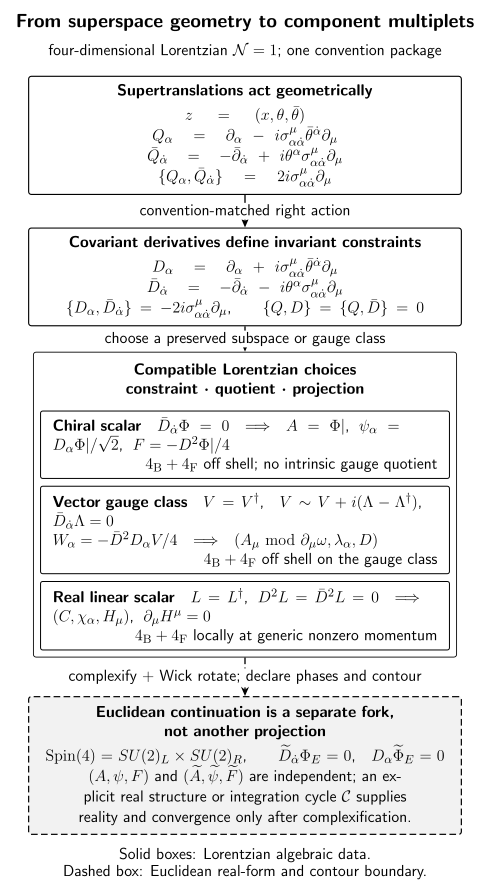
The same four-dimensional Lorentzian convention package carries to covariant constraints and then to component projections. Chirality, a vector prepotential modulo chiral supergauge transformations, and real linearity are different reductions; Euclidean tilded fields require an independently declared real structure and contour rather than another Lorentzian projection.
Superfield constraints and closure at a glance
Section titled “Superfield constraints and closure at a glance”The table is generated from one frozen set of the expansions and projections developed above. Counts are real local off-shell functional counts in four-dimensional Lorentzian supersymmetry; the real-linear count additionally assumes generic nonzero momentum. A gauge-removable coefficient is not called auxiliary, a Bianchi identity is not called an equation of motion, and is not counted independently of its prepotential.
| Object and reality | Defining constraint | Gauge equivalence | Independent fields and real count | Auxiliary status | Supersymmetry realization | Closure class | Equations of motion used |
|---|---|---|---|---|---|---|---|
| Chiral scalar ; complex | None intrinsically | ; | One complex —two real algebraic auxiliary components—in the canonical chiral action | Apply to and project with | Exact off shell on the chiral field space | None | |
| Real vector prepotential | Reality only before gauge fixing | , | ; before the quotient | are gauge-removable, not auxiliary; becomes the one real auxiliary in Wess–Zumino gauge | Apply to the whole real superfield | Exact off shell on the supergauge class | None |
| Wess–Zumino representative ; real | Wess–Zumino gauge condition | Residual | ; after the residual gauge quotient | One real algebraic auxiliary in the standard vector action | Raw supertranslation followed by a field-dependent chiral supergauge compensator | Exact off shell modulo ordinary gauge | None |
| Field strength ; chiral spinor with conjugate | and | Abelian invariant; non-Abelian covariant | subject to the Bianchi identity; the same gauge-class data as , not a second multiplet | The same one real | Induced from | Abelian: exact off shell; non-Abelian: exact off shell modulo gauge covariance | None; the displayed relation is a Bianchi identity |
| Real linear scalar | Locally with ; global flux sectors are separate | with ; locally at generic nonzero momentum | No independent algebraic scalar auxiliary in the minimal real-linear description | Apply to ; the derivative algebra preserves both linear constraints | Exact off shell on the constrained field space | None; transversality is kinematic |
This is a comparison of field multiplets, not of one-particle irreducible representations. “Exact” therefore means closure on the stated off-shell field space, with its displayed constraint or gauge quotient, before imposing dynamics. The extended-superspace page uses this finite baseline to identify when an auxiliary sector becomes an infinite harmonic or projective tower.
Why Wess–Zumino gauge hides manifest closure
Section titled “Why Wess–Zumino gauge hides manifest closure”Let denote the superspace translation of . Its lowest scalar and spinor components are generally nonzero, so it exits the gauge slice. Choose a chiral parameter that removes those regenerated components and define
Two such transformations close as
in the Abelian theory. The compensator is not optional bookkeeping: without it, the displayed component fields are not mapped into the chosen representative. The role of physical, auxiliary, gauge, and compensator components is analyzed in Gates, Grisaru, Roček, and Siegel 1983, §§ 3.9–3.10 and 4.2.
Common pitfalls
Section titled “Common pitfalls”A prepotential is not a field strength. is gauge redundant and depends on a choice of representation. is constrained and carries the gauge-covariant curvature data.
The Bianchi identity is not a field equation. follows from the prepotential definition. A dynamical equation such as is stronger.
A real linear field is not an unconstrained real field with two coefficients deleted. The differential constraints relate higher components and impose ; the two-form gauge interpretation is part of the count.
Exercises
Section titled “Exercises”1. Prove field-strength chirality
Section titled “1. Prove field-strength chirality”Show that .
Solution
By definition,
Any product of three barred spinor derivatives vanishes because there are only two independent dotted components and the derivatives anticommute. Hence the result is zero without an equation of motion.
2. Count Wess–Zumino gauge
Section titled “2. Count Wess–Zumino gauge”Why does contribute three, rather than two, real off-shell components?
Solution
Before field equations, a four-component gauge potential is quotiented by one arbitrary scalar gauge function, leaving three functional components. The reduction to two photon polarizations additionally uses the Maxwell equation and residual gauge conditions, so it is an on-shell count. Adding the real gives four bosonic off-shell components.
3. Distinguish identity from dynamics
Section titled “3. Distinguish identity from dynamics”Compare the statements
Solution
The first is the superspace Bianchi identity implied by writing in terms of a real prepotential. The second is the source-free field equation of the free vector action. Imposing the second puts the vector multiplet on shell.
Continue
Section titled “Continue”Off-Shell Closure and Auxiliary Fields uses these component counts to diagnose auxiliary completions. Superspace Measures, F-Terms, D-Terms, and Component Extraction builds invariant actions from the superfields defined here.
References
Section titled “References”-
Gates, S. James, Jr., Marcus T. Grisaru, Martin Roček, and Warren Siegel. Superspace, or One Thousand and One Lessons in Supersymmetry. Frontiers in Physics 58. Reading, MA: Benjamin/Cummings, 1983. Corrected open edition, 2001. arXiv:hep-th/0108200.
-
Salam, Abdus, and John Strathdee. “Super-Gauge Transformations.” Nuclear Physics B 76 (1974): 477–482. DOI.
-
Weinberg, Steven. The Quantum Theory of Fields. Volume III: Supersymmetry. Cambridge: Cambridge University Press, 2000, §§ 26.2–26.3 and §§ 27.1–27.3. DOI.
Original QFT.org content:CC BY 4.0, unless an item supplies different terms. Third-party material retains its own terms.