

Supersymmetry Across Dimensions, Signatures, and Reality Conditions
The symbol does not have a dimension-independent numerical meaning. The invariant datum is the number of real supercharges together with their Lorentz representation, chirality, reality condition, and R-symmetry action. In Lorentzian signature the minimal package ranges from one real chiral charge in two dimensions to 32 real components in eleven dimensions; in Euclidean signature the compatible antilinear structures change, so analytic continuation usually requires complexifying the charges rather than erasing factors of .
Required background. Clifford algebras and Spin groups supplies the mod-eight structure, while spinors, conjugations, and bilinears supplies chirality, charge conjugation, and real versus quaternionic modules.
Helpful background. Lorentz fields and Poincaré particles explains why field-spinor and one-particle representations are related but not identical.
Spinor data before supersymmetry notation
Section titled “Spinor data before supersymmetry notation”Fix a spacetime signature , a Clifford relation, and an irreducible complex spinor module . Four questions determine the supersymmetry notation:
- Chirality: if is even, does , and may a charge occupy only one chirality?
- Reality: is there an equivariant antilinear map with ? Its fixed points define a Majorana-type real form.
- Quaternionic structure: if instead , a single fixed-point condition is impossible. A symplectic-Majorana condition pairs with an even-dimensional internal space carrying an antisymmetric form.
- Compatibility: does preserve chirality or exchange and ? Only in the first case can a Weyl and Majorana-type condition be imposed simultaneously.
The complex Dirac dimension is . A Weyl projection halves it in even dimension. A compatible Majorana condition halves the number of real components relative to an unconstrained complex spinor, while a symplectic condition acts on a doublet and removes the doubling it introduced. These statements are representation theory; a superalgebra additionally needs a symmetric spinor bilinear whose vector component can appear in .
The mod-eight derivation and its bilinear symmetry conditions are given in Van Proeyen 1999, §§ 3–4 and Weinberg 2000, § 32.1 and Appendix 32.A, pp. 382–407. Nahm’s classification supplies the corresponding superalgebras Nahm 1978, pp. 149–166.
Minimal Lorentzian supercharges from two to eleven dimensions
Section titled “Minimal Lorentzian supercharges from two to eleven dimensions”The table uses one time direction and the site’s mostly-minus metric. “Minimal real ” counts independent real operator components. The R-symmetry column gives the compact zero-charge automorphism family for copies; a particular action may preserve only a subgroup, and nonzero central charges reduce it further.
The figure makes the two encodings easy to compare: inspect the solid versus dashed card boundaries for the reality family, the markers for compatible chiral conditions, and the separate four-dimensional continuation fork. The fork changes the real structure; it is not a charge-counting arrow.
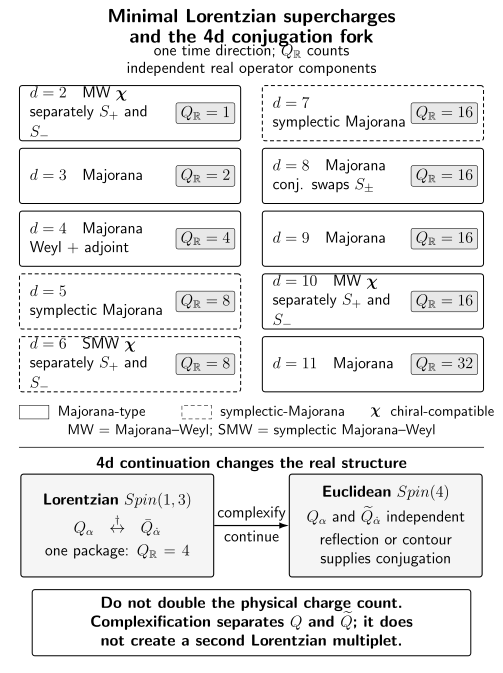
Minimal Lorentzian spinor packages for one time direction, with counting independent real operator components. Solid boundaries denote Majorana-type conditions, dashed boundaries denote symplectic-Majorana conditions, and marks compatibility with chirality. The lower fork is a schematic change of real structure under four-dimensional analytic continuation, not an existence claim or a doubling of physical supercharges. The semantic table below supplies the extension and stabilizer information deliberately omitted from the graphic.
The extension column is representative, not exhaustive. A scalar extension may be central in the strict sense, but a non-scalar -form does not commute with Lorentz transformations and is therefore a tensorial extension of the supertranslation algebra. Once a charge is fixed, the internal group becomes ; a -form charge also leaves only its Lorentz stabilizer. “Convention-dependent; no extra channel asserted here” means that the spinor-reality census alone does not determine a channel—not that every extension is forbidden.
| Minimal spinor condition | Minimal real | Common notation | Zero-charge R family | Representative scalar or p-form extension channel | Fixed-charge stabilizer | |
|---|---|---|---|---|---|---|
| 2 | Majorana–Weyl, separately left and right | 1 per chirality | mixed-chirality scalar ; unavailable for a strictly chiral minimal algebra | ; rank and singular values matter | ||
| 3 | Majorana | 2 | scalar for ; unavailable for | ; rank and skew-eigenvalue degeneracies matter | ||
| 4 | Majorana, equivalently one Weyl charge plus its adjoint | 4 | complex scalar for ; unavailable for | ; rank and skew-eigenvalue degeneracies matter | ||
| 5 | symplectic Majorana | 8 | minimal | a real scalar singlet is allowed; further tensor channels are not catalogued here | a singlet leaves the internal family intact; nonsinglets retain | |
| 6 | symplectic Majorana–Weyl | 8 per chirality | same-chirality self-dual or anti-self-dual 3-form ; the duality sign follows the chirality convention | stabilizer of the internal 3-form tensor in the applicable factor; the form also selects Lorentz directions | ||
| 7 | symplectic Majorana | 16 | minimal | convention-dependent; no extra channel asserted here | if a charge is chosen, ; tensor charges also select Lorentz directions | |
| 8 | Majorana; conjugation exchanges the two Weyl modules | 16 | minimal | convention-dependent; no extra channel asserted here | if a charge is chosen, ; tensor charges also select Lorentz directions | |
| 9 | Majorana | 16 | convention-dependent; no extra channel asserted here | if a charge is chosen, ; tensor charges also select Lorentz directions | ||
| 10 | Majorana–Weyl, separately for each chirality | 16 per chirality | same-chirality self-dual or anti-self-dual 5-form channel; the duality sign follows the chirality convention | stabilizer of its internal tensor in ; the form also selects Lorentz directions | ||
| 11 | Majorana | 32 | minimal | 2-form and 5-form channels | minimal has no continuous R factor; the forms also select Lorentz directions |
The spinor conditions, real dimensions, and zero-charge R families follow the one-time-direction entries in Van Proeyen 1999, Table 2, p. 22, and Eq. (4.12), pp. 30–31. The representative extension entries follow by applying the gamma-matrix symmetry rules in Weinberg 2000, § 32.3, pp. 397–401; in eleven dimensions the check is , the dimensions of momentum, the 2-form, and the 5-form inside a symmetric spinor matrix.
This is a spinor and algebra census, not a catalog of interacting theories. Requiring a massless multiplet with no spin above two gives the familiar ceiling of 32 real supercharges and under the usual finite-field-content assumptions; the state-counting argument appears in Weinberg 2000, § 32.2, pp. 393–397. It does not prove that every table entry has an interacting nongravitational realization.
Several common names are now transparent:
- four-dimensional has real supercharges, and has ;
- three-dimensional has real supercharges, while has ;
- five-dimensional and six-dimensional each have ;
- ten-dimensional type IIA has and type IIB has in one common chirality convention; both have real supercharges.
Thus “same ” does not mean “same amount of supersymmetry,” and “same number of real supercharges” does not mean “same algebra.”
R-symmetry as the commutant of the spinor real form
Section titled “R-symmetry as the commutant of the spinor real form”Let denote copies of a minimal spinor. The transformations on that preserve the momentum term in form the algebraic R-symmetry. Its compact type follows from the commutant of the spin representation:
In even dimensions, inequivalent chiralities can carry independent multiplicities, giving a product group. This rule explains rather than memorizes the Zero-charge R family column of the table. It also distinguishes an R-symmetry from flavor: an R-generator acts nontrivially on , whereas a flavor generator commutes with every supercharge.
Central charges transform in tensor representations of this multiplicity space. Selecting a charge sector retains only the stabilizer of the central-charge matrix. Therefore the automorphism group of the abstract zero-charge algebra, the symmetry of a Lagrangian, the anomaly-free quantum R-symmetry, and the stabilizer of a state need not coincide. Strathdee’s cross-dimensional representation catalog makes these qualifications explicit in Strathdee 1987, pp. 273–300.
Positive-definite Euclidean signature
Section titled “Positive-definite Euclidean signature”For , the type of an irreducible spinor is periodic modulo eight. The following table records the representation-theoretic reality structure; it does not by itself choose a reflection-positive Euclidean QFT contour.
| Spinor type | Action of conjugation | Consequence | |
|---|---|---|---|
| 0 | real chiral | preserves each , | a real chiral condition is possible at the module level |
| 1, 7 | real nonchiral | a Majorana-type real form is possible | |
| 2, 6 | complex chiral | exchanges and | a single chiral spinor has no real form |
| 3, 5 | quaternionic nonchiral | a symplectic doublet is needed for a real condition | |
| 4 | quaternionic chiral | preserves chirality but has | a symplectic-Weyl doublet is possible |
The four-dimensional warning is especially important. Lorentzian has left and right Weyl modules related by Hermitian conjugation. Euclidean has two independent pseudoreal doublets. Consequently a Lorentzian pair
continues to independent complex Euclidean generators
not to two variables related by pointwise Hermitian conjugation. A Euclidean functional integral must state its integration cycle or reflection operation separately. Counting the complexified components as new physical supercharges would incorrectly relabel the theory.
A checked cross-dimensional translation
Section titled “A checked cross-dimensional translation”Compare four-dimensional with three-dimensional .
In four dimensions,
contains complex components constrained by the adjoint relation to : eight real charges. After reduction on one spatial direction, a four-dimensional Weyl spinor becomes a three-dimensional complex two-component spinor, equivalently two Majorana spinors. The index set therefore reorganizes into four three-dimensional Majorana charges , again real components.
The invariant checkpoint is the rank of the rest-frame positive matrix : it is eight over the reals on both sides. What changes is the Lorentz group and R-symmetry. The four-dimensional zero-charge automorphism embeds in the three-dimensional R-symmetry because the commutant of the reduced Lorentz action on the supercharges is larger. In field realizations, the extra symmetry also reorganizes the scalar descending from a higher-dimensional gauge field. Equality of real counts therefore licenses dimensional reduction, not an identification of the two algebras.
Common pitfalls
Section titled “Common pitfalls”Counting a Weyl spinor as two real charges in four dimensions. A two-component Weyl charge is complex and comes with its Hermitian adjoint; four-dimensional has four real supercharges.
Using Lorentzian conjugation after Wick rotation. In four Euclidean dimensions, dotted and undotted charges are independent complex variables until a contour or reflection structure is supplied.
Reading the table as an existence theorem. The Clifford module determines candidate algebraic data. Interacting QFT existence, unitarity, anomaly cancellation, and a spin ceiling are additional requirements.
Check your understanding
Section titled “Check your understanding”1. Equal counts, different algebras
Section titled “1. Equal counts, different algebras”How many real supercharges are carried by four-dimensional , three-dimensional , and six-dimensional ?
Answer
All three have 16 real supercharges: in four dimensions, in three dimensions, and chiral charges in six dimensions. Their Lorentz spinors, R-symmetries, and possible central or tensorial extensions are nevertheless different.
2. Analytic continuation is not charge doubling
Section titled “2. Analytic continuation is not charge doubling”Why may and be treated as independent complex generators after continuation to four-dimensional Euclidean signature without turning Lorentzian into a theory with eight real supercharges? What extra datum is needed to recover a Euclidean notion of conjugation?
Answer
The Lorentzian odd space starts with four real components. Complexification replaces their real coefficients by complex ones; writing the resulting four-complex-dimensional odd space as two independent Euclidean Weyl doublets changes its real structure but does not add generators to the complexified algebra. Interpreting those four complex coordinates as eight new Lorentzian real charges would count the complexification twice. A Euclidean construction must separately specify an antilinear reflection operation or an integration contour that selects the appropriate reality conditions for observables; pointwise Hermitian conjugation between the two Weyl modules is unavailable.
References
Section titled “References”- Werner Nahm, “Supersymmetries and Their Representations,” Nuclear Physics B 135 (1978), 149–166, DOI.
- Jonathan Strathdee, “Extended Poincaré Supersymmetry,” International Journal of Modern Physics A 2 (1987), 273–300, DOI.
- Antoine Van Proeyen, “Tools for Supersymmetry,” in Annals of the University of Craiova, Physics 9 (1999), 1–48, arXiv.
- Steven Weinberg, The Quantum Theory of Fields, Volume III: Supersymmetry, Cambridge University Press (2000), Chapter 32, DOI.
Original QFT.org content:CC BY 4.0, unless an item supplies different terms. Third-party material retains its own terms.