

Nonrenormalization Theorems: Wilsonian, 1PI, and Infrared Scope
The perturbative nonrenormalization theorem is a statement about local F-terms in a Wilsonian action written in holomorphic variables. It does not say that the Kähler potential, physical Yukawa couplings, or a massless theory’s nonlocal 1PI action receive no corrections. Keeping the functional, cutoff, field normalization, and infrared domain explicit resolves most apparent exceptions.
Required background. Holomorphic couplings and background superfields supplies the source-holomorphy argument. Supergraphs and quantum effective actions supplies superspace propagators and -algebra.
Helpful background. The 1PI effective action defines the Legendre transform and its vertex functions.
The Wilsonian theorem
Section titled “The Wilsonian theorem”Let be obtained by integrating out modes between a UV scale and a nonzero Wilsonian scale . For external momenta much smaller than , it has a local derivative expansion,
Assume four-dimensional supersymmetry, a supersymmetric regulator, and perturbation theory about a nonsingular background. Then:
- the local Wilsonian superpotential receives no perturbative loop corrections in holomorphic field variables;
- the two-derivative holomorphic gauge coupling has one-loop-exact perturbative Wilsonian running when the regulator and coupling convention preserve holomorphy; and
- -terms, including , generally do renormalize.
The theorem concerns perturbative loops. Nonperturbative sectors can generate a superpotential when their zero modes and symmetries permit it. The classic superspace proof and its hypotheses are developed in Grisaru, Siegel, and Roček 1979, pp. 429–450; the distinction between perturbative and nonperturbative holomorphic terms is emphasized in Seiberg 1993, pp. 469–475.
Why supergraphs produce full superspace integrals
Section titled “Why supergraphs produce full superspace integrals”A chiral vertex carries and an antichiral vertex carries . Superspace propagators contain spinor derivatives and superspace delta functions. For a loop diagram, -algebra uses these delta functions to identify the vertex coordinates and leaves an integral over all four Grassmann coordinates,
To rewrite a full-superspace term as a chiral one, one uses
For a derivative-free local expression built only from chiral external fields, makes the projection vanish. A nonzero chiral-looking loop contribution instead needs spinor derivatives combined with a nonlocal factor such as ; its coefficient can also contain antichiral couplings supplied by conjugate vertices. Such a factor is excluded from the local Wilsonian derivative expansion at fixed , but it can occur after massless modes are integrated all the way to zero momentum. Chiral integrals containing superspace or spacetime derivatives are separate higher-derivative F-terms and require their own classification.
The proof is not simply “the integrals do not match.” The decisive combination is superspace -algebra and locality. Nor does it constrain an arbitrary higher-derivative chiral integral; special F-terms with derivatives or additional fields require their own analysis.
A complementary component and superspace treatment, including the separation of Wilsonian superpotentials from wavefunction renormalization, is given in Weinberg 2000, §§ 27.6 and 30.3.
Wilsonian and 1PI domains
Section titled “Wilsonian and 1PI domains”The two functionals answer different questions.
| Property | Wilsonian action | 1PI action |
|---|---|---|
| modes integrated out | momenta above | all quantum modes |
| locality | derivative expansion for external momenta below | may be nonlocal in a massless theory |
| perturbative superpotential | unchanged in local holomorphic variables | no unconditional transfer at massless exceptional kinematics |
| nonperturbative F-terms | allowed when zero modes and dynamics permit them | inherited in vertices, with additional infrared qualifications |
| -terms and running | and wavefunction factors generally run | full momentum-dependent vertices generally run |
| infrared-sensitive chiral form | excluded from the local derivative expansion | possible through nonlocal factors such as |
| natural use | RG flow and local operator coefficients | exact vertex functions and quantum field equations |
| field normalization | conveniently holomorphic | often expressed in canonical or renormalized fields |
The decision map below puts the infrared test in the right place. Follow the Wilsonian branch only when a positive separation scale and a local derivative expansion have been specified; follow the 1PI branch through the mass-gap question before transferring any zero-momentum exactness claim.
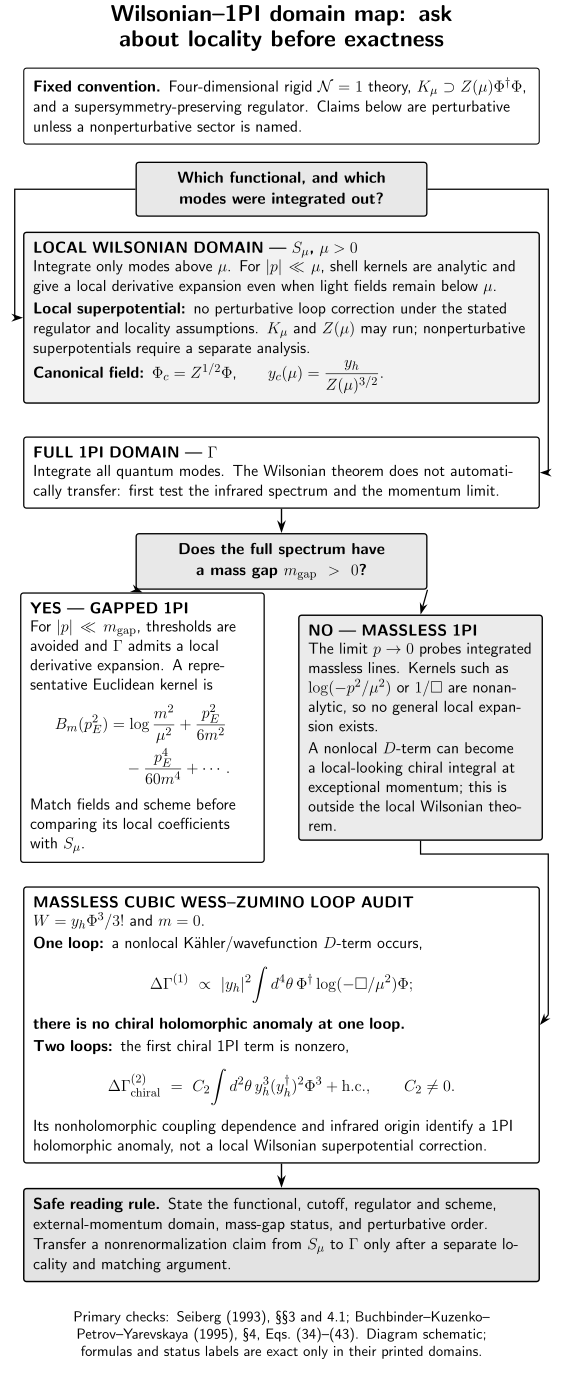
Domain classifier for four-dimensional rigid effective actions. At Wilsonian cutoff and external momentum , shell contributions admit a local derivative expansion: the local superpotential has no perturbative loop correction in holomorphic variables, although Kähler data and canonical couplings run. A full 1PI action needs an infrared test. A complete mass gap permits a low-momentum local expansion, whereas massless propagation produces logarithms or inverse boxes. In massless cubic Wess–Zumino theory the one-loop correction is a nonlocal Kähler -term; the first chiral 1PI term occurs at two loops and is not a local Wilsonian superpotential correction. The layout is schematic; the structured description gives the complete domain and status table.
In a massless theory, a 1PI contribution can schematically take the form
and, after superspace projection, resemble a chiral integral at exceptional momentum. It is still a nonlocal infrared effect, not a generated local Wilsonian superpotential. This distinction and its implications for vacuum analysis are made explicit in Poppitz and Randall 1996, pp. 281–284. At a generic background where all internal fields acquire a mass, the infrared singularity is cut off and the distinction often becomes less dramatic; that is a domain statement, not a new theorem.
The 1PI effective potential also depends on the Kähler metric. Even when the Wilsonian is exact, solving for canonically normalized masses or scattering amplitudes requires and wavefunction renormalization.
When protection claims apply places the perturbative Wilsonian theorem and the massless-1PI locality caveat beside branch-metric and nonperturbative claims without transferring assumptions between rows.
A massless chiral theory at one and two loops
Section titled “A massless chiral theory at one and two loops”Consider
with no mass. Classify possible one-loop terms:
-
A local correction to the holomorphic Wilsonian superpotential is forbidden perturbatively.
-
A wavefunction term
is allowed and is logarithmically renormalized.
-
After the canonical change of variables , the physical Yukawa parameter is
Thus runs although the holomorphic coefficient does not.
-
A nonlocal 1PI structure containing is not ruled out at zero mass and exceptional external momentum. It must not be relabeled as a Wilsonian threshold correction.
At two loops there is a sharper test of an overstrong 1PI reading. In the massless theory, the full 1PI functional contains an infrared contribution whose zero-momentum projection has the chiral form
where depends on the normalization used for the cubic coupling. Before the exceptional zero-momentum limit, the same contribution is represented by a nonlocal full-superspace structure with inverse powers of . Its dependence on is a warning that it is not a holomorphic local Wilsonian coefficient. The first such chiral 1PI correction occurs at two loops, not at one loop; it is calculated in Buchbinder et al. 1995, § 4, Eqs. (34)–(43) and interpreted as an infrared holomorphic anomaly in Poppitz and Randall 1996, pp. 281–284.
This example separates four statements that are often conflated: no perturbative correction to the local Wilsonian , one-loop wavefunction renormalization, a two-loop infrared chiral term in the massless 1PI functional, and nontrivial momentum dependence of 1PI vertices.
Assumptions that must accompany an exactness claim
Section titled “Assumptions that must accompany an exactness claim”Before using “nonrenormalized,” record:
- the functional ( or );
- the operator (superpotential, gauge kinetic term, higher F-term, or -term);
- the perturbative or nonperturbative scope;
- the regulator and preserved supersymmetry;
- the holomorphic or canonical field coordinates;
- the infrared condition (mass gap, generic background, or exceptional momentum excluded); and
- the field-space patch and singular loci.
Changing one entry can change the conclusion. In particular, the Wilsonian theorem cannot be moved to the 1PI action merely by taking : the derivative expansion can fail precisely in that limit.
Common pitfalls
Section titled “Common pitfalls”“The superpotential never changes.” Perturbative Wilsonian loops do not change it in holomorphic variables. Instantons, gaugino condensation, or other strong dynamics can generate nonperturbative terms.
“A running Yukawa violates nonrenormalization.” Canonical normalization introduces wavefunction factors. The holomorphic and canonically normalized Wilsonian couplings are different coordinates on coupling space; neither replaces the momentum-dependent 1PI data needed for an observable amplitude.
“Any chiral-looking 1PI term is a local F-term.” A factor records infrared propagation. Locality must be checked before applying a Wilsonian theorem.
Exercises
Section titled “Exercises”Suppose and the Wilsonian Kähler term is . Express the canonical mass and Yukawa coupling in terms of , , and .
Solution
With ,
Their scale dependence can therefore be entirely due to even when and are perturbatively unrenormalized.
Why does adding a nonzero mass improve the transfer of a zero-momentum statement from the Wilsonian action to the 1PI action?
Solution
A mass cuts off the infrared region that could generate or other nonanalytic momentum dependence. The 1PI functional then admits a local expansion at momenta well below the mass. This removes the specific IR loophole, although canonical normalization and nonperturbative effects still have to be treated separately.
Why does the factor in the two-loop chiral-looking term not contradict holomorphy of the Wilsonian superpotential?
Solution
The term belongs to the massless 1PI functional at exceptional momentum. Before taking that limit it comes from a nonlocal full-superspace expression, so it is neither a local Wilsonian coefficient nor constrained to be holomorphic in the chiral source . The finite-cutoff Wilsonian superpotential remains in perturbation theory.
References
Section titled “References”- I. L. Buchbinder, S. M. Kuzenko, A. Yu. Petrov, and J. V. Yarevskaya, “Superfield Effective Potential,” arXiv:hep-th/9501047 (1995), § 4, arXiv.
- Marcus T. Grisaru, Warren Siegel, and Martin Roček, “Improved Methods for Supergraphs,” Nuclear Physics B 159 (1979), 429–450, DOI.
- Erich Poppitz and Lisa Randall, “Holomorphic Anomalies and the Nonrenormalization Theorem,” Physics Letters B 389 (1996), 280–286, arXiv, DOI.
- Nathan Seiberg, “Naturalness versus Supersymmetric Non-renormalization Theorems,” Physics Letters B 318 (1993), 469–475, arXiv, DOI.
- Steven Weinberg, The Quantum Theory of Fields, Volume III: Supersymmetry, Cambridge University Press (2000), §§ 27.6 and 30.3, DOI.
Original QFT.org content:CC BY 4.0, unless an item supplies different terms. Third-party material retains its own terms.