

BPS Particles and Central Charges
A central charge can turn the supersymmetry algebra into a quantitative mass inequality. Saturation shortens the representation and protects an index, but it does not by itself prove that a particle of the chosen charge exists or remains stable throughout parameter space. Those are dynamical and chamber-dependent questions.
Required background. BPS shortening and central-charge bounds supplies the representation theory. Helpful background. Supercurrent multiplets explains how extended charges enter current algebra, and electric and magnetic one-form symmetries clarifies charge lattices and global form.
The four-dimensional N=2 particle bound
Section titled “The four-dimensional N=2 particle bound”Fix the normalization
where . For a massive state in its rest frame, . Write and take phase-rotated linear combinations of and the Hermitian conjugate of . Their anticommutators diagonalize to eigenvalues proportional to
The norm of any state obtained by acting with a supercharge is nonnegative. Therefore
This is the central-charge positivity argument of Witten and Olive 1978, pp. 97–101. The numerical coefficient belongs to the displayed algebra convention. Rescaling changes the written bound, not its physics.
If , all fermionic oscillators act nontrivially and the particle belongs to a long massive multiplet. If , the oscillators associated with annihilate the state. A half-BPS particle preserves four of the eight real supercharges and occupies a shorter multiplet. The preserved combination depends on the phase ; two BPS states preserve the same supercharges only when their central charges have aligned phases.
Central charge as a function of vacuum and charge
Section titled “Central charge as a function of vacuum and charge”In an abelian low-energy theory of rank , electric and magnetic charges form an integral lattice . In a symplectic basis,
The central charge is linear in :
where labels the vacuum, are special coordinates, and flavor charges couple to complex masses . Factors such as depend on the chosen normalization of the supersymmetry algebra and special coordinates.
Electric–magnetic monodromy changes the charge basis and the period vector together, leaving invariant. Thus a statement like “the particle is electric” is frame-dependent, whereas its charge-lattice pairing and mass are invariant.
The rank-one pure- realization of this charge lattice, period central charge, monodromy action, and exact BPS mass is developed in Seiberg and Witten 1994, § 4, manuscript pp. 16–19, Eqs. (4.1)–(4.9).
For a one-particle BPS state,
The right-hand side is exact once the exact periods and masses are known. It predicts the mass conditional on the state’s existence. It does not populate the charge lattice automatically.
Existence, stability, and protection are different claims
Section titled “Existence, stability, and protection are different claims”For each proposed charge , ask four questions in order.
-
Is the charge allowed? The global gauge group, line-operator spectrum, flavor group, and Dirac quantization determine .
-
Does a normalizable one-particle state exist? This can require semiclassical quantization, an exact construction, or another dynamical argument.
-
Is it stable in the chosen chamber? A decay is kinematically marginal when
which for occurs when the two constituent phases align.
-
Which protected quantity is known? An index can remain invariant under continuous deformations that preserve the gap in the relevant sector even while unprotected degeneracies rearrange.
This order prevents a common logical reversal: algebra gives a lower bound for every state, not an existence theorem for every lattice vector.
Protected spin information
Section titled “Protected spin information”In four-dimensional theories, a useful protected quantity is the second helicity supertrace. One common convention is
The trace is over the one-particle Hilbert space of charge in the vacuum , with the center-of-mass multiplet treated in the stated convention. Long multiplets cancel; short multiplets contribute. Other authors absorb signs or universal multiplet factors into , so a wall-crossing formula is meaningful only after its convention is declared.
This normalization and its role as the chamberwise four-dimensional BPS index are stated in Gaiotto, Moore, and Neitzke 2010, Introduction, p. 2, Eq. (1.1), and § 2.1, pp. 7–9.
The index can jump on walls of marginal stability because a normalizable bound state merges with a multiparticle continuum. This does not contradict local constancy away from walls: the spectral condition required for index invariance fails exactly at the wall.
The following exact fixture keeps the logical layers visible in one place. In particular, compare the chamber labels with the conditional mass card: the central charge exists on both sides, but the composite particle does not.
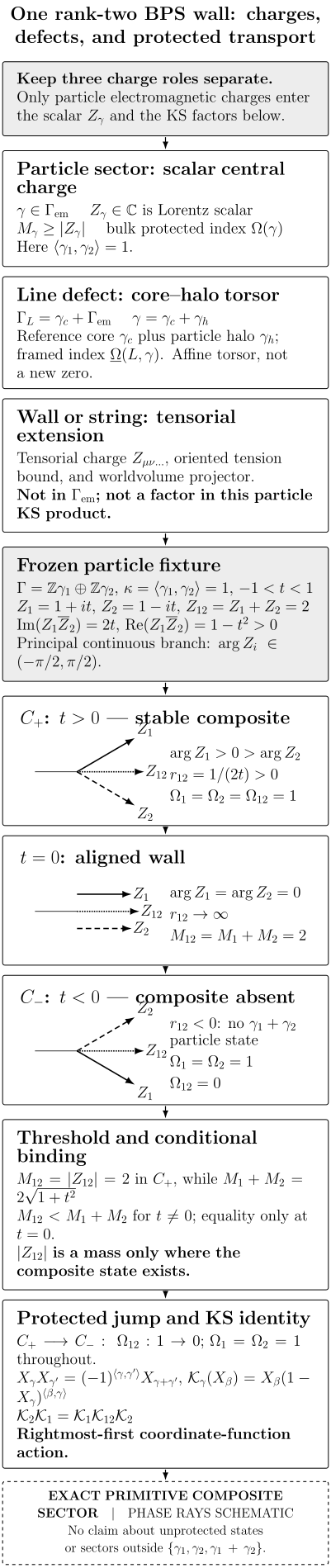
For the frozen primitive sector, the seed particles remain in both chambers, whereas the conditional BPS particle has in and is absent in . The pairing, radius sign, masses, and indices are exact for ; only the drawn phase-ray angles are schematic. The upper bands distinguish this particle scalar central charge from line-defect torsors and tensorial wall or string charges. A structured fixture and chamber table records the equations, hypotheses, source locators, and independent checks.
Example: weakly coupled SU(2)
Section titled “Example: weakly coupled SU(2)”On the Coulomb branch of pure Yang–Mills theory, the gauge group is generically broken to . In a conventional basis,
At weak coupling the charged boson is an electric BPS state, while semiclassical monopoles and dyons carry magnetic charge. Near a monopole singularity, and the monopole becomes massless. The electric-variable effective action then appears singular; in a magnetic frame the light monopole is included explicitly Seiberg and Witten 1994, pp. 19–52, arXiv:hep-th/9407087.
This example illustrates all four layers: the charge lattice allows many ; the algebra fixes for BPS states; semiclassics or exact arguments establish existence in a chamber; and wall crossing controls how the protected spectrum changes between chambers. This four-layer logic applies throughout the chapter. The actual weak- and strong-coupling spectra, their seed states, and their chamber transitions are developed in BPS Spectra and Walls, where the theory-specific existence claims are established rather than inferred from the central-charge formula.
From the algebra to a projector
Section titled “From the algebra to a projector”The rest frame identifies dotted and undotted little-group indices. For , define
The displayed algebra gives the exact positive norm
At saturation, positivity therefore implies
and the Hermitian-conjugate condition. These are two complex null generators, or four preserved real supercharges. This is an exact projector in the rest-frame convention above, rather than a formula left up to an unspecified phase. The same null combination appears classically by setting fermion variations to zero, which is why energy square-completion and the projector give the same first-order equations on the BPS solitons page. The full norm-matrix derivation and state counts are given on BPS Bounds, Shortening, and Multiplet Recombination. For a scalar Clifford vacuum, the fixed-charge count drops from states in a long multiplet to in the half-BPS quotient. A CPT-complete spectrum with also contains the sector, giving and states, respectively; comparing a fixed-charge count on one side with a CPT-complete count on the other creates a spurious factor of two.
Common pitfalls
Section titled “Common pitfalls”Treating the bound as an existence theorem. constrains states already present in the Hilbert space. It does not assert a BPS particle for every .
Suppressing normalization. The coefficient relating and depends on how enters the algebra. Display the algebra before quoting a numerical bound.
Ignoring the chamber. A BPS index is locally constant only away from walls. A charge and central charge without a vacuum and chamber do not specify a spectrum.
Exercises
Section titled “Exercises”Let and in fixed mass units, with .
- Show that and determine when equality holds.
- Interpret the equality as a possible marginal decay condition.
- Explain why it does not prove that a bound state exists on either side.
Solution
Directly, , hence . Equality holds at modulo , when the phases align. At that locus a BPS particle of charge can have the same mass as two separated BPS constituents, so decay is marginal. Existence and which side supports a normalizable bound state depend on interactions and the charge pairing; the triangle inequality alone supplies neither fact.
Starting from the displayed rest-frame algebra, verify the saturation projector directly:
- Compute for the defined above.
- Explain why both and act trivially at .
- Count the preserved real supercharges.
Solution
The phase-adapted conjugate has the same diagonal norm as , while their mixed anticommutator is . Therefore
At saturation, the expectation value of the positive operator vanishes. Positivity then makes both the operator and its adjoint null on the irreducible charge sector; quotienting those null descendants gives the short multiplet. The two complex components of account for four preserved real supercharges, one half of the four-dimensional algebra.
References
Section titled “References”- Gaiotto, Davide, Gregory W. Moore, and Andrew Neitzke. “Four-Dimensional Wall-Crossing via Three-Dimensional Field Theory.” Communications in Mathematical Physics 299 (2010): 163–224. doi:10.1007/s00220-010-1071-2. arXiv:0807.4723.
- Seiberg, Nathan, and Edward Witten. “Electric–Magnetic Duality, Monopole Condensation, and Confinement in Supersymmetric Yang–Mills Theory.” Nuclear Physics B 426 (1994): 19–52; erratum 430 (1994): 485–486. arXiv:hep-th/9407087.
- Witten, Edward, and David Olive. “Supersymmetry Algebras That Include Topological Charges.” Physics Letters B 78 (1978): 97–101. doi:10.1016/0370-2693(78)90357-X.
Further reading
Section titled “Further reading”- Bilal, Adel. “Duality in SUSY Yang–Mills Theory: A Pedagogical Introduction to the Work of Seiberg and Witten.” 1996. arXiv:hep-th/9601007.
Original QFT.org content:CC BY 4.0, unless an item supplies different terms. Third-party material retains its own terms.