

Topological and Holomorphic Twists
A twist changes which combination of Euclidean rotations and R symmetry acts as the rotation group. Its first payoff is algebraic: a spinorial supercharge can become a scalar differential. Its physical payoff is conditional. A topological twist has all translations trivial in -cohomology, whereas a holomorphic twist has only the anti-holomorphic translations trivial. Neither conclusion follows from the word “twist” alone; the global bundle, quantum symmetry, -square, Ward identity, and boundary conditions must all cooperate.
Required background. Generalized Killing spinors and global spin-R bundles supplies the global bundle test. -cohomology and Hodge complexes supplies the passage from a nilpotent supercharge to cohomology.
Helpful background. Two-dimensional A- and B-twists develops the dimension-specific sigma-model constructions; here they are a worked precursor, not material to repeat.
The twist datum and the global bundle
Section titled “The twist datum and the global bundle”Let be the part of the Euclidean spin group preserved by the geometry, and let be the R-symmetry group. A twist begins with a homomorphism
The twisted rotation group is the diagonal subgroup
For an abelian R factor, inversion is a homomorphism; composing with it is equivalent to reversing the generator, and hence the signs used to label all R charges. For a nonabelian R symmetry, however, group inversion is generally an antihomomorphism, so does not by itself define an alternative twist. An equivalent convention must instead compose with a genuine automorphism and transform the representations consistently. What matters is the declared restriction of representations. If a field transforms in before twisting, afterward it is decomposed under . This operation changes its geometric spin assignment, not the local interactions.
Apply the same decomposition to the supercharges. A singlet of is a candidate scalar . More generally, on a complex -fold one can preserve and select a scalar under the twisted while retaining holomorphic rotations. The cohomological complex is defined on the subalgebra invariant under the bosonic square:
In a gauge theory the square commonly has the equivariant form
Thus may be nilpotent on gauge-invariant operators fixed by the residual isometry and global transformations even when it is not nilpotent on every elementary field.
The group-theory decomposition is only the local part of the construction. On a curved manifold one also needs:
- an -reduction of the frame bundle, such as an orientation or complex structure;
- a spin-R structure, including any common central quotient needed to define all fields;
- an R-symmetry background whose transition functions and connection implement and obey flux quantization;
- a globally defined section representing ;
- a quantum-mechanically valid R-current and a consistent treatment of its anomalies.
An R-symmetry ’t Hooft anomaly does not simply erase the symmetry. It means that coupling it to a background may require inflow or additional data; without such a cancellation or trivialization, the twisted theory can be relative and the claimed metric independence can acquire an anomaly. A local scalar in the supersymmetry algebra is therefore not yet a globally defined topological field theory.
The twist is the third stage of the chapter-wide chain below. Read its two branches separately: a topological twist makes every translation exact, whereas a holomorphic twist makes only the antiholomorphic translations exact. The solid chain continues only after the scalar charge and its global bundle have been established.
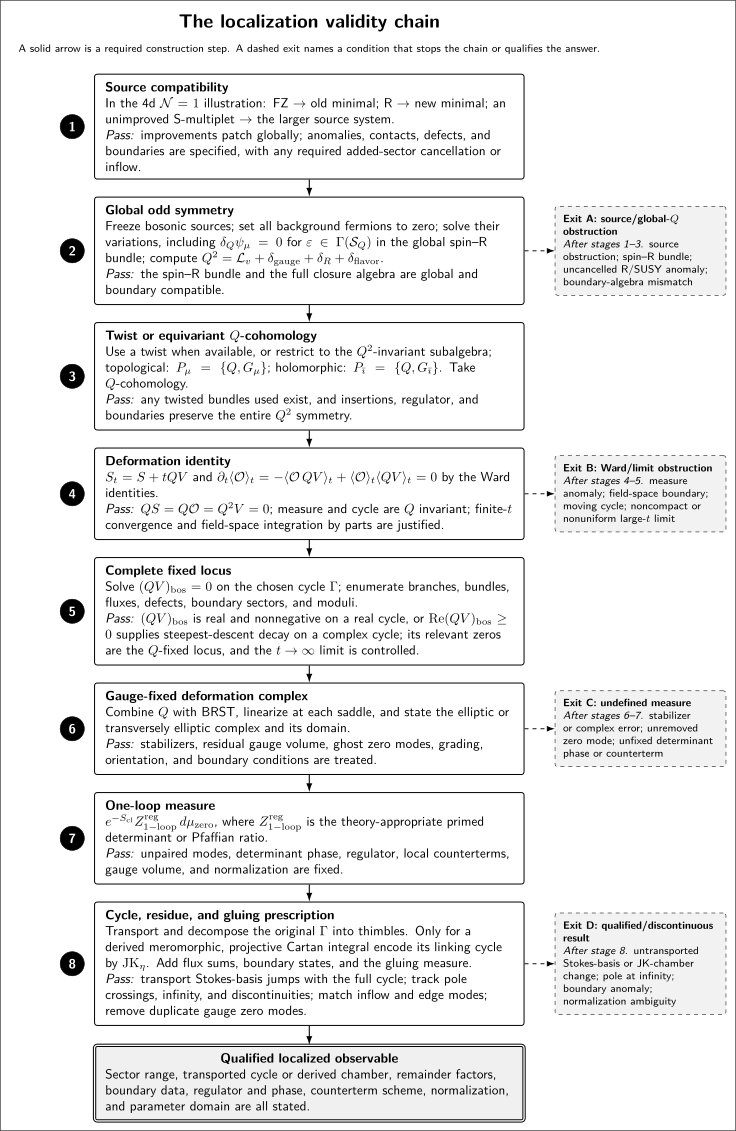
At the twist stage, gives topological translation invariance, while gives antiholomorphic exactness and leaves holomorphic dependence. These local algebraic relations do not replace the spin–R bundle, flux-quantization, anomaly, or boundary tests shown by the dashed exits. The full eight-stage diagram is schematic and not to scale; supercharge and R-charge normalizations are theory dependent.
The reflowing text equivalent of the eight-stage chain preserves every input, construction, pass condition, output, and failure exit for narrow-screen and print reading.
Donaldson–Witten twist as a representation calculation
Section titled “Donaldson–Witten twist as a representation calculation”For four-dimensional Euclidean supersymmetry,
The Poincaré supercharges transform as
where the last entry is the representation and the unused charge is suppressed. The Donaldson–Witten twist uses
Then
With the orientation convention , the left-handed supercharges yield a scalar and a self-dual two-form, while the right-handed supercharges become a one-form. The vector-multiplet fermions reorganize in the same way into , , and . This is the cohomological field content used in the original construction Witten 1988, §§2–3.
Here is one off-shell convention. Take Lie-algebra fields anti-Hermitian and define
for every other adjoint field . With an auxiliary self-dual two-form ,
Applying twice gives on every displayed field. The auxiliary is what makes this statement off shell; eliminating it would make part of the algebra close only after using an equation of motion. Factors of and some signs change with Hermitian generators, so the transformation table and the gauge-transformation convention must always be read together.
Gauge-invariant polynomials such as
are closed. Their descendants obey
If is a closed -cycle, is closed. If , then
The observable therefore depends only on the homology class in -cohomology, provided the deformation does not cross another insertion, a defect, or a boundary Witten 1988, §3, pp. 370–371, Eqs. (3.34)–(3.39).
Topological and holomorphic protection
Section titled “Topological and holomorphic protection”The flat-space algebra gives a quick local diagnostic:
| Twist type | Translation relation | Expected position dependence |
|---|---|---|
| topological | for every direction | locally constant away from collisions |
| holomorphic | , while may survive | holomorphic in , with allowed singularities at collisions |
For a topological claim on a curved manifold, the corresponding quantum statement is that the stress tensor is exact up to declared anomaly or improvement terms,
Use the Euclidean convention . For metric-independent insertions, a variation of a normalized correlator then has the form
If , the Ward identity has no measure or boundary remainder, and the insertions stay separated, the right-hand side vanishes. This is the derivation; “ is a scalar” by itself is not enough Witten 1988, §2.2, p. 361, Eq. (2.33), and §3, p. 365, Eqs. (3.8)–(3.9).
For a holomorphic twist, the same argument applies only in anti-holomorphic directions. Locally,
away from contact loci, while holomorphic derivatives need not vanish. In four-dimensional theories with a symmetry, the rigid supersymmetric background on a compact four-manifold selects complex geometry, and the twisted variables make the holomorphic dependence explicit Closset et al. 2014, §§2–4. This result is not a claim that every complex manifold and every R-charge assignment supports the same theory: the global bundles, background fields, and anomalies remain part of the input.
What can obstruct the conclusion
Section titled “What can obstruct the conclusion”A publication-level twist record should answer each of these questions:
- Twist datum: What are , , , and the representations of all fields and supercharges after restriction?
- Global lift: Which spin, spin-c, or spin-R bundle exists, and are all R fluxes compatible with the charge lattice?
- Closure: What is on fields, gauge-invariant operators, and extended operators? Is closure off shell or only on shell?
- Quantum symmetry: Is the R-current preserved by the regulator? If it has an anomaly, what cancels or records it?
- Protected directions: Which translations or stress-tensor components are actually exact?
- Ward identity: Are the measure, contour, boundary conditions, and insertions invariant, including contact terms?
- Residual data: Which metric, complex-structure, bundle, counterterm, boundary, or polarization dependence remains?
A failure at an early step cannot be repaired by a later formal cohomology calculation. Conversely, a holomorphic twist is not an incomplete topological twist: retaining holomorphic dependence is its intended protected structure.
Common pitfalls
Section titled “Common pitfalls”Treating the twist as a change of dynamics. The representation reassignment is kinematic. Dynamics enters when one proves the quantum Ward identities and identifies the surviving -cohomology.
Equating scalar with nilpotent. A scalar supercharge may square to a gauge transformation, isometry, or global symmetry. State the invariant subalgebra on which its cohomology is taken.
Calling every metric-independent classical action topological. A quantum anomaly, a spacetime boundary, contact terms, or local background counterterms can restore metric or framing dependence.
Exercises
Section titled “Exercises”1. Twisted supercharges. Decompose both chiralities of the four-dimensional supercharges under .
Solution
For , the and doublets combine as , so this chirality gives : a scalar and a self-dual two-form. For , the doublet becomes an doublet, so the result is , the vector representation. The identification of the triplet with self-dual rather than anti-self-dual forms uses the stated orientation convention.
2. Homological invariance. Let . Derive the difference between the two integrated descendants.
Solution
Stokes’ theorem and the -st descent equation give
The two insertions define the same -cohomology class. If crosses another operator or meets a boundary, extra contact or endpoint terms must be included.
3. Holomorphic versus topological. Suppose but is not exact. What can be concluded about a separated two-point function of -closed operators?
Solution
The Ward identity makes its derivative vanish, so the correlator is holomorphic away from collisions. Nothing forces the derivative to vanish. Poles or other holomorphic singularities at coincident points are compatible with the conclusion because the separated-insertion Ward identity does not control contact terms.
References
Section titled “References”- Closset, Cyril, Thomas T. Dumitrescu, Guido Festuccia, and Zohar Komargodski. “From Rigid Supersymmetry to Twisted Holomorphic Theories.” Physical Review D 90 (2014): 085006. doi:10.1103/PhysRevD.90.085006. Open preprint.
- Witten, Edward. “Topological Quantum Field Theory.” Communications in Mathematical Physics 117 (1988): 353–386. doi:10.1007/BF01223371. Open PDF.
Next step
Section titled “Next step”The rigorous finite-dimensional model for the next part of the argument is the Atiyah–Bott–Berline–Vergne fixed-point formula.
Original QFT.org content:CC BY 4.0, unless an item supplies different terms. Third-party material retains its own terms.