

Marginal Stability, Chambers, and Wall Crossing
A wall of marginal stability is a real codimension-one locus where central charges of possible decay products align. On the wall, a BPS bound state can separate at no energy cost; across it, a protected index may jump. Wall crossing constrains that jump through charge pairings and phase ordering. It does not determine the entire BPS spectrum from algebra alone, and it says still less about unprotected excited states.
Required background. BPS particles and central charges fixes the charge and index conventions. Helpful background. Framed BPS states gives the halo interpretation, and Stokes phenomena provides a useful structural analogy for ordered discontinuity factors.
Locating a marginal-stability wall
Section titled “Locating a marginal-stability wall”Consider a possible decay
The BPS masses obey the triangle inequality
Marginality requires aligned, not anti-aligned, central charges:
The first equation alone also includes anti-alignment, where and the proposed two-body decay is not marginal in the same way.
Let
In the two-center approximation, a conventional orientation gives the separation
Thus the bound state exists only on the side where the right-hand side is positive, and its radius diverges as the wall is approached. Reversing the definition of the symplectic pairing or interchanging and reverses both signs without changing the physical chamber. The two-center separation and its stability interpretation follow from Denef 2000, § 6.1, Eqs. (6.4)–(6.5), p. 24, and § 6.4, Eqs. (6.6)–(6.7), pp. 27–28, arXiv:hep-th/0005049. That source derives the formula for supergravity centers; the framed page uses the rigid heavy-core halo version separately.
The primitive jump
Section titled “The primitive jump”Assume:
- and are primitive charges;
- only the two-center bound state becomes marginal on the chosen wall segment;
- their protected one-particle indices are constant there;
- no additional aligned charge ray or scaling solution participates.
Define
where “empty” names the adjacent chamber without this two-center bound state. In the second-helicity-supertrace convention used on the particle page,
The factor is the dimension of the relative angular-momentum multiplet, whose spin is . The sign is the helicity-supertrace sign. Authors who reverse the definition of the index or define as final minus initial will display a different sign; the stable-minus-empty definition above removes that ambiguity here.
When protection claims apply places this primitive formula beside other exactness statements. Its row keeps the charge primitivity, generic two-ray wall, support property, fixed constituent indices, and orientation conventions attached to the conclusion; none may be silently transferred to a crowded or nonprimitive alignment.
For an exact finite fixture, take and two hypermultiplet constituents with . Then
The two orbital states form spin before the universal BPS multiplet is folded into the index. If a proposed calculation gives , it may be using the opposite index convention; if it gives magnitude other than two, it has lost the charge pairing or included extra states.
Chamber data are part of the answer
Section titled “Chamber data are part of the answer”A reproducible wall-crossing statement records:
| Input | What must be specified | Failure if omitted |
|---|---|---|
| Charge lattice | Basis, global form, and pairing convention | The integer and allowed decays are ambiguous. |
| Central charges | Functions and branch choices | The wall and phase order cannot be located. |
| Path | Initial chamber, oriented crossing, and endpoint | The sign and even the set of crossed walls are ambiguous. |
| Protected quantity | Unrefined or refined index and universal factors | Multiplicities from different conventions cannot be compared. |
| Spectrum near the wall | Every ray that becomes aligned | A primitive formula may be applied outside its hypotheses. |
| Completeness claim | Bounded charge sector or full spectrum | A local consistency check can be mistaken for a classification. |
This information is especially important when several walls meet. A small deformation of the path can change their order; consistency requires the ordered product of jumps to be path-independent when no singularity is enclosed.
Ordered symplectomorphisms
Section titled “Ordered symplectomorphisms”Introduce twisted-torus Darboux variables with
Define the elementary automorphism by
A BPS state of index contributes the factor . Keeping the index as an external power makes the sign convention and the elementary lattice action independently checkable. We compose rightmost first: .
The Kontsevich–Soibelman statement is that the phase-ordered product of these transformations is locally constant as the vacuum varies, provided the angular sector boundaries do not cross BPS rays. When rays exchange order, the spectrum between them must change so that the total transformation remains the same. The general ordered-product identity is formulated in Kontsevich and Soibelman 2008, arXiv:0811.2435.
For , the elementary pentagon identity in these conventions is
with the displayed order tied to a chosen clockwise phase convention. The new middle factor is the bound state required on the other side. For larger pairing or nonprimitive charges, towers and rational invariants enter; the primitive formula alone is insufficient.
This order can be checked explicitly on two variables. Take , , , and , so twisted multiplication gives . Then
Both sides of the pentagon send
This finite calculation fixes the exponent order, twisted sign, and composition order simultaneously. Gaiotto, Moore, and Neitzke use the same exponent, but write their pentagon in point-map order. Automorphisms act on coordinate functions by pullback, which reverses point-map composition. Reversing every factor in their eq. (2.21) to match the explicitly rightmost-first action used here gives precisely the identity above. See Gaiotto, Moore, and Neitzke 2010, eqs. (2.13)–(2.16) and (2.20)–(2.21), arXiv:0807.4723.
The next figure freezes the same automorphisms together with an oriented central-charge path. Inspect both the patterned ray order and the state labels: is a composite-absent chamber, not an empty particle spectrum.
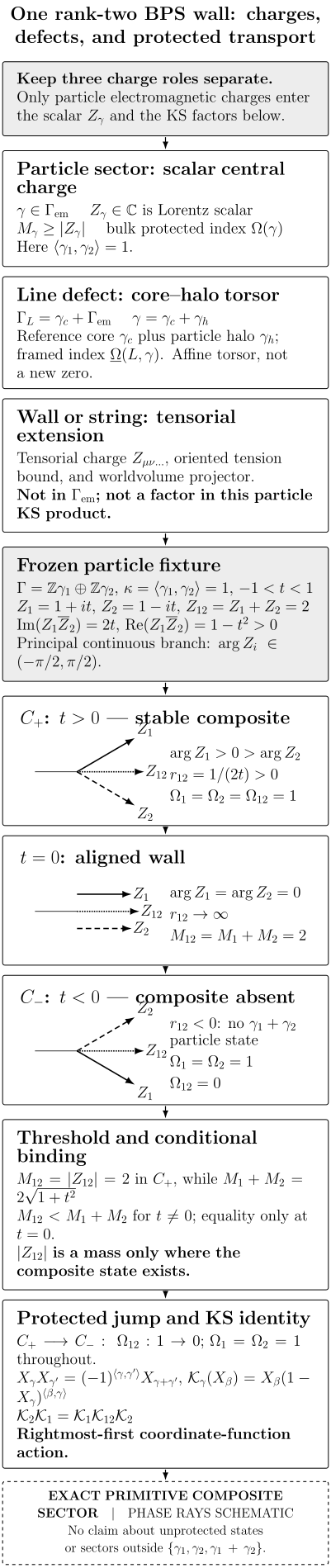
For and the oriented path with decreasing , the primitive composite index changes as , while in both chambers. The rightmost-first identity is an action on coordinate functions; translating the GMN point-map order reverses every factor, not the pairing. Exact equations, chamber contents, hypotheses, source locators, and the two-variable check are in the structured fixture and chamber table. The phase-ray angles are schematic, and no unprotected or out-of-sector spectrum is claimed.
Framed derivation through halos
Section titled “Framed derivation through halos”Place a line defect with core charge and let bulk particles of charge form halos. When the phase of crosses the phase selected by the defect, the halo radius passes through infinity. The framed generating function changes by a factor built from and .
Now demand that the framed answer after transporting the defect between two vacua be independent of how the path is slightly deformed. The equality of the resulting ordered halo factors is the bulk wall-crossing identity. This argument clarifies both the strength and the limit of the result: it constrains protected indices because long multiplets cancel, and it assumes that every relevant BPS ray in the angular sector has been included. For the four-dimensional field-theory derivation, see Gaiotto, Moore, and Neitzke 2010, pp. 163–224, arXiv:0807.4723.
What wall crossing cannot establish
Section titled “What wall crossing cannot establish”Wall-crossing identities are consistency equations. Given enough seed data, they can propagate an index to other chambers. They cannot, without those seeds and a completeness argument,
- prove that the proposed initial spectrum is complete;
- reconstruct long multiplets or unprotected degeneracies;
- determine a BPS wavefunction or its size far from the wall;
- justify a primitive formula when multiple or nonprimitive constituents align;
- cross a singular locus where the charge lattice or effective description itself changes without additional input.
An exact computation in a bounded charge cone is valuable evidence, but its scope should remain bounded to that cone.
Common pitfalls
Section titled “Common pitfalls”Using phase equality without the positivity condition. Alignment and anti-alignment both set the imaginary part to zero. The real part distinguishes a marginal sum from a marginal difference.
Hiding the orientation of the jump. A bare has an arbitrary sign. Define the chamber order or use stable-minus-empty as above.
Applying the primitive formula to a crowded ray. If , other decompositions, or scaling solutions contribute, use the full ordered-product formula with the appropriate rational or refined invariants.
Exercises
Section titled “Exercises”Let , , and , with small real .
- Locate the wall.
- Using the separation convention above, determine which sign of supports the two-center state to leading order.
- If both constituents have index one, compute the stable-minus-empty primitive jump.
Solution
The wall is at , where both central charges are positive real. To first order,
Since , the displayed is positive for . The jump is
This determines a protected contribution in the two-center approximation, not a complete spectrum.
References
Section titled “References”- Denef, Frederik. “Supergravity Flows and D-Brane Stability.” Journal of High Energy Physics 08 (2000): 050. arXiv:hep-th/0005049.
- Gaiotto, Davide, Gregory W. Moore, and Andrew Neitzke. “Four-Dimensional Wall-Crossing via Three-Dimensional Field Theory.” Communications in Mathematical Physics 299 (2010): 163–224. arXiv:0807.4723.
- Kontsevich, Maxim, and Yan Soibelman. “Stability Structures, Motivic Donaldson–Thomas Invariants and Cluster Transformations.” 2008. arXiv:0811.2435.
Further reading
Section titled “Further reading”- Bryan, Daniel, and Piotr Sułkowski. “Wild Wall-Crossing and Symmetric Quivers in 4d and 3d Field Theories.” Journal of High Energy Physics 10 (2025): 115. doi:10.1007/JHEP10(2025)115. Versioned arXiv:2506.09972v2, § 2.2, pp. 11–16, and § 6.3, pp. 60–62. This provides a class-, -Kronecker, refined/wild example, not a source for the general KS theorem.
Original QFT.org content:CC BY 4.0, unless an item supplies different terms. Third-party material retains its own terms.